Analytical report on the composition of election commissions of the constituent entities of the Russian Federation at the start of the 2026 State Duma elections, in four parts
Part 1: The non-public nature of public bodies
Introduction
In the film Gangs of New York, director Martin Scorsese puts the following words into the mouth of William Tweed, one of the most unprincipled and corrupt politicians in US history:
“Remember the first rule of politics: the ballots don’t make the result, the counters make the result.”
Political control over the vote-counting procedure and over those who carry it out is indeed one of the key elements of the political process in systems where elections are widely used to confer power on someone.
The “Election Atlas” project has analysed the composition of the election commissions of the constituent entities of the Russian Federation (IKSF), as well as the territorial election commission of the Sirius Federal Territory (although formally the Sirius TEC has a lower status than the commissions of other constituent entities, its powers differ little from theirs, so we have conditionally also classified it as an IKSF). It is these election commissions (ECs) that will play a key role in organising and conducting the vote-counting procedure in the upcoming elections directly across all territories of modern Russia. Thus, 90 IKSFs have been created within the currently controlled borders (including the Sirius TEC).
This publication is the first of four. It is devoted to the extent to which an ordinary voter is able to understand who exactly bears responsibility for the integrity of elections in their region. This section of the report was not originally planned; however, analysing the composition of IKSFs involves collecting and studying personal information about current commission members, including in comparison with previous compositions. Unfortunately, while gathering information we encountered certain problems caused by the absence of any standards whatsoever for presenting information in the election commission system. Moreover, this looks like a deliberate policy: the lack of proper information about who exactly organises elections fits into the overall strategy of the election commission system to maximise the closure of public data to voters. Some of the problems related to the non-public nature of election commissions, for example the history of changes to their composition, are fortunately largely addressed by the volunteer project “Izbirkomy”.
In the next instalments of the report “And who will do the counting?” we will discuss the “representatives” of parties, administrations and the “public” in the composition of IKSFs, which commissions are the most “United Russia” and which are the most “officialdom-heavy”, and how and from whom the “electoral nomenklatura” is formed in Russia.
Key findings
The anti-rating of the most non-public, “closed” election commissions is predictably headed by the election commissions of the Donetsk, Zaporizhzhia, Luhansk and Kherson regions — they share the top spot by a wide margin. In the case of these regions, it is often impossible to find out even the names of the commission members who will be organising the State Duma deputy elections in the respective territories. Among Russia’s “old regions”, the anti-rating of the most closed commissions, which provide the least information about their members, includes the election commissions of Arkhangelsk, Amur, Vladimir and Rostov oblasts.
Other regional election commissions also, for the most part, disclose insufficient information about their members. There are virtually no standards for providing information about election commission members on the official websites of election commissions. If an ordinary voter wants to find out who will conduct the elections and approve their results in their region, in most cases they will be able to learn very little from the official information sources of the election commissions themselves. The question of who will count the voters’ ballots will most likely remain unanswered.
The ability to identify several supporters or members of one party, or commission members who are connected to each other, is extremely hampered. The websites of election commissions most often lack even information about their members’ affiliation with particular political parties; only a handful of election commissions publish data on the subjects that nominated their members to the commission. As a result, situations are possible where members of one party are appointed to the commission by other parties.
Despite the fact that formally all election commission members are equal and make decisions collegially, in practice an information inequality exists in many commissions between the commission leadership and ordinary members. The official EC websites most often make it clear who plays the main role in the commission. Such a practice of informing about the members of a body is characteristic of hierarchically structured agencies and corresponds to a nomenklatura approach, where a clear separation is made between “superiors” and “ordinary members”. The majority of IKSF members (which are bodies of public authority) are themselves completely non-public. Media personalities who actively maintain social networks, let alone comment in any way on their activities in the election commission, are extremely rare among them.
The extremely limited public nature of election commissions and their individual members is a characteristic feature of closed bureaucratic structures and evidence that the system of election commissions has turned into yet another executive-branch agency, removed from public oversight and operating within the overall power vertical.
Political and legal status, significance and principles of IKSF formation
According to the norms of the Federal Law “On Basic Guarantees of Electoral Rights and the Right to Participate in a Referendum of Citizens of the Russian Federation” (hereinafter — the Federal Law “On Basic Guarantees…”), IKSFs are state bodies of the constituent entities of the Russian Federation, operate on a permanent basis and are legal entities. They do not belong to any branch of state power; they are classified among the so-called “state bodies with a special status”, and the term “public authority body” is also applied to them. Election commissions, in essence, possess public-authority functions.
At the same time, the legislation treats them as collegial bodies consisting of authorised persons, i.e. persons nominated by specific subjects and appointed in accordance with the established procedure for a fixed term. The term of office for IKSFs is set at 5 years; however, any commission member has the right to leave the current composition for personal reasons or may be removed from its composition if their status proves incompatible with EC membership. The number of terms in an EC is not limited in any way.
The formation of election commissions, especially IKSFs, is an extremely important process, since it is on them that the conduct of elections in the country as a whole and in the regions in particular depends.
Formally, the commission organising the State Duma deputy elections is the Central Election Commission of Russia (CEC of Russia), but it does not count voters’ ballots itself; it merely aggregates summary data coming from the regions. Voters’ ballots are directly counted by precinct election commissions (PECs) at polling stations. The data from PEC protocols is then entered into the State Automated System “Vybory” (GAS “Vybory”) in the territorial election commissions (TECs). It is there that the main secret action takes place — the data from all PEC protocols is summed up, and the winners and losers in the ongoing elections are determined. It is the IKSFs that manage the GAS “Vybory” system at the level of the entire region; it is the IKSFs that form the compositions and control the activities of lower-level TECs; it is the IKSF specialists who can make changes to the uploaded protocol data; and it is the IKSFs that tabulate the official voting results for the region as a whole, as well as for the majority of single-mandate constituencies.
On 3 April 2026, the CEC of Russia vested the powers of district election commissions (DECs) for the State Duma deputy elections in the IKSFs and several TECs. In 79 constituent entities, the regional election commissions will determine the election winners in 149 single-mandate constituencies; in nine regions, including Moscow and St Petersburg, territorial commissions will determine the winners in 73 constituencies. In Crimea, the regional election commission will determine the result in one single-mandate constituency, while local TECs will do so in the other two. The CEC of Russia itself will tabulate the voting results for the party (proportional) part of the elections and distribute deputy mandates among the political party lists.
Overall, the CEC exercises rather general political and methodological oversight of the upcoming elections, while the direct organisers, managers and controllers of all electoral procedures on the ground, including the vote-counting procedure, are the IKSFs. TECs have never, with rare exceptions, played an independent organisational, let alone political, role. In many cases, TEC chairs are part of the staff structure of regional election commissions. The GAS “Vybory” system administrators in TECs are almost always employees of the IKSF apparatus.
According to the law, among the permanent members of an IKSF (commission members with decisive vote — hereinafter CMDV) there must be professional electoral specialists for whom work in the election commission is their main and effectively sole employment. These include the chair, their deputy (deputies), the secretary and the so-called ordinary commission member(s) on a permanent (staff) basis. Such permanent (staff) commission members (CMDV (S)) have received the status of “persons holding state positions”, which effectively equates them to state officials. Other, non-staff, CMDVs are a kind of non-professional election commission worker, for whom activity in the EC is either a political or civic hobby alongside their main occupation, or a continuation of their party-political activity within the framework of some party, representing its interests in the commission.
According to the design of the creators of the modern Russian electoral system, IKSFs should be formed as politically neutral, collegial bodies consisting of permanent members representing various socio-political interests and without obvious political dominance by any of them.
The legislation stipulated that state bodies of the constituent entity of the Russian Federation participate in forming IKSFs (the head of the executive branch and the regional legislative body, by their resolutions, appoint an equal number of IKSF members). Their candidacies for appointment may be nominated by representative bodies of local self-government (LSG deputies), political parties, public organisations (NPOs), the higher election commission (the CEC for IKSFs), and the previous composition of the commission being reappointed.
At the same time, the law lays down certain conditions that must be observed when forming the composition of an IKSF:
no less than half of the commission’s composition must consist of representatives (nominees) of political parties; moreover, parliamentary parties that have their representatives in the State Duma receive a kind of “parliamentary quota”, and parties that additionally have their deputies in the legislative body of the constituent entity of the Russian Federation receive a “regional quota”, i.e. they must effectively receive their representation in the IKSF automatically;
state and municipal officials may be appointed to the commission, but their number may not exceed half of all commission members.
Such a complex formation process was supposed to ensure a diverse composition of the election commission, without political dominance by any specific forces, as well as the political neutrality of the commission and a balance of different interests among election participants, and consequently the objectivity, legality and legitimacy of the decisions taken by the EC.
However, even formal compliance with all the conditions for forming an IKSF’s composition laid down by the legislation does not guarantee observance of the most important principle of activity for both an individual election commission and the entire electoral system as a whole — namely, their independence from state authorities. The political independence and autonomy of an IKSF as a collegial body is made up of the political independence and autonomy of the subjects participating in the nomination of commission members (political parties, LSG bodies, public associations, the election commissions themselves, deputies). Compliance with formal conditions in the absence of political subjecthood leads only to the bureaucratisation of a political institution, its transformation into yet another executive-branch agency, which, in our view, is what has happened with the electoral system in Russia. The extremely limited public nature of election commission formation has become a tool for concealing this fact.
The non-public nature of IKSF compositions
Since elections are first and foremost a political process, it was extremely important for us to ascertain the political connections of IKSF members — their membership in and/or participation in the activities of political parties or socio-political organisations associated with them. Literally a handful of election commissions contain information about the affiliation of CMDVs with particular political parties. It is characteristic that, when submitting an application and consent for nomination to an EC, a candidate is not required to indicate their party affiliation, unlike candidates for deputy. As a result, situations are possible where members of one party are appointed to the commission by other parties, and we have identified such cases. Whose interests, which party’s, will they actually represent in such a case? Most often this concerns “nominees” from the so-called “small parties”.
For example, Pavel Titov, director of the regional centre for sports training in adaptive sports, joined the EC of Chelyabinsk Oblast on the proposal of the Rodina party, but in 2024 he left its composition because he became the head of the Karabash Municipal District and headed the local branch of the United Russia party (“New head of Karabash — United Russia member Pavel Titov” — news item on the website of the United Russia regional branch). In July 2024, Oleg Egorushin joined the EC of Volgograd Oblast from the Russian Party of Pensioners for Social Justice (RPPSS), whose entire socio-political career is linked to United Russia, and in spring 2026, while being a commission member from the RPPSS, he took part in the United Russia party primaries.
There are quite widespread cases where the same person, over the course of several convocations, was nominated and supposedly represented the interests of a new party each time in the commission.
It appears that the information about IKSF members contained on commission websites should be standardised, should reflect their socio-political experience and experience of working in the electoral system as fully as possible, and should include: full name, education (level of education, speciality, qualification, place of education), place of work or service (indicating position), and in their absence — type of occupation, whether they are in state or municipal service, experience of working in election commissions at various levels (if any), affiliation with political parties and other public associations, as well as biographical information (experience of professional and socio-political activity).
Unfortunately, the reality looks different.
Firstly, there are no standards whatsoever for providing information about election commission members even on the official websites of election commissions.
Only some commissions present fairly detailed biographical information about their members (such as, for example, the EC of Perm Krai, the Republic of Karelia; the experience of the EC of the Republic of Komi, the Republic of North Ossetia — Alania, the Republic of Tatarstan, Vologda Oblast, Chelyabinsk Oblast, St Petersburg deserves particular attention), but even then not for all — predominantly for members of the leadership troika (for example, the EC of the Karachay-Cherkess Republic, the Republic of Tyva). On the composition page of the EC of Leningrad Oblast there is only the biography of the commission chair, as on the website of the election commission of the Nenets Autonomous Okrug.
Despite the fact that all election commission members are equal and make decisions collegially, in practice an information inequality exists in many commissions between the commission leadership and ordinary members. Such websites involuntarily make it clear who plays the main role in the commission.
Such a practice of informing about the members of a body is quite characteristic of hierarchically structured agencies and corresponds to a nomenklatura approach, where a clear separation is made between “superiors” and “ordinary members”.
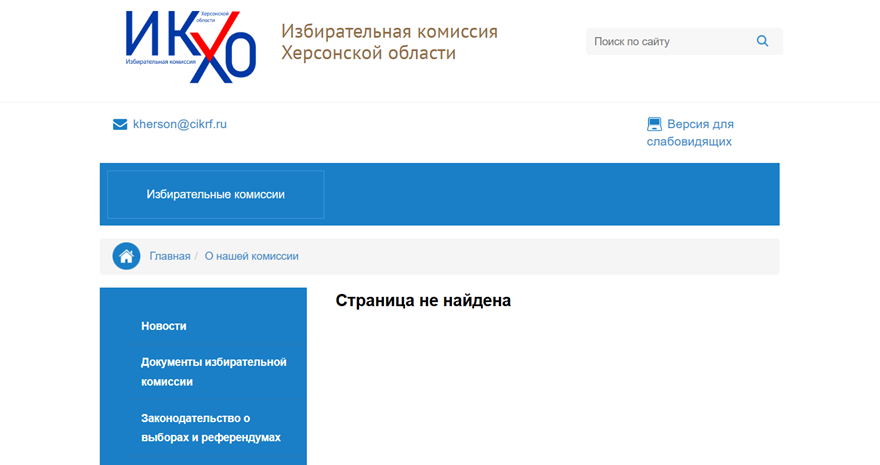
In most cases, commissions limit themselves to indicating the full name of the commission member, by whom they were appointed, and by whom they were nominated (not always) to the commission. Other information — year of birth, education, position held or type of activity, experience of working in the election commission or in the electoral system — is encountered extremely rarely. For example, among the leaders in the “closedness” of data on commission members were the election commissions of the Republic of Adygea, Voronezh, Bryansk and Volgograd oblasts, Krasnodar, Zabaykalsky and Khabarovsk krais, on whose websites the most minimal information about their members is posted: full name, by whom nominated, by whom appointed. The EC of Amur Oblast distinguished itself by particular conciseness, where there is not even information about by whom a commission member was appointed. On the website of the EC of Arkhangelsk Oblast there are only the full names of commission members; it is presumably assumed that more detailed information can be gleaned from the texts of the normative legal acts posted below, but the resolution of the oblast council contains only the same full names of the seven appointed commission members, while on the websites of the ECs of Vladimir Oblast and Rostov Oblast there is not even that. On the websites of the ECs of Astrakhan, Volgograd and Bryansk oblasts, and Sevastopol, unlike the majority of IKSFs, there is no separate page at all with their compositions and information about the current commission members; there are not even their photographs, and a special link leads to the commission list in the GAS “Vybory” system. The websites of the ECs of the DPR, LPR, Zaporizhzhia and Kherson oblasts (“page not found”) contain no lists of CMDVs at all. Their compositions were partially established through normative acts on the appointment of commission members and rare mentions in the media. The presentation of information on the websites of a number of ECs deserves attention, for example, the Republic of Kalmykia, where the place of work of the commission member and the output data of the normative legal act on their appointment are indicated in tabular form, among other things.
A strange “media openness” solution has been adopted on the website of the EC of the Republic of Mari El, where, on the commission composition page, instead of biographical notes on its members, links to speeches and interviews by some of its members are posted.
The website of the EC of the Republic of Khakassia, extremely inconveniently and unmodernly, offers to download the election commission composition as a Word file instead of opening it on a separate page.
As noted above, many commissions do not indicate which of their members (apart from the chair, deputy chair and secretary) work on a permanent (staff) basis (for example, the EC of Pskov Oblast).
A similar problem exists not only with election commission websites, but even with the normative acts on the appointment of IKSF members issued by heads and legislative assemblies — in many cases this is simply a list of full names without any additional information (for example, by whom they were nominated). As an example, one can cite the 2021 resolution of the Arkhangelsk Oblast Assembly of Deputies on appointment.
As a result, understanding who represents whose interests in the commission becomes very difficult, and sometimes impossible. This, in turn, leads to a reduction in the accountability of the subjects that nominated them to society, and makes it harder to identify situations where several supporters or members of one party end up in an EC, or, for example, situations where commission members are connected to each other.
Secondly, on the websites of many election commissions it proved impossible to find the compositions of past convocations in order to assess the rotation of their compositions and the experience of individual commission members. There is a de facto “information zeroing-out” of departed commission members: over five years, changes in composition have occurred in most commissions — someone left by personal wish, someone for natural reasons, someone changed region or place of work, someone for political reasons — but almost never is information about that person’s tenure in the commission preserved on the website; a kind of zeroing-out of information about them occurs, as if they had never been part of the commission. Moreover, this often concerns honoured workers of the system who were in the election commission for several convocations and even headed commissions. Thus, a zeroing-out of the personal responsibility of departed election commission members also occurs for those decisions that were taken by the commission during their time in its composition.
Thirdly, it is almost never indicated that a newly appointed election commission member joined the commission after its formation. When, whom exactly and for what reason they replaced in the composition of the current commission, and when the act on their appointment was adopted — this is also not indicated.
Another characteristic feature has become the non-public nature of the majority of IKSF members. It is hard to imagine a modern Russian without social networks, yet for IKSF members this is effectively the norm. Media personalities who actively maintain social networks, let alone comment in any way on their activities in the election commission, are extremely rare among commission members. While for commission members on a permanent (staff) basis or for members from among administrative figures, the absence of personal social media profiles or their closed nature can still somehow be explained by their status as state officials, who are instructed to behave extremely cautiously on the Internet, for others, especially from among representatives of parties fighting for voters’ attention, such closedness seems illogical.
The majority of CMDVs either have no accounts even on Russian social networks (“Vkontakte”, “Odnoklassniki”), or they are inactive. It is noticeable that many EC members have closed their personal “Vkontakte” pages or stopped maintaining them several years ago. Literally a handful publish anything on them concerning elections and their professional activities as commission members. Mentions of CMDVs on external resources are linked rather to their party or related activities than to public activity in the EC.
A general preliminary conclusion can be drawn as follows: if an ordinary voter wants to find out who will conduct the elections and approve their results in their region, in most cases they will be able to learn very little from the official information sources of the election commissions themselves. The question of who will count the voters’ ballots will most likely remain unanswered. At the same time, it cannot be said that the IKSF compositions include some nobodies. Very many of the commission members have quite rich professional and political experience.
The worst of the worst
The anti-rating of the most non-public, “closed” election commissions is predictably headed by the election commissions of the so-called “new” Donetsk, Zaporizhzhia, Luhansk and Kherson regions — they share the top spot by a wide margin.
These commissions were first formed in February 2023. The 2026 State Duma deputy elections will be the second federal election campaigns, after the 2024 presidential elections, to be conducted by their members. Information about who is in the composition of these commissions proved to be extremely scarce. According to the law, election commissions are public and open bodies. All their sessions must be held openly and publicly. However, the full compositions of the Zaporizhzhia and Kherson IKSFs still remain classified. Unlike other regions, even the full names of many commission members in these oblasts cannot be found either on the election commission websites, or in the regional section of the GAS “Vybory” system, or in the corresponding resolutions on their appointment adopted by the regional heads and regional deputies.
When clicking on the link “Election Commission of … (region name)”, where in other regions a list of commission members appears, in these cases either nothing happens (websites of the EC of the DPR, Zaporizhzhia oblast), or a “page not found” message appears (EC of Kherson Oblast). On the website of the EC of the LPR, a transition occurs to a page with a personal reception schedule, where the time and date of reception by commission chair Marianna Sumskaya, her deputy Ekaterina Tereshchenko and secretary Olga Chernyavskaya are indeed indicated, but information about other commission members is absent.
The websites of the ECs of the DPR, LPR and Zaporizhzhia Oblast do not contain a transition to the regional segment of the GAS “Vybory” system, which is mandatory for other regions. Usually, a list of IKSF members and by whom they were nominated to the commission is contained there, as well as lists of members of lower-level commissions — TECs and PECs. The website of the EC of Kherson Oblast, although it contains such a link, displays a message upon transition stating that there is “no data” on commission members.
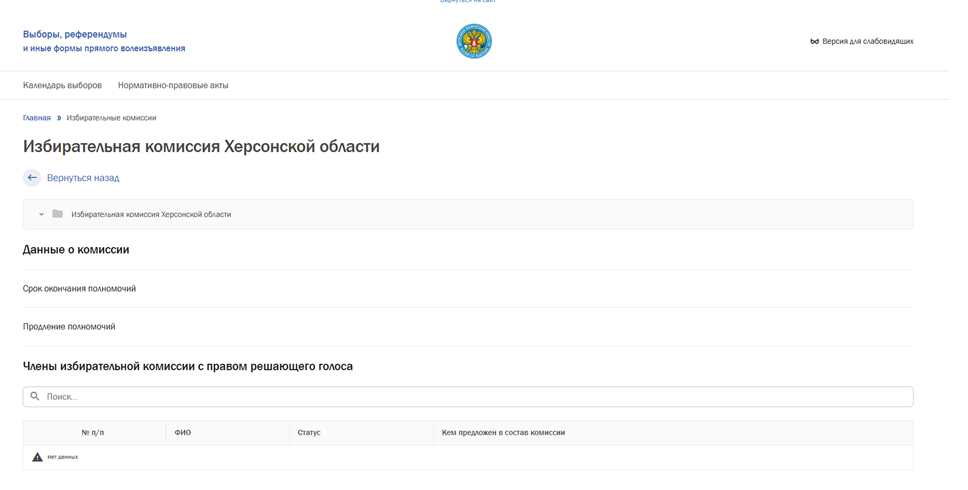
The most classified are the Kherson and Zaporizhzhia election commissions. Their compositions were partially established through normative acts on the appointment of commission members, from CEC of Russia resolutions and rare mentions in the media. Although photographs from commission sessions are available on the election commission resources, only the names of the commission leadership, as well as some TEC and PEC chairs, are publicly mentioned.
For example, in its resolution No. 108/847-8 of 15 February 2023, the CEC of Russia recommended that the acting head of Kherson Oblast include in the commission Sergey Valerievich Vysotin, born 1975, higher education, deputy head of the organisational department — head of the electoral process support division of the apparatus of the Election Commission of the Republic of Crimea, as well as Marina Yuryevna Zakharova, born 1985, higher education, chair of the Election Commission of Kherson Oblast, which acting head Vladimir Saldo does by his decree of 21 February. Zakharova was then elected chair of the commission, and Vysotin — its deputy. I. V. Kravchenko became the commission secretary. On 22 February 2023, the CEC of Russia adopted resolutions on the appointment of five members to the ECs of Zaporizhzhia and Kherson oblasts; although the resolutions themselves state that lists are attached, they are absent, and the publication of these resolutions in the CEC “Vestnik” explicitly states that they are “not published”. Also, from another CEC resolution of February 2024, one can learn that Valeria Veremyeva, born 1998, who held the position of head of the organisational and legal department of the apparatus of the “Election Commission of Kherson Oblast”, is appointed to the EC of Kherson Oblast in place of Vladimir Bespalov.
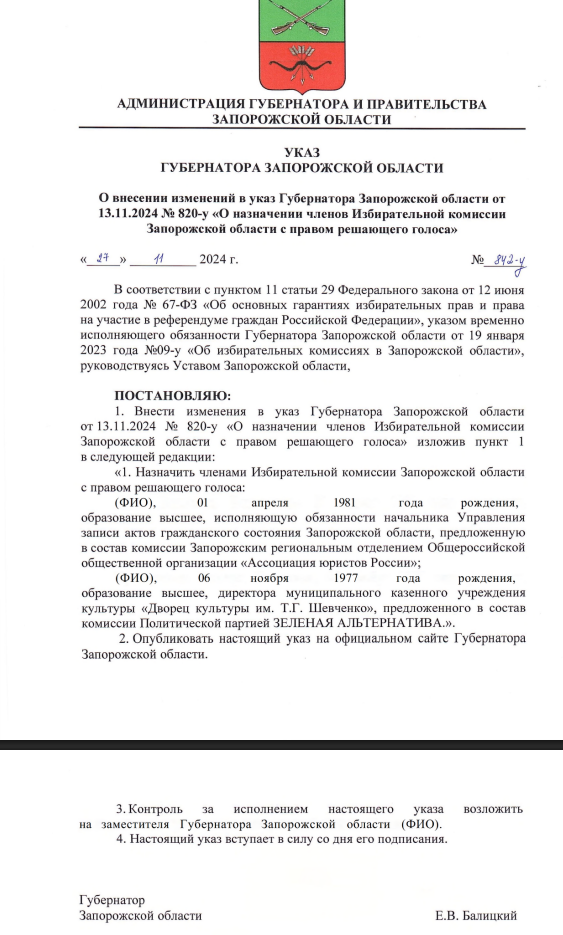
Similarly, information is publicly available only about two members of the EC of Zaporizhzhia Oblast appointed by the CEC (chair Galina Katyushchenko and secretary Elena Sivenkova). A governor’s decree in November 2024 speaks of the appointment of two new members, while instead of names it says “(full name)”, although all other information is present — date of birth and place of work, thanks to which it is not difficult to establish that this concerns the head of the Civil Registry Office (ZAGS) Viktoria Dolya, nominated by the “Association of Lawyers of Russia”, and the director of the Taras Shevchenko Palace of Culture Viktor Krivorotko, nominated by the “Green Alternative” party.
The compositions of the election commissions of the DPR and LPR, at the time of their appointment, were established on the basis of resolutions of the relevant authorities on the appointment of commission members (LPR: resolution of the People’s Council, decree of the head; DPR: resolution of the council, decree of the head).
Among Russia’s “old regions”, in our view, the anti-rating “top” of the most closed commissions, which provide the least information about commission members, should include the election commissions of Arkhangelsk, Amur, Vladimir and Rostov, where the websites contain effectively only the full names of commission members. The election commissions of Astrakhan, Volgograd and Bryansk oblasts and the city of Sevastopol did not bother at all to post information about commission members on their own resources, but simply made links to the resource of the CEC of Russia.