The Elections Atlas project has launched a weekly social-media monitoring programme for the State Duma election period. We will track how active election participants are in the online space. Like the monitoring of federal TV election coverage that began earlier, the reviews of party activity on social media will be published every week, but with a slight delay. The report for the week of 16–22 June is already published on the site.
The results of the social-media monitoring will be published weekly.
For the week of 22–29 June, 230,802 posts were studied. This week saw the pre-election congresses of United Russia, the LDPR, the Party of Pensioners, Rodina and Yabloko, as well as the sentencing in the political criminal case against Yabloko deputy chairman Maxim Kruglov.
Main conclusions for the second week of monitoring:
- Despite the high degree of control the Russian authorities exercise over domestic social networks, the information agenda on them still differs from what can be seen in the largest media outlets — on federal television. Thus, unlike television, social networks actively raised important topics that influence political preferences — the fuel shortage, controversial party initiatives.
- At the same time, the total dominance of United Russia persists, which is largely driven by the open and mass use of administrative resources at all levels of government: thousands of official public pages of government bodies, local self-government and budget-funded institutions in various regions of the country have been drawn into this work. The number of posts about the party’s activities from bodies and institutions that are legally prohibited from participating in political parties’ campaigning activities runs into tens of thousands per week.
- The posting leaders of last week are holding their positions. United Russia is increasing the volume of posts and reach, but the engagement rate remains the same. A Just Russia increased the number of publications by one and a half times, and activity also grew thanks to the resonant statement by party leader Mironov on the death penalty for corrupt officials.
- The Communist Party (CPRF) shows a qualitative leap: with a slight decrease in the number of posts (–6.4%), engagement grew 3.3 times (mainly due to likes and comments). In the public space the previous week, resonant statements were made by Gennady Zyuganov (continuing the topic of Russians’ deposits; his speech was even discussed at a sitting of the current State Duma) and Nina Ostanina, who spoke out against New People’s draft law on domestic violence.
- New People reduced the number of posts by a quarter, yet last week the “Manifesto of the Women of Russia” went very actively viral online; its aim is to help women in difficult life situations (single mothers, victims of domestic violence, ex-wives left without alimony). It also has opponents — the “Bez Bab” society, which surrounded the office with slogans and placards.
- Small parties (the Greens, Yabloko, Rodina) are increasing engagement (though it remains low due to the small number of mentions). This is mainly happening thanks to intra-party resonant events. For example, for Yabloko a significant share of engagement and posting last week came from mentions of the sentence handed down to party deputy chairman Maxim Kruglov. The Greens are the only small party that is not showing growth, and is even losing comments (-70%) and engagement (-7.6%). At the same time, the number of posts remained almost unchanged.
Dynamics of mentions and views
In the second week of the election campaign, a rise in mentions of two parties is noticeable — United Russia and A Just Russia began to be mentioned roughly one and a half times more often. Moreover, the secret of A Just Russia’s high mention count is the same as last week — it is actively mentioned by small party public pages. For United Russia, the explanation for the growth in mentions was, among other things, connected with the party’s pre-election congress.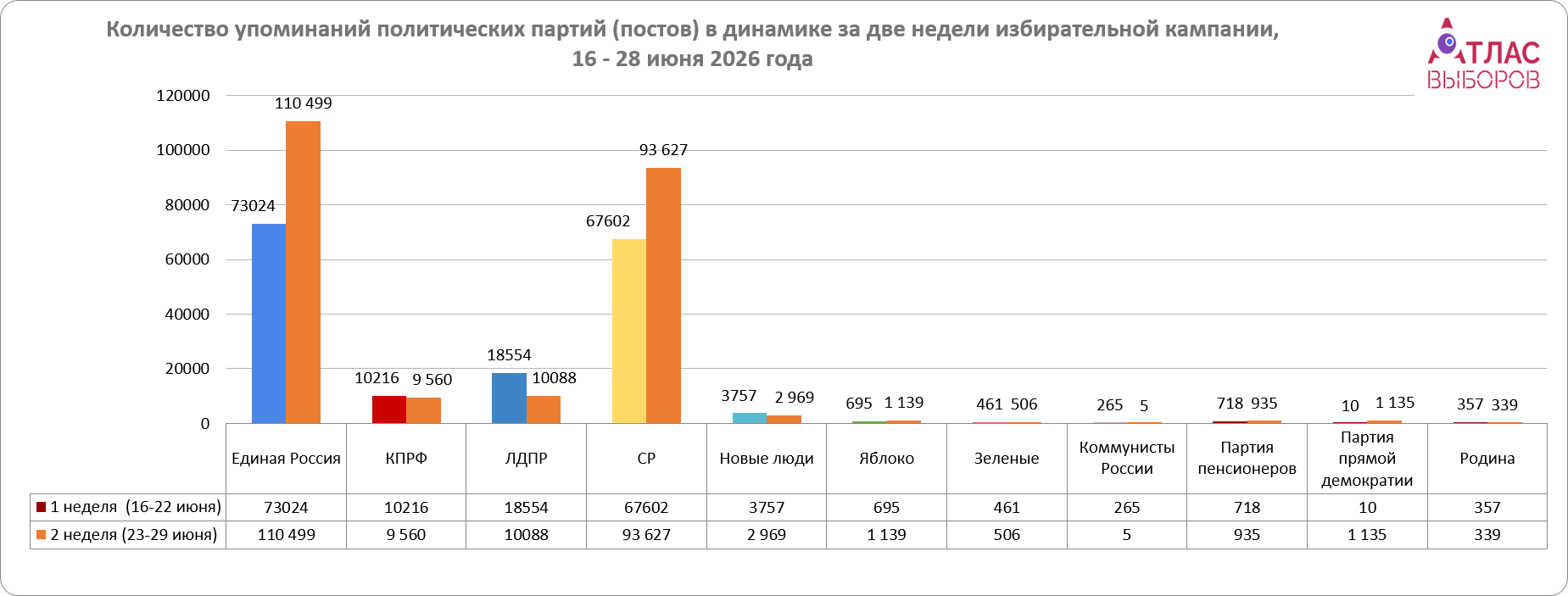
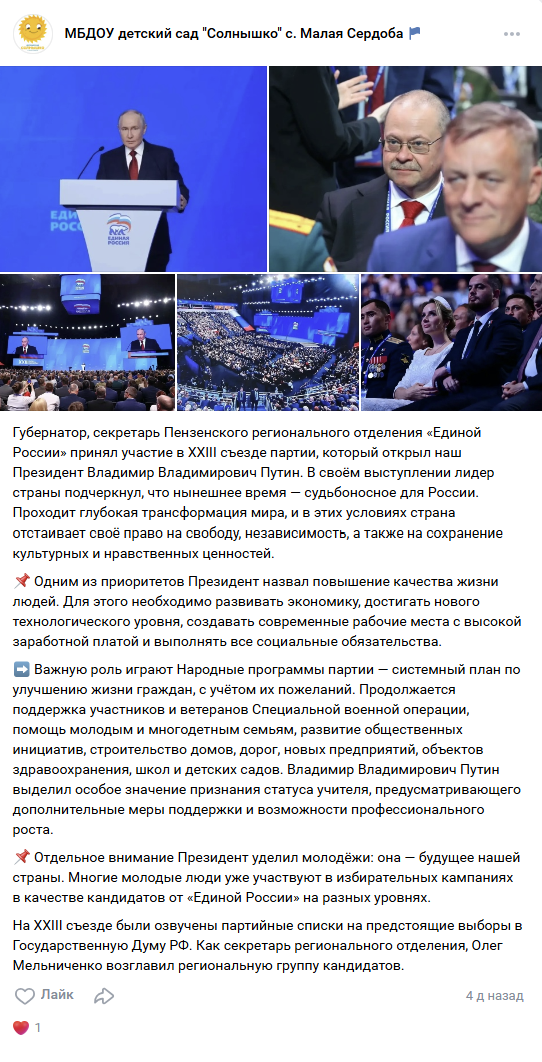
At the same time, a significant portion of such mentions came from official public pages of government bodies, local self-government and budget-funded institutions. For example, the “Solnyshko” kindergarten from the village of Malaya Serdoba in Penza Oblast actively reports on the regional governor’s trip to a party pre-election event (we identified 709 identical posts published almost simultaneously by other kindergartens, schools and other budget-funded institutions). The kindergarten preferred not to tell its subscribers about the congresses of other parties that took place the same week.
The administration of the Komsomolsky rural settlement in Samara Oblast reported on the participation of the “Samara Oblast team” in the United Russia congress. Its example was followed by at least 97 other official public pages of local self-government bodies. The “Samara Oblast team” apparently did not take part in other party congresses.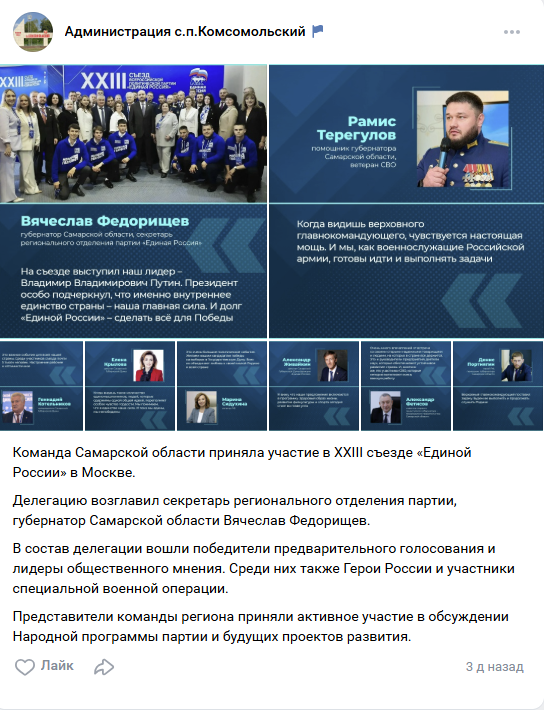
Administrations of municipal okrugs in Krasnoyarsk Krai also posted 114 identical posts describing the party of power’s election programme.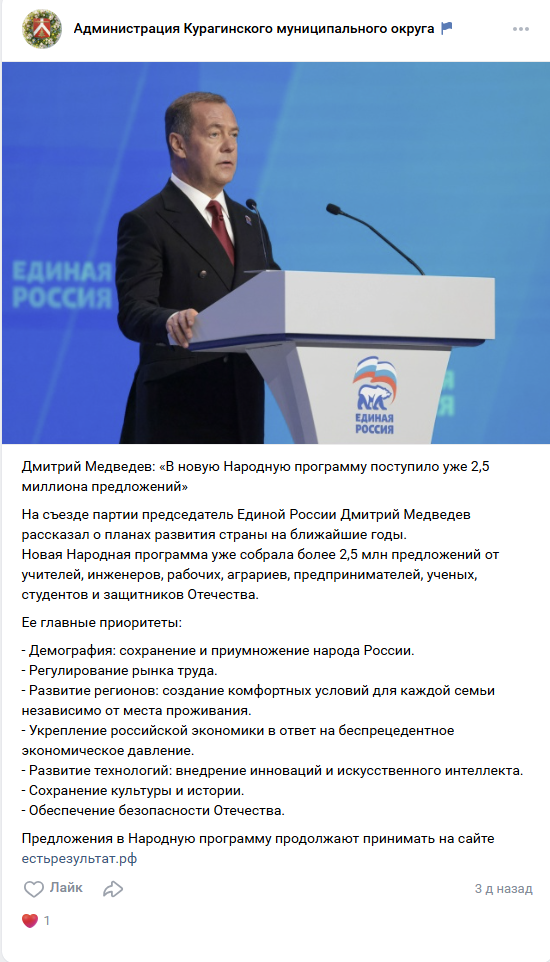
The congress and the programme turned out not to be the only way of disseminating information about the activities of the United Russia party on the platforms of state bodies, local self-government bodies and budget-funded institutions. For example, in Yakutia thousands of identical posts about various events of the party of power are placed every day. For instance, a post about United Russia’s “Culture of the Small Motherland” project was placed in more than 2,000 Yakut official public pages.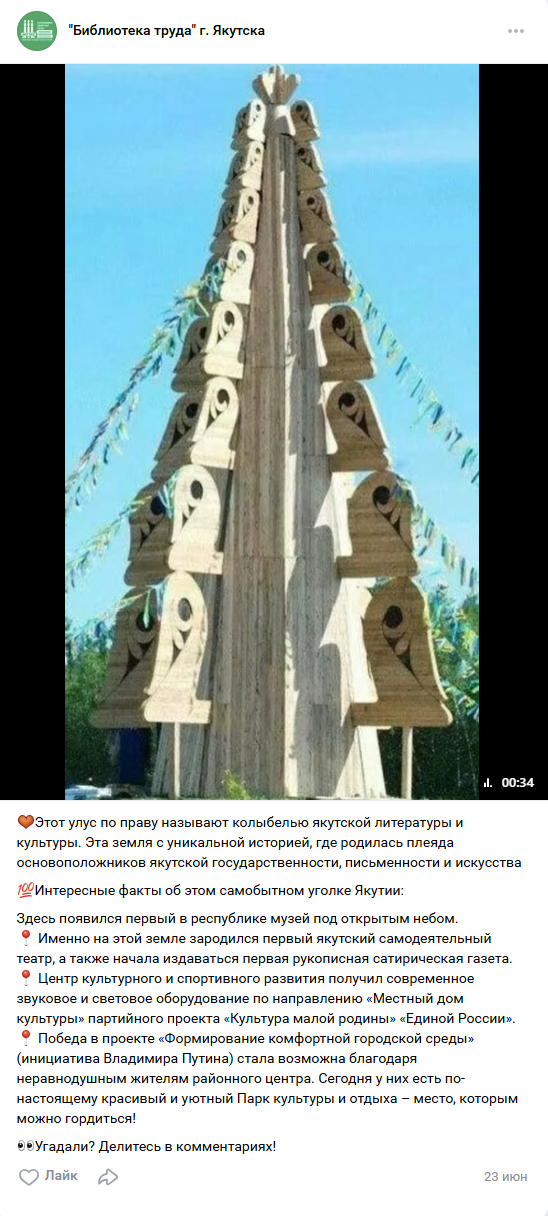
The only party with a noticeable growth in views in absolute figures in the second week of the election campaign was United Russia. A Just Russia and the CPRF also saw growth, but it was moderate. The LDPR and New People, on the contrary, even experienced a slight decline.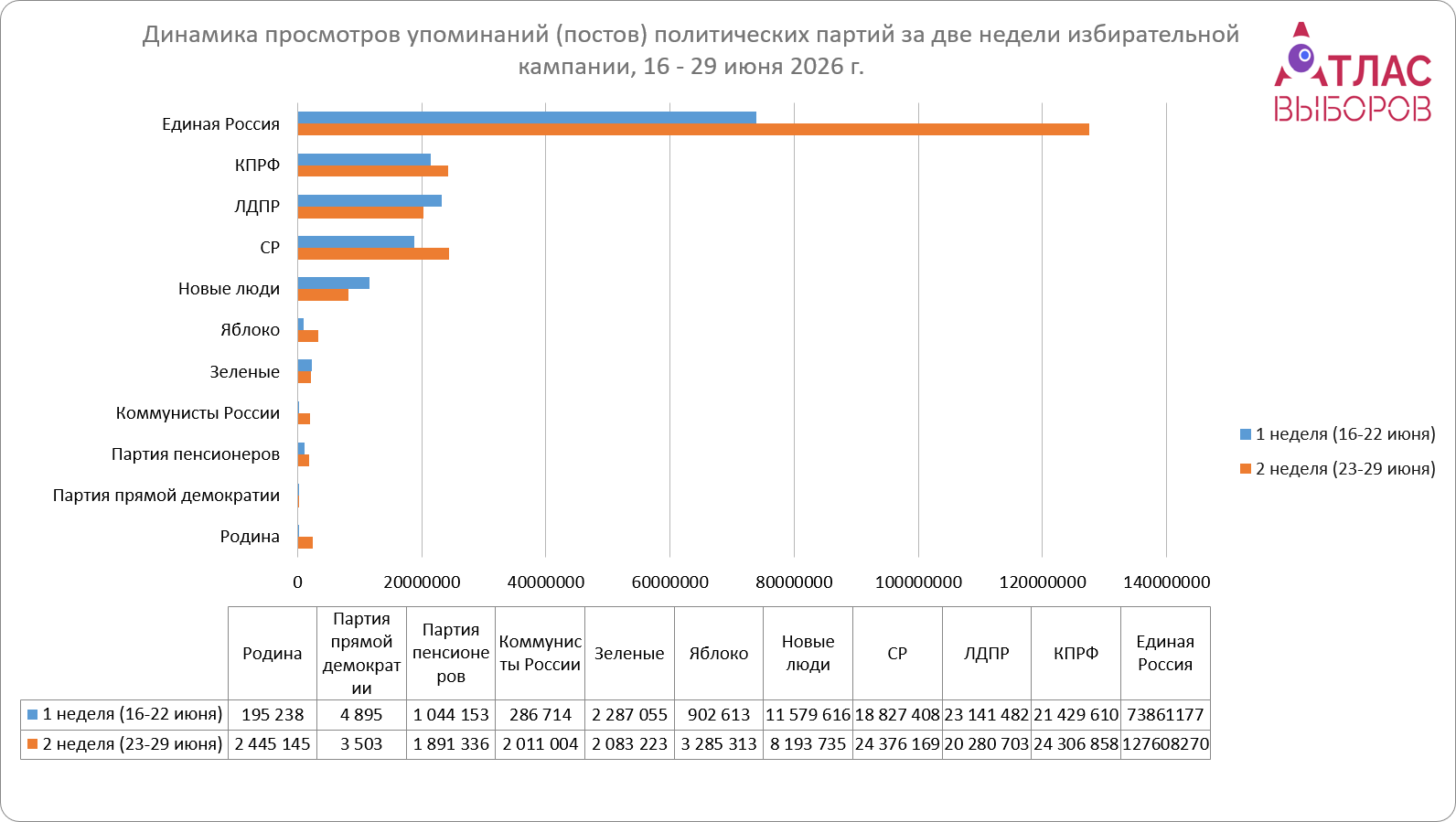
The majority of popular posts mentioning United Russia are devoted to the congress that took place. Despite the fact that Vladimir Putin is not formally a member of the United Russia party, the president spoke at the pre-election congress. Particular attention on social media was drawn to the placard “Being for Putin is the bare minimum”. Moreover, the party ostentatiously presents itself as the presidential party.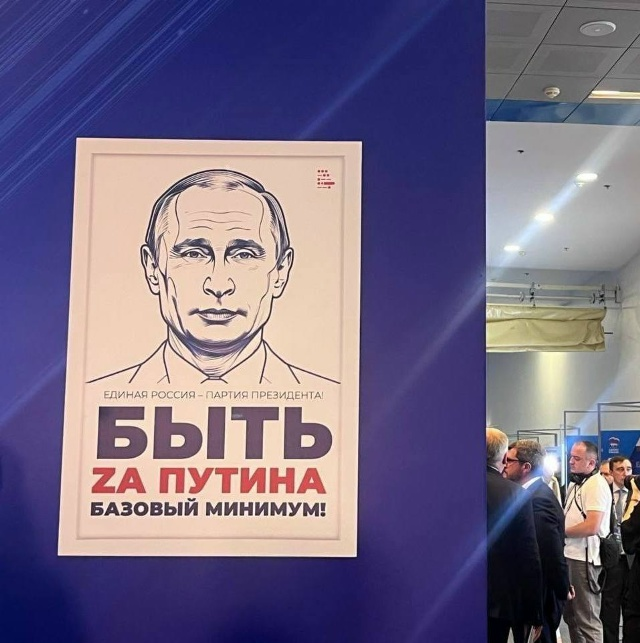
New People’s most popular post is connected with queues for fuel at petrol stations in Irkutsk. The topic is indeed very acute and relevant for the whole country; next week the number of party mentions in the context of this topic is likely to increase substantially, as each party will try to score “points” on an issue that is pressing for voters.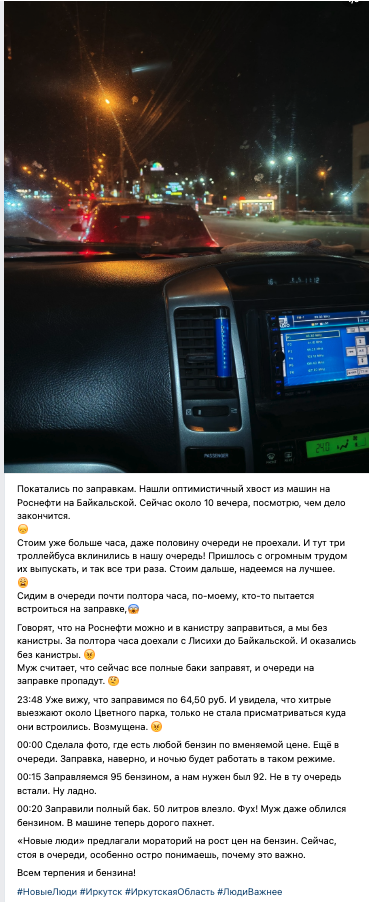
The second most popular topic of New People’s posts is the women’s manifesto. It is noteworthy that, thanks to the discussion about value positions on the issue of domestic violence, the number of mentions grew at once for both New People and the CPRF, which had criticised them. Let us recall that CPRF deputy Nina Ostanina expressed disagreement with the escalation of the domestic violence topic, indicating that the sanction measures proposed by New People would cause fear among young people and a reluctance to enter into legal marriage. Additional resonance for the “Women’s Manifesto” was provided by the action by the “Bez Bab” society near the office providing assistance to women in difficult life situations. Most of all, the participants in the action spoke out against the need to pay alimony.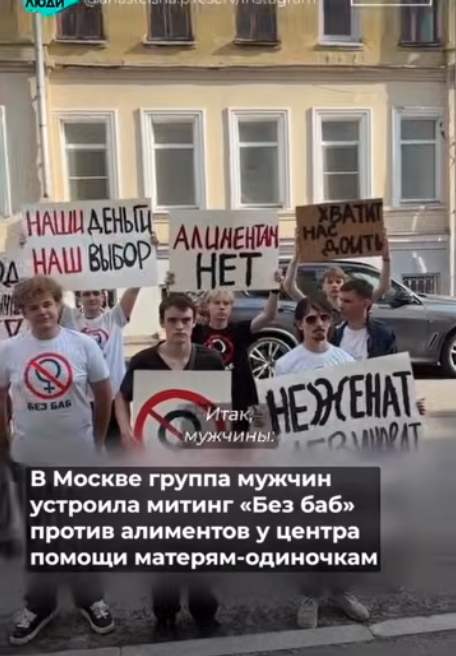
It is worth noting that both of these topics were completely ignored in the election context on television. Thus, social networks, despite their overall controllability and censorship by the Russian authorities, still create a more adequate pre-election agenda than the official media, on which this task was originally placed by society.
User reaction
If the number of mentions and the number of views are not very reliable indicators, since they can be inflated fairly easily, then engagement looks more informative, as it expresses social-media users’ interest in texts that mention parties. Engagement is calculated as the sum of reposts, likes and comments. It is also theoretically susceptible to manipulation, but so far such facts are not conspicuous.
It is worth reiterating that engagement, like other indicators, was assessed across four platforms: MAX, Telegram, Youtube, VKontakte — it is highly likely that when correct data for Instagram, Facebook, Odnoklassniki are included in the analysis, new conclusions and correlations will emerge. This especially concerns Instagram, where engagement indicators are traditionally higher than on VKontakte.
Over the past two weeks, total engagement on social networks grew from 3.4 million to 4.1 million interactions. Moreover, this growth was provided not by United Russia and the SRs, whose mentions grew substantially, but by the CPRF.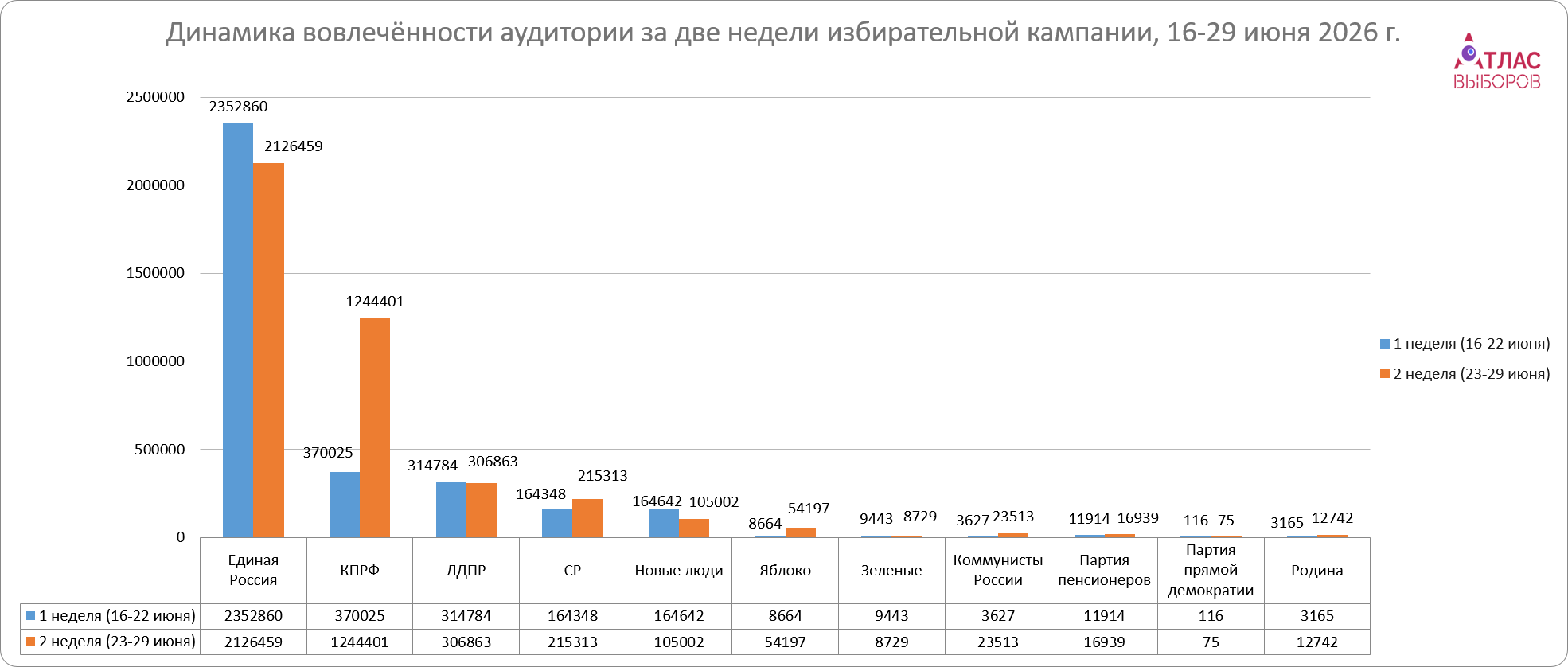
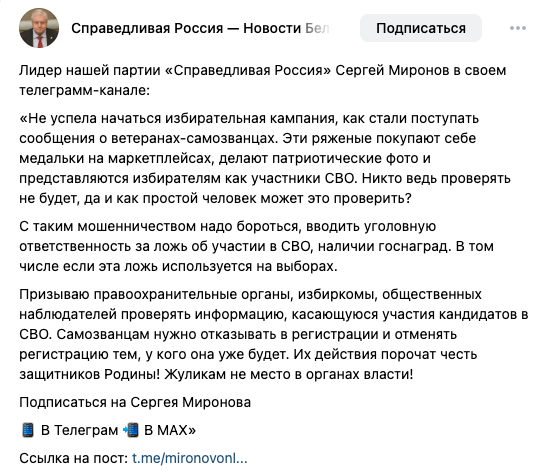
United Russia’s engagement even fell from 2.35 million to 2.13 million (-9.6%), despite a one-and-a-half-fold increase in the number of posts: there was a lot of information about the congress that took place and some of the party’s initiatives, but the uniform content elicited little reaction from users. A Just Russia saw a small increase in engagement — from 164.3 thousand reactions to 214.3 thousand (an increase of +50 thousand or +30%) with a 38% growth in posts. Last week Sergei Mironov came forward with at least two initiatives that provoked a stormy reaction: the death penalty for corrupt officials, and the need to combat SMO veteran candidates who may be fraudsters.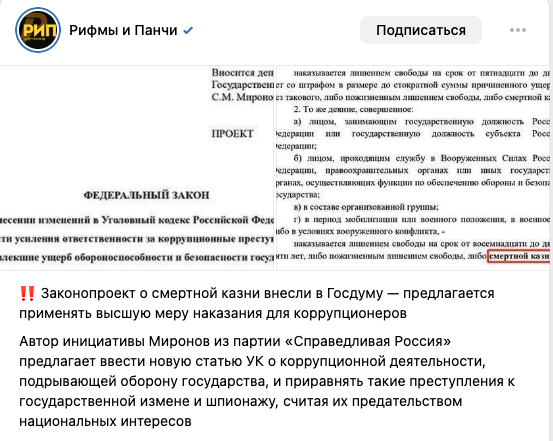
However, the truly impressive growth was seen by the CPRF — from 370 thousand reactions to 1.24 million (+236%, absolute increase +874 thousand). At the same time, the number of mentions of the Communists even fell slightly — by 6%. This effect was produced by the echoes of Gennady Zyuganov’s provocative quote, as well as the discussion between Nina Ostanina (CPRF) and Ksenia Goryacheva (New People). In addition, a notable role was played by the nomination of the popular Communist blogger Nikolai Bondarenko as a candidate for State Duma deputy.
The LDPR showed an insignificant decline from 314.8 to 306.9 thousand (-2.5%) with a 46% drop in the number of posts. Engagement is holding up thanks to higher-quality publications, but overall publication activity is declining. Over the past week there were indeed no resonant events connected with mentions of the party, yet the audience is active.
New People are demonstrating perhaps the most problematic dynamic: a fall in both reach and response without visible external causes, while their initiatives are not detached from the agenda. There was probably preparation for the party congress, and we may be able to observe a new surge of activity next week.
Small parties (Yabloko, Communists of Russia, Rodina and others) are showing growth, but absolute values remain low. At the same time, they are beginning to attract attention. Some of them also held congresses last week. For example, the surge in engagement for the Rodina party is precisely connected with the discussion of Oleg Pakholkov’s candidacy for the State Duma elections.
Dynamics of platform use
The overall growth in posts of nearly a third was provided by mentions on VKontakte — its share grew by 4%. Telegram lost more than a third of its volume (the volume of posts fell from 13.2 thousand to 8.6 thousand). YouTube remains a niche platform, although its growth (+47%) is the highest in relative terms: United Russia, the LDPR and the CPRF increased their presence there.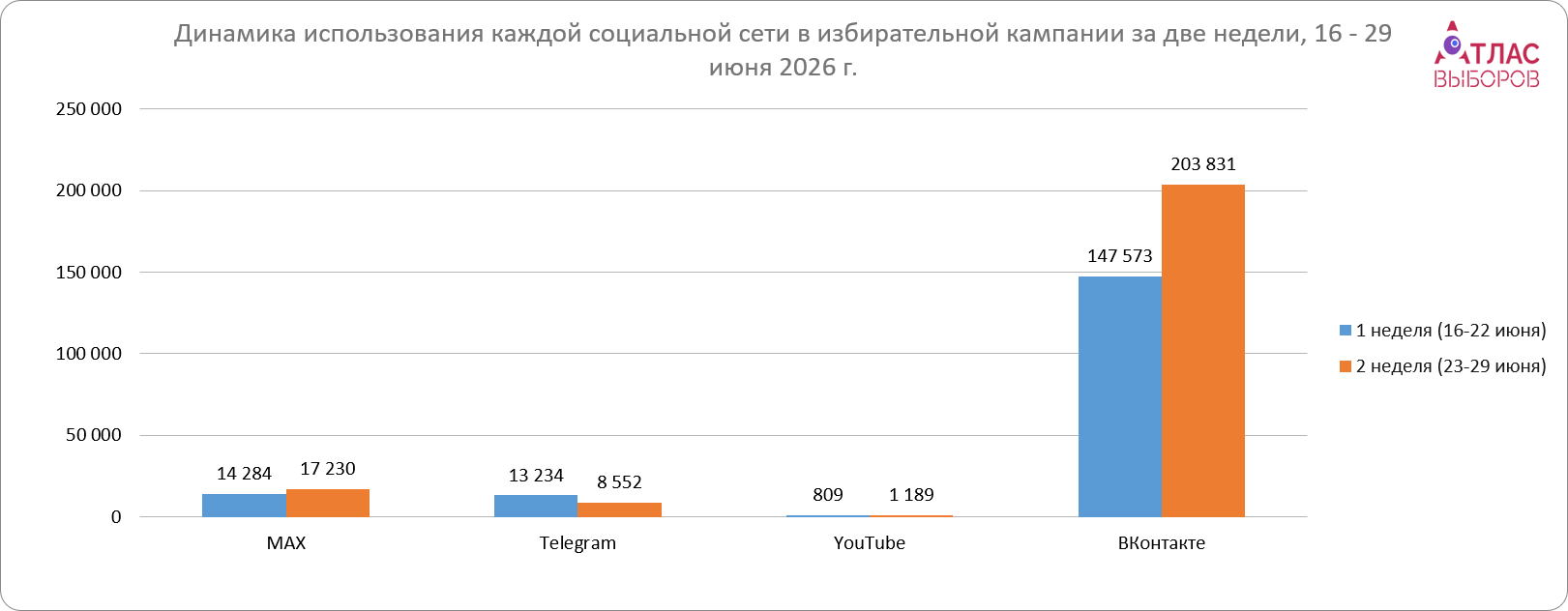
United Russia is increasing its presence primarily through VKontakte public pages — growth of almost 1.7 times. Such public pages are subject to pre-moderation, meaning that the publication of each post in them requires the approval of the public page administrator. Tellingly, this communication channel is practically absent for other parties, apart from their party accounts. At the same time, United Russia’s use of Telegram has declined. YouTube, albeit from a small base, shows noticeable growth.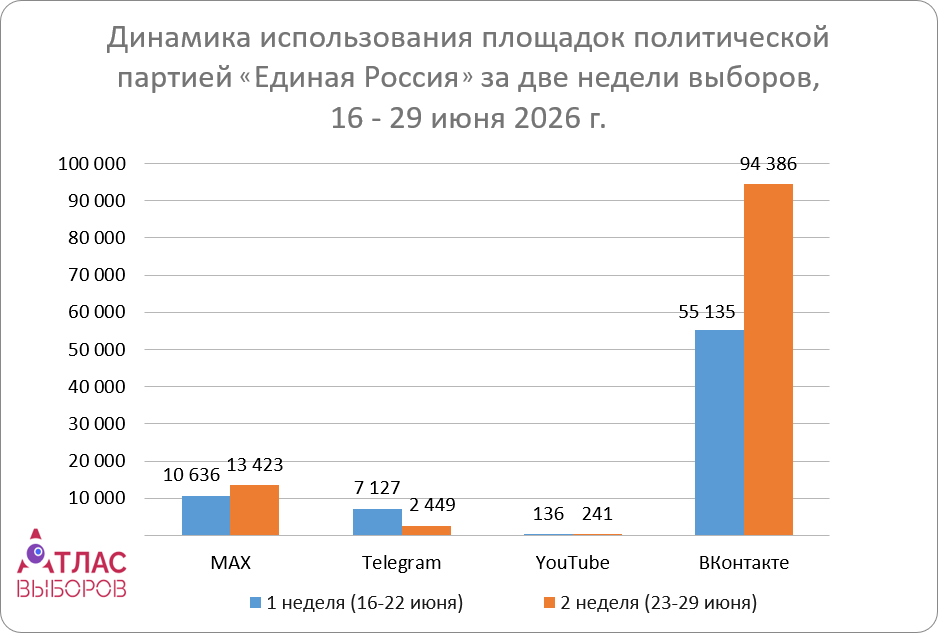
The CPRF is maintaining roughly the same volume of mentions, with a slight shift towards MAX and YouTube, while Telegram is also losing ground.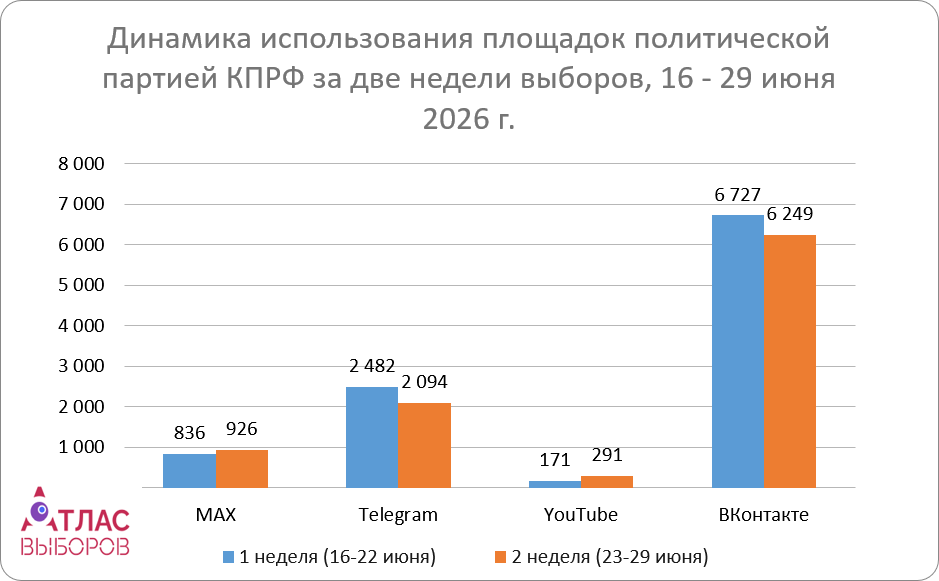
The LDPR saw a sharp reduction in the number of mentions on VKontakte (almost by half). The party congress held on 23 June did not affect the situation in quantitative terms. The LDPR maintained its previous level of mentionability on MAX, and slightly increased its presence on Telegram and YouTube. Admittedly, in the case of Telegram, a significant portion of such mentions are not posts, but user comments under them.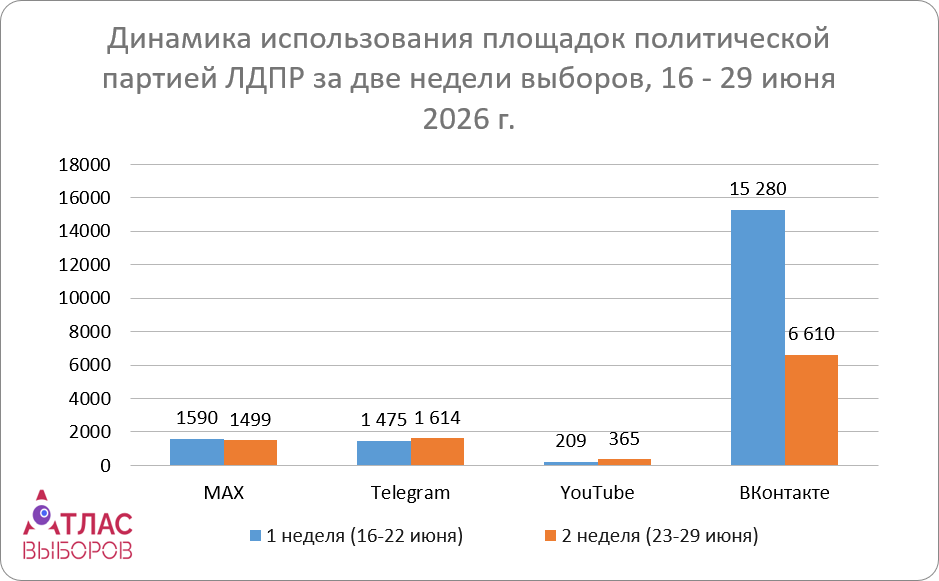
The SRs increased activity on all platforms, especially on VKontakte, which made them the second-largest content generators after United Russia. Growth on Telegram and MAX is also present, but very moderate.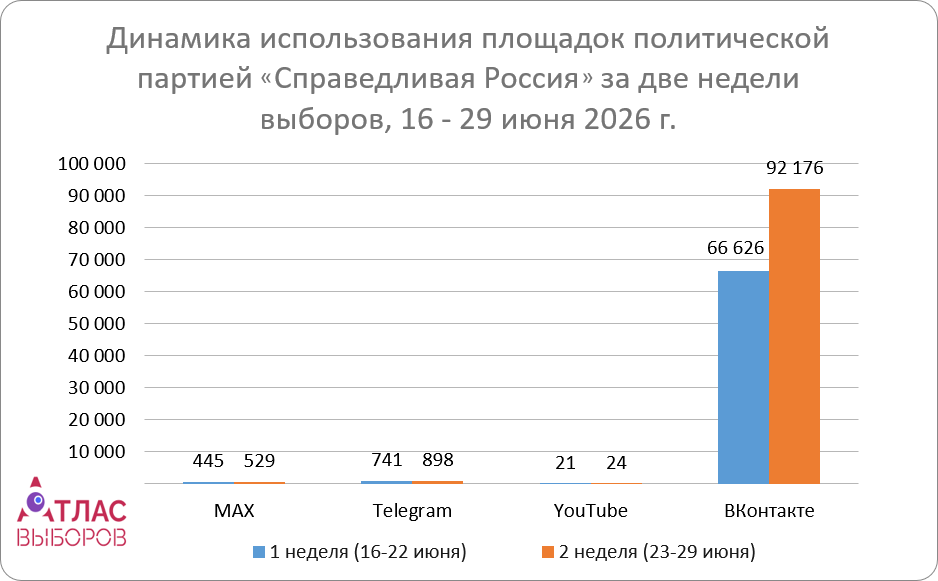
New People reduced activity on all platforms, but proportionally, without sharp imbalances. The party congress took place later than the timeframe of the social-media activity analysis in this report, so a surge in mentionability can be expected in the future.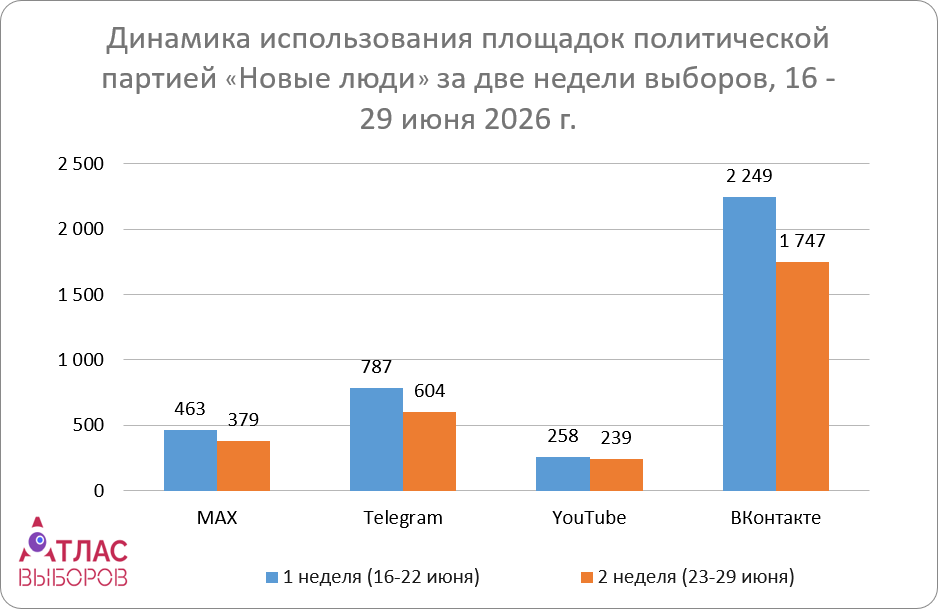
The remaining parties are practically invisible on social networks, just as on television. Even their pre-election congresses did not help them. Formally, Yabloko, Rodina and the Party of Pensioners showed growth in mentionability and/or views, but the indicators are still very small. The Party of Direct Democracy looks the most modest of all (3–5 posts per week).
The key leitmotif of mentions of the Yabloko party is connected with the sentencing of former Moscow City Duma deputy Maxim Kruglov in the criminal case on fakes.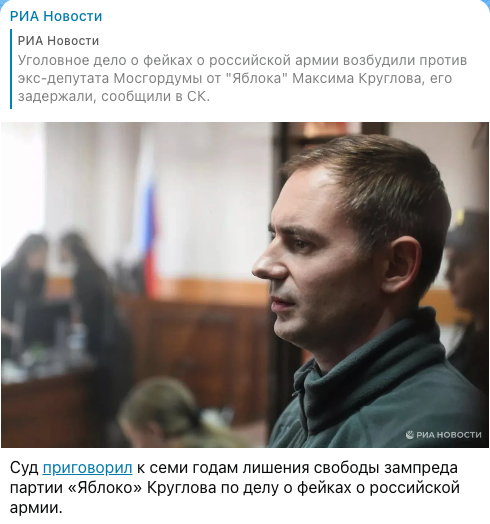
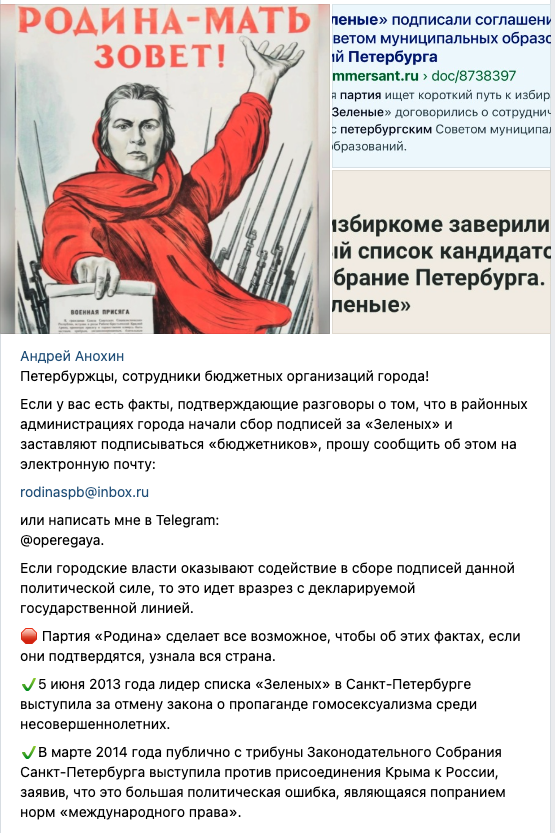
A significant share of mentions of small parties is connected with the posting of a post about the collection of signatures by the Greens for the elections of deputies to the legislative assembly of St Petersburg, which lists the parties that also need to collect signatures to be admitted to participate. At the same time, the collection of signatures by the Greens in St Petersburg is actively covered by a network of district public pages that are evidently controlled by the local authorities. They mass-post videos about the collection of voters’ signatures in support of the Greens. Supporters of the Rodina party drew attention to this and accused the Greens of illegal use of administrative resources. It appears that this is true, and the St Petersburg administration is indeed helping the Greens — overcoming the barrier would allow the party to guaranteed retain the “parliamentary privilege” in federal elections for the next five years.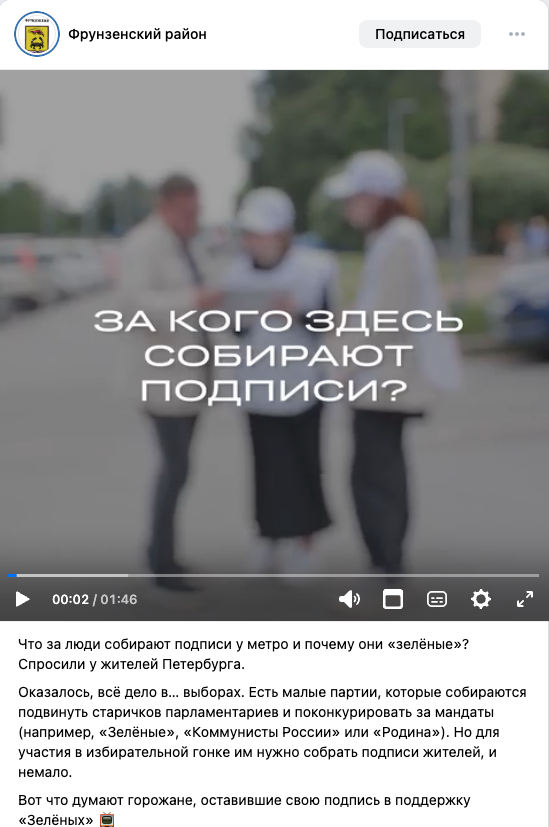
Methodology
For the social-media monitoring, four platforms currently used by Russians were selected: VKontakte, MAX, Telegram, YouTube. Unfortunately, we have not yet managed to set up effective monitoring of Odnoklassniki and Instagram, which could substantially influence the overall data. If this can be done in the coming weeks, the data will be added.
The analysis used mentions of 11 parties that have the right to nominate lists and candidates without collecting voters’ signatures: United Russia, the CPRF, the LDPR, A Just Russia, New People, Yabloko, Communists of Russia, the Party of Direct Democracy, Rodina, the Party of Pensioners, the Greens. If other parties stand in the elections, they will be added to the monitoring.
We analysed posts on each platform, and we were interested in the following indicators:
- number of mentions (posts) on social networks, broken down by political party;
- number of mentions, broken down by platform;
- engagement (reposts, reactions, activity in comments);
- duplicate posts, which very often indicate centralised dissemination of materials;
- key topics;
- use of administrative resources.