The “Election Atlas” project has launched a weekly monitoring programme of federal television channels during the State Duma deputy election period. We will track how equally the activities of election participants are covered on state-controlled federal television channels.
Television remains one of the main sources of information for many Russians. At the same time, society places a special role on the media — they are responsible for creating the conditions for citizens to conduct public political discussion. Both the Russian Constitution and many international covenants require the media to take ethical and balanced positions and to cover the election process in a fair, balanced and impartial manner. Media representatives must not engage in campaigning.
The results of the media monitoring are published weekly.
Main findings for the fourth week of the campaign
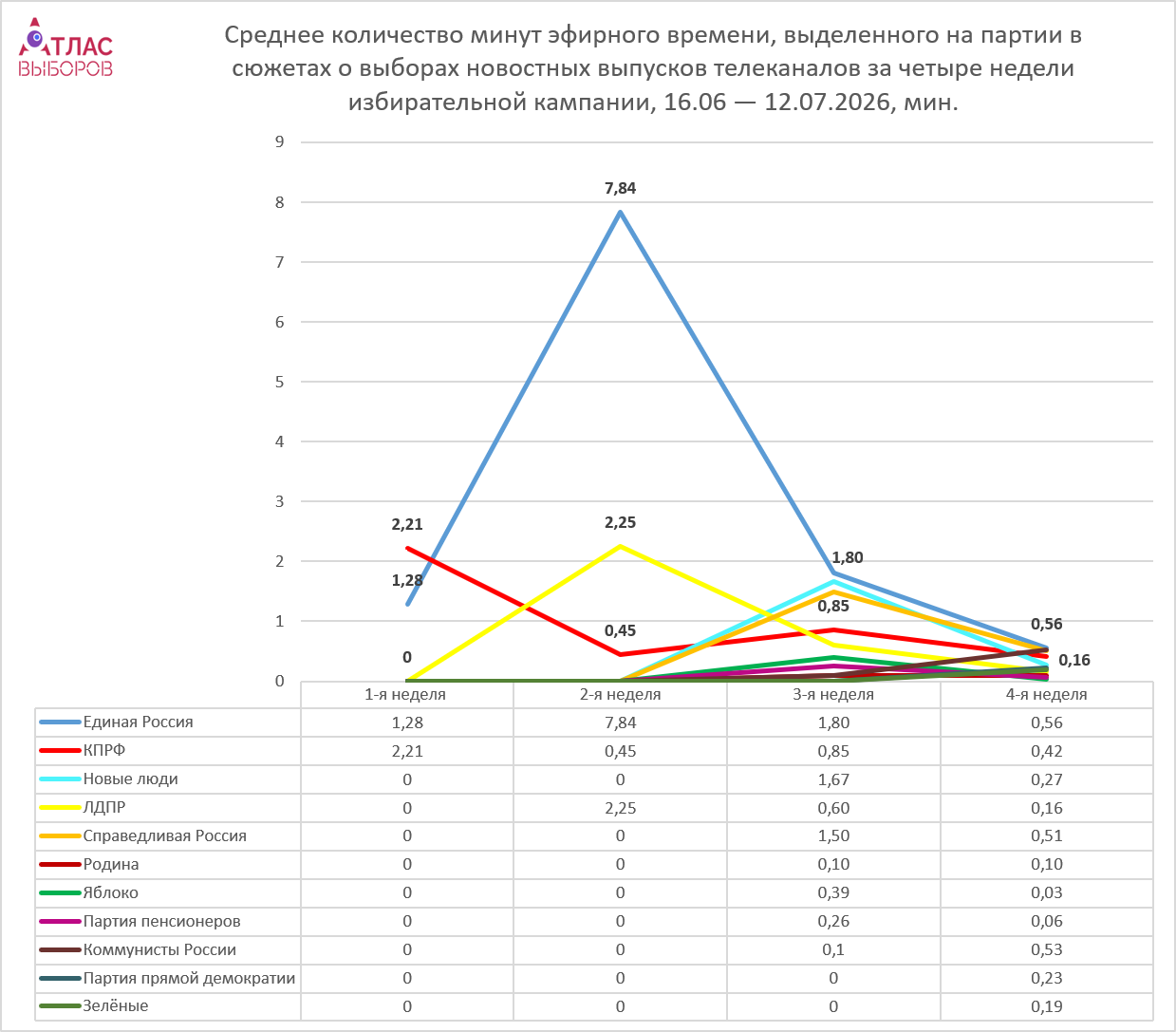
Through the efforts of the federal television channels, election-related activity has definitively “gone into hibernation” for viewers. The already small amount of airtime devoted to the elections shrank by a further third in the fourth week and turned out to be focused on a completely secondary technical procedure — the submission of candidate documents to the Russian Central Election Commission. Most reports mentioning a specific party were brief, extremely dry and uninformative — averaging a few seconds per mention.
For the first time since the start of the campaign, all parties participating in the elections were mentioned on federal channels at once. Admittedly, this was the achievement of just one channel out of six — TV Tsentr. At the same time, all non-parliamentary parties, with the exception of Communists of Russia, received less than one minute of airtime each over the entire week.
United Russia regained the lead in terms of the amount of airtime devoted to it. In addition to reports on the submission of documents to the Russian CEC, the television channels covered the candidates included in the party list, their work on the party programme, and provided direct speech from a party representative. The party also regularly appeared in reports not directly related to the election campaign.
Number and content of news reports
The already small amount of airtime that federal television channels devote to informing their viewers about the main domestic political event of this year has collapsed even further. If in the second week of the campaign the channels devoted a total of 105 minutes to the elections, and in the third week — 65 minutes, then in the fourth week this figure shrank by a further third — to 41 minutes. For example, on Channel One the amount of airtime devoted to the elections was 40% less than a week earlier, and on Russia 1 — 55% less. On average, the six channels together devoted less than six minutes a day to the topic of the ongoing elections to the Russian parliament.
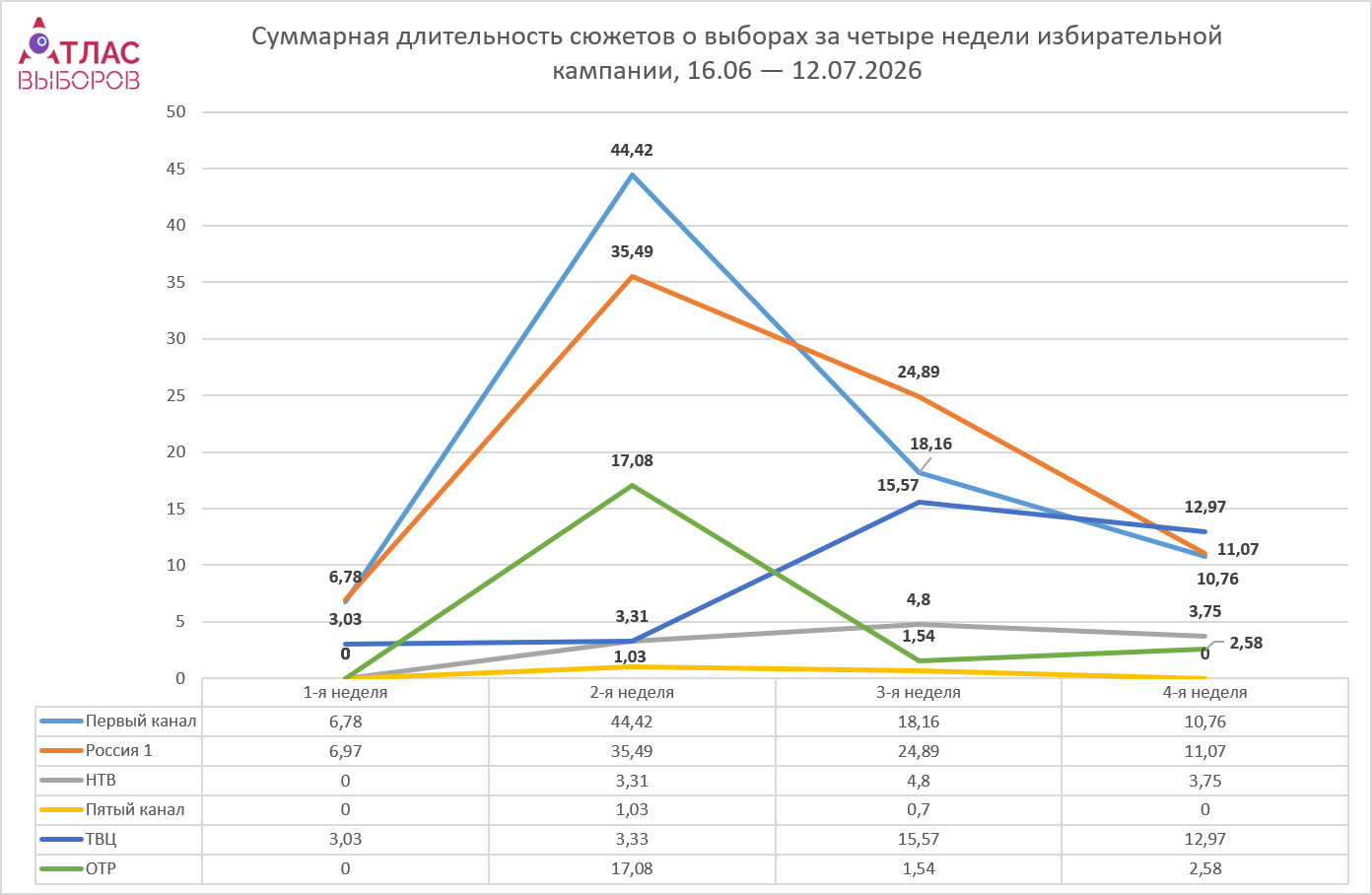
Moreover, the main news hook of the week was not even the activity of the political parties, but a completely secondary, technical procedure — their submission of documents to the Russian CEC. For instance, Channel One devoted more attention to the procedure for certifying candidate lists (in effect, this is simply the procedure for the Russian CEC to accept party documents for further verification) and accompanied the reports with direct speech from party representatives. TV Tsentr also covered the purely technical side of the campaign, regularly reporting on the certification of party lists. NTV limited itself to a relatively small number of reports, mostly devoted to the submission of documents to the CEC and individual statements by party leaders. The OTR channel very briefly reported on the CEC completing the acceptance of documents from parties; individual parties were not mentioned. On Channel Five this week there were no reports related to the elections. Only the Russia 1 channel, in addition to covering electoral procedures, reported on the current activities of the parliamentary parties and their legislative initiatives, and even then only a little — see below.
Distribution of airtime between parties
In terms of content, the federal television agenda remained focused mainly on the parliamentary parties. In addition to reports on the registration of candidate lists, the television channels covered the working trips of party leaders, their social initiatives and individual socio-political events.
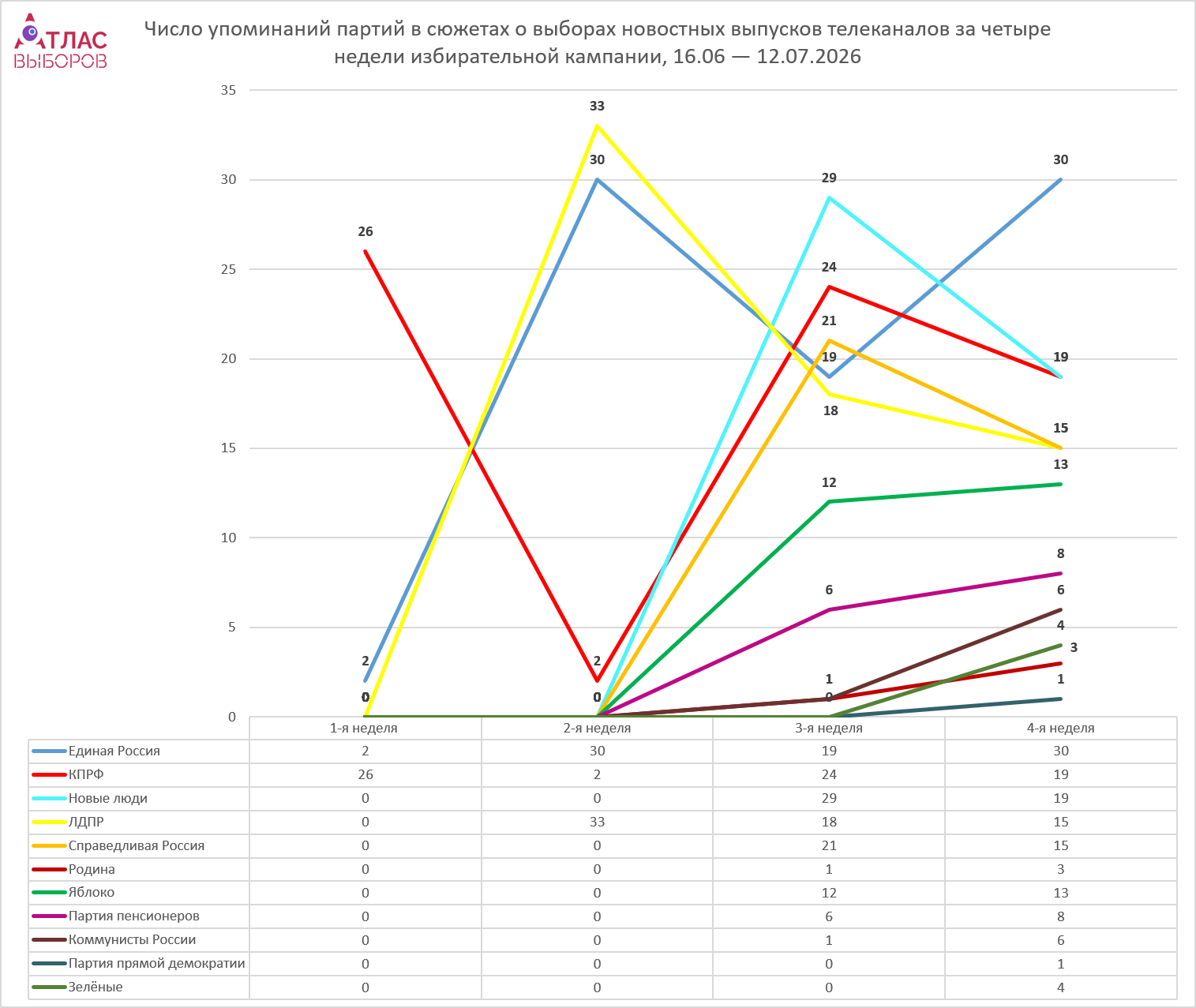
The number of mentions of United Russia on federal television increased, while for most other parties it decreased. The only exceptions were parties that in previous weeks had either not been mentioned at all or had been at the bottom of the ranking by number of mentions. For example, The Greens and the Party of Direct Democracy appeared on federal television for the first time in connection with the submission of documents to the CEC. The Party of Pensioners, Communists of Russia and Yabloko were also mentioned somewhat more often than before; however, as in the previous week, this mainly involved brief reports devoted to the technical stages of the election campaign.
For the first time, all parties participating in the elections were represented in the federal television agenda, but exclusively thanks to TV Tsentr.
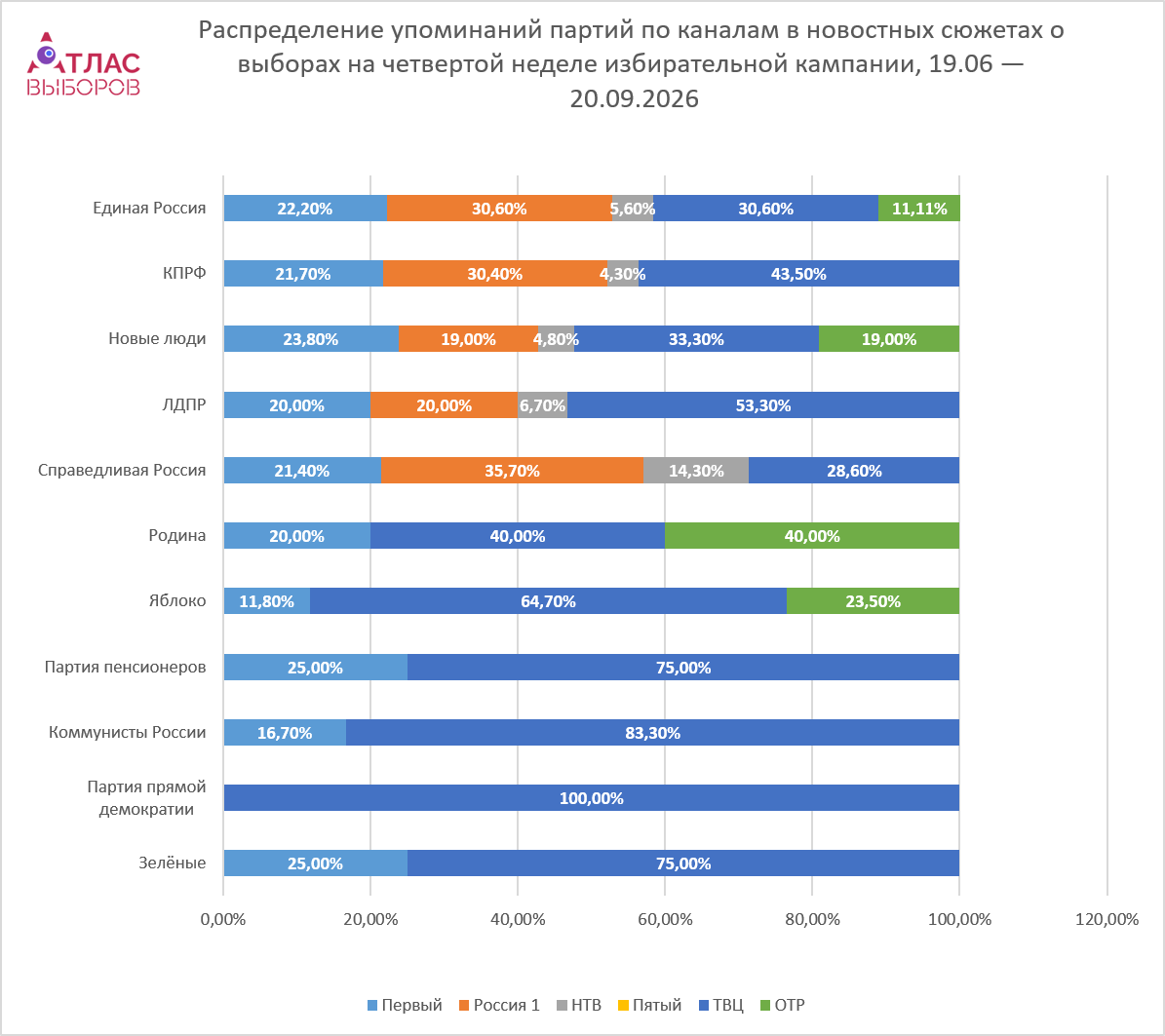
The total airtime allocated to political parties in election-related reports decreased for almost all campaign participants. This is because the main focus of the federal television channels this week was on the work of the CEC and the procedure for accepting and verifying the documents submitted by the parties.
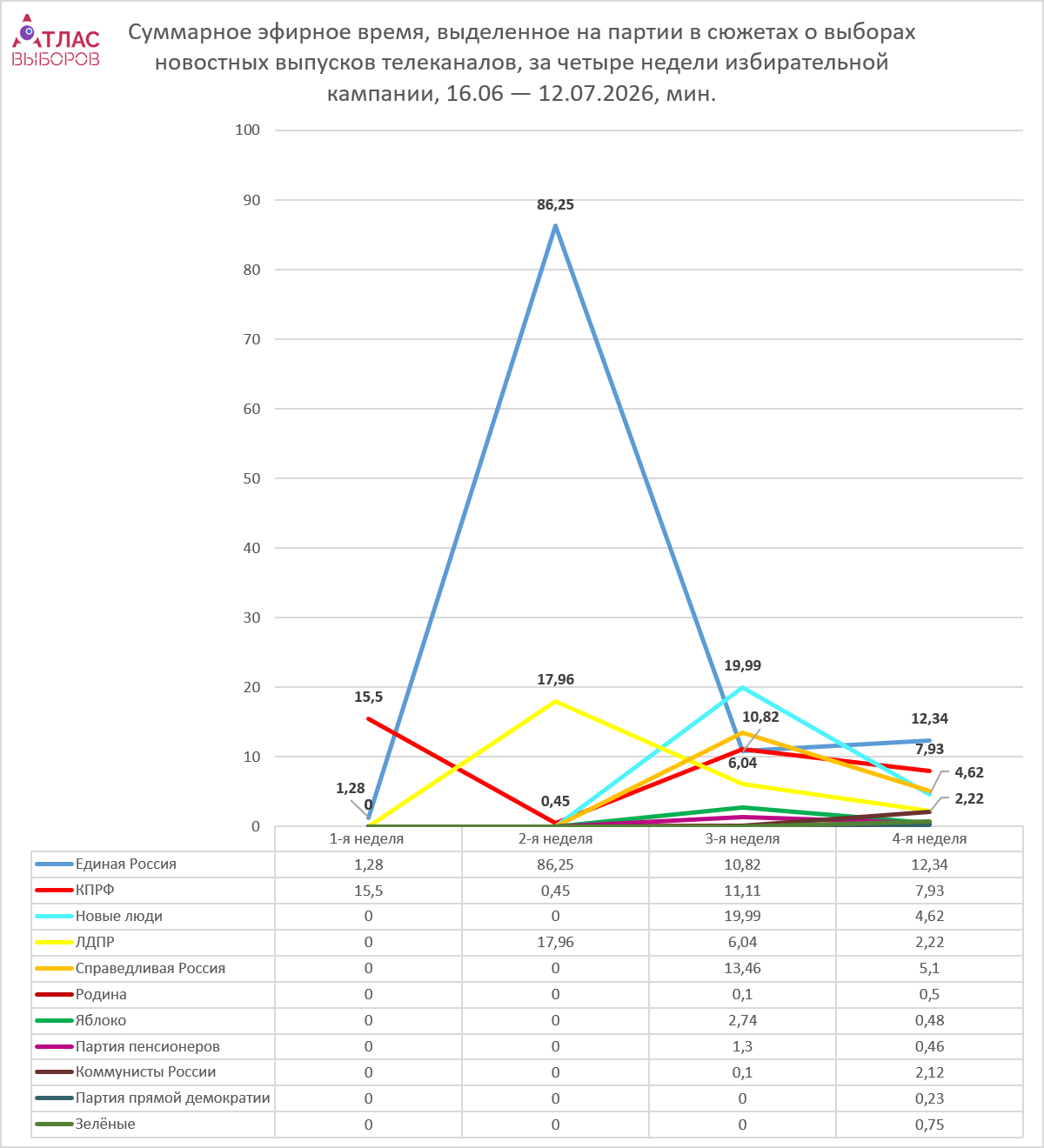
United Russia regained the lead in terms of the amount of airtime devoted to it, but even the “party of power’s” volume turned out to be very modest. As a result, even its mentions proved to be devoid of substance — for none of the parties did a mention exceed even 40 seconds.
Tone of mentions
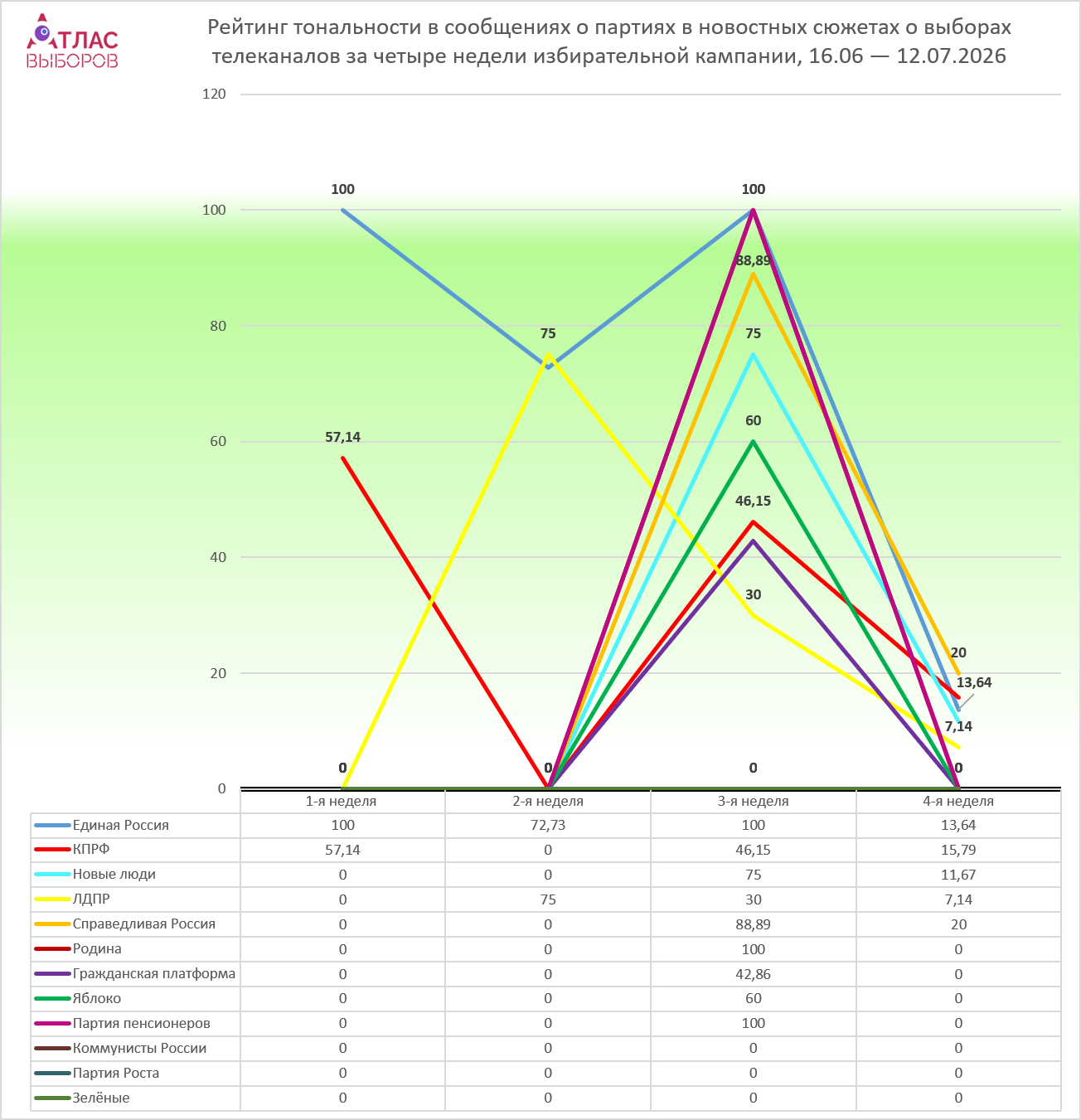
As earlier in this election campaign, the activities of the parties that received mentions on federal television were covered almost exclusively in a neutral tone.
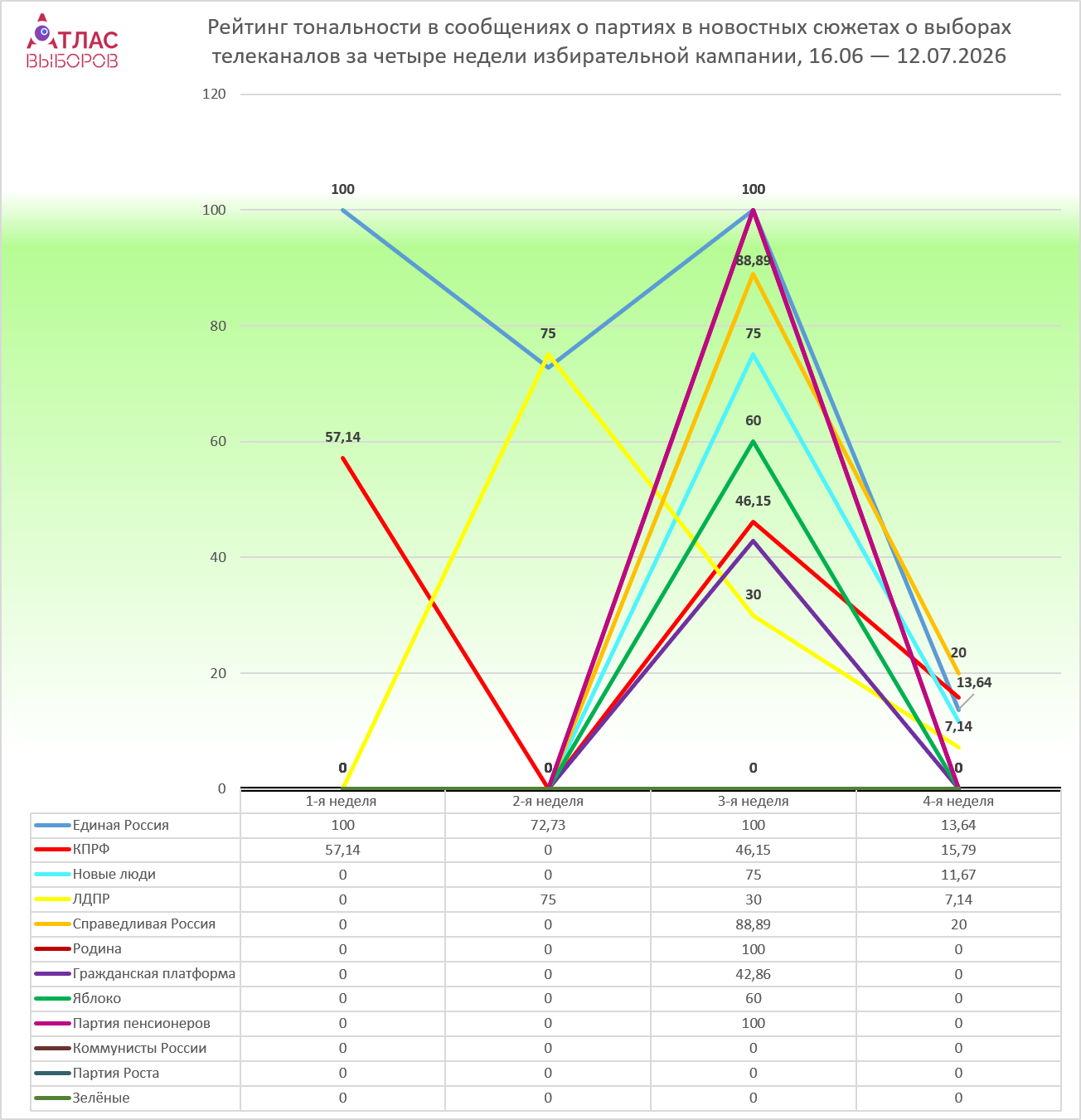
As a result, we see that since the start of the campaign, not a single party has yet encountered negative commentary from the television channels, and the fourth week turned out to be the most “neutral” in tone.
News hooks of the week by party
United Russia
The main news hook was the Central Election Commission’s certification of the party’s federal candidate list. Federal television channels reported on the composition of the list, emphasising that it included representatives of socially significant professions, Heroes of Russia and 76 “participants in the special military operation”. NTV provided direct speech from the head of the party’s Central Executive Committee, Alexander Sidyakin, who stated that the party’s goal in the upcoming elections is to obtain a parliamentary majority. On the Russia 1 channel, the party was again characterised as the country’s largest political force.
In addition to the election campaign, United Russia was mentioned in reports on a meeting of the presidium of the Duma faction devoted to a bill on the development of artificial intelligence. The reports emphasised the need for state regulation of artificial intelligence technologies and the compliance of domestic developments with Russian legislation and traditional spiritual and moral values.
CPRF
The main news hook was the certification of the federal candidate list by the Central Election Commission. On Russia 1, a discussion of food security issues was covered, where the CPRF leader presented the party programme, and one of the reports covered the sending of humanitarian aid by the Communists to participants in the special military operation. In addition, the television channels covered Gennady Zyuganov’s working trips to Tatarstan and Chuvashia.
LDPR
The LDPR was also mentioned mainly in connection with the certification of its candidate list. Additionally, the Russia 1 channel covered the party’s social initiatives: a bill on providing social housing to families with disabled children and exempting them from capital repair contributions. It also reported on a working trip by party chairman Leonid Slutsky to Norilsk, during which measures to support residents of the Arctic zone and other social initiatives were discussed.
A Just Russia
The main news hook was also the submission of documents to the Russian CEC. The reports noted that the candidates included participants in the special military operation and authors of social initiatives. Additionally, federal television channels covered Sergei Mironov’s working trip to Vladivostok, where the party leader met with medical workers. On NTV, a statement by Alexander Babakov was aired about the party’s readiness to achieve its best result in the entire history of its participation in elections.
New People
The party also submitted documents to the Russian CEC, and the television channels covered this event. It was reported that the party had nominated around 380 candidates, including participants in the special military operation and representatives of various professional communities. The reports included statements by party chairman Alexei Nechayev about the need for professionally accomplished people and representatives of the new generation to enter politics. On NTV, there was a separate report on the party’s educational projects and the candidates’ work with young people.
Yabloko
All reports mentioning the party were brief; they reported on the certification of lists at the Russian CEC. The television channels did not mention the errors previously found by the CEC in Yabloko’s candidate lists and merely reported that the party had successfully submitted its documents.
Rodina, the Party of Pensioners, Communists of Russia, The Greens and the Party of Direct Democracy
Reports mentioning the remaining parties were limited to information about the submission of documents, the number of candidates and the completion of the relevant stage of the election campaign. The candidate lists and political programmes of these parties were not discussed on federal air.
Methodology
Six federal television channels that are part of the first multiplex and enjoy the greatest popularity with viewers were selected for the media monitoring — Channel One, Russia 1, NTV, TV Tsentr, Channel Five, OTR.
On each of the six channels, news bulletins available in video archives were analysed. For the fourth week of the election campaign, from 6 July to 12 July 2026, 216 news bulletins were studied (Channel One — 38 bulletins, Russia 1 — 32 bulletins, NTV — 32 bulletins, TV Tsentr — 28 bulletins, OTR — 61 bulletins, Channel Five — 25 bulletins).
We analysed each news bulletin for the presence of reports about political parties. If there were reports about parties, we were interested in the following indicators:
the number of mentions of the party;
the time allocated to the party;
the tone of the information (positive, neutral, negative);
the presence of direct speech from party representatives;
the presence in the report of voters’ opinions about the parties;
characteristics of the parties voiced by the presenter or voiceover.