The Elections Atlas project has launched a weekly social-media monitoring programme for the State Duma deputy election period. We will track how active election participants are in the online space.
Social-media monitoring results are published weekly.
During the week of 30 June to 6 July, 162,223 posts were studied. This week saw pre-election congresses of five political parties: Communists of Russia (30 June), New People (1 July), the Party of Direct Democracy (3 July), A Just Russia (4 July), and the Greens (5 July).
Main findings
Despite the fact that the third week of the election campaign featured congresses of five political parties (almost half of all election participants), the campaigning itself is frankly stagnating. After the active growth in the second week, driven by administrative coverage of the United Russia congress, the following seven days brought a sharp decline across all key metrics. The drop was especially noticeable in engagement — i.e. user reactions (–53.5%) — and views (–40.7%).
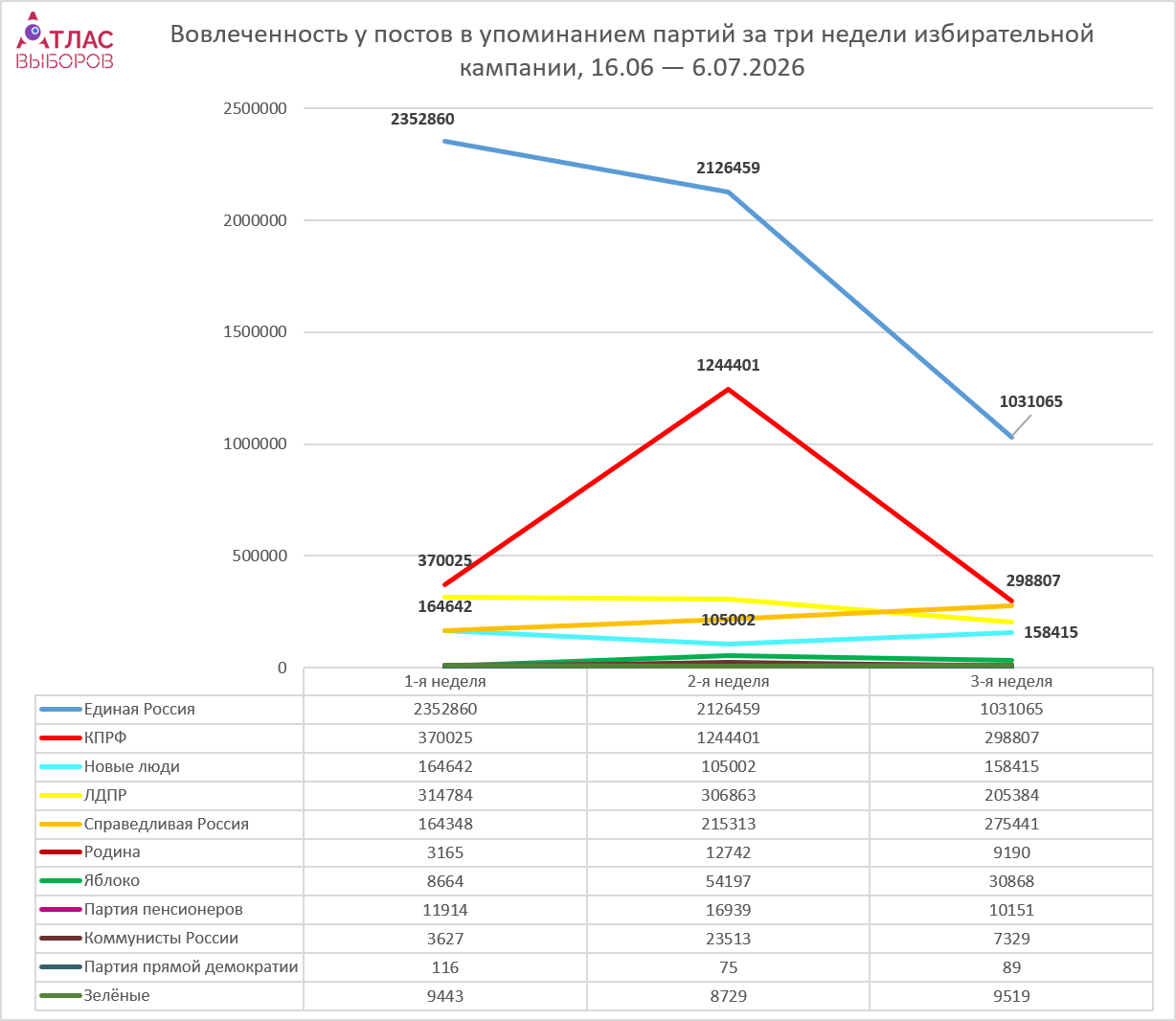
The leader in decline across all indicators was United Russia: mentions, audience volume and engagement all fell by half. Despite this, United Russia remains the clear leader in the main indicators and dominates the social-media space. Only in the number of mentions does the party trail A Just Russia, with its enormous network of small public pages. Moreover, in the case of A Just Russia, the growth in posts mentioning the party is not accompanied by a commensurate growth in reactions — the quality of the content not only remains low but is even declining.
The CPRF and the LDPR are also seeing declining indicators. For the CPRF, engagement fell by 76% (from 1.24 million to 298,800), while the number of posts also shrank by 18% (from 9,560 to 7,820). For the LDPR, the number of user reactions dropped by a third and the number of views by a quarter, with a virtually unchanged number of posts.
Among the parliamentary parties, only New People managed to improve its indicators noticeably: engagement grew by 50.8% (from 105,000 to 158,400) while posts rose by 19.7% (from 2,970 to 3,550). The party succeeded in improving the effectiveness of its content, helped both by the viral “Manifesto of the Women of Russia” in the second week of the election campaign and by the congress that took place, as well as by party representatives’ speeches on legislative initiatives.
Among the smaller parties, Yabloko looks slightly better than the rest — it is two to three times ahead of its pursuers among the “second-tier” parties across all indicators, but at the same time it trails the “parliamentary five” by an even wider margin. The least visible party on the internet, paradoxically, is the Party of Direct Democracy, which simply does no work and has near-zero indicators.
General trend in mentions of political parties
Despite the fact that the third week of the campaign saw the largest number of party pre-election congresses, the number of party mentions in social-media posts declined: in the second week the total number of posts was 230,800, after which it fell sharply in the third week to 162,200 (–29.7%). However, each party experienced this decline in its own way.
The main decline occurred for United Russia, which held its congress precisely in the second week. The party remains the leader in the volume of content generated: however, after 110,500 posts mentioning the party in the second week of the campaign, in the following seven days its activity fell to 52,600 posts (–52.4%, more than halved). Even with such a decline, United Russia accounts for a third of the total number of mentions (52,600 out of 162,200).
A Just Russia appears to have reached a plateau on this indicator: after 67,800 posts in the first week and 93,600 in the second, in the third week the party registered 84,600 posts. This is a 9.7% decline relative to the peak, even despite the party congress that took place. The reason may be that the congress fell on the weekend, and almost all mentions of A Just Russia on social media are linked to the work of the party’s network of public pages — the party apparatus staff were resting, even despite such an important event.
The LDPR, after a sharp drop in the second week (from 18,500 to 10,100), stabilised at the level of 10,300 posts, showing slight growth (+1.9%). The party has evidently settled into a planned work rhythm after its congress, without making any sharp leaps.
The CPRF shows a gradual decline from 10,200 to 9,600 and then to 7,800 (–18% in the third week). This correlates with a general waning of interest in their resonant statements, which did not produce a long-term effect.
New People is one of the few parties that increased the number of posts in the third week (+19.7% compared to the second, from 2,970 to 3,550). This is linked to the party congress that took place, as well as the launch of the viral “Manifesto of the Women of Russia” and the active promotion of other initiatives, which required additional publication activity.
Against this backdrop, the smaller parties are practically invisible.
Views
As the number of party mentions on social media and messengers decreased, the number of views of those posts fell accordingly. The second week created a kind of information peak thanks to the coverage of the United Russia congress in administrative public pages.
The low level of audience attention at the height of summer is to be expected. At the same time, there are publications that attracted a large audience.
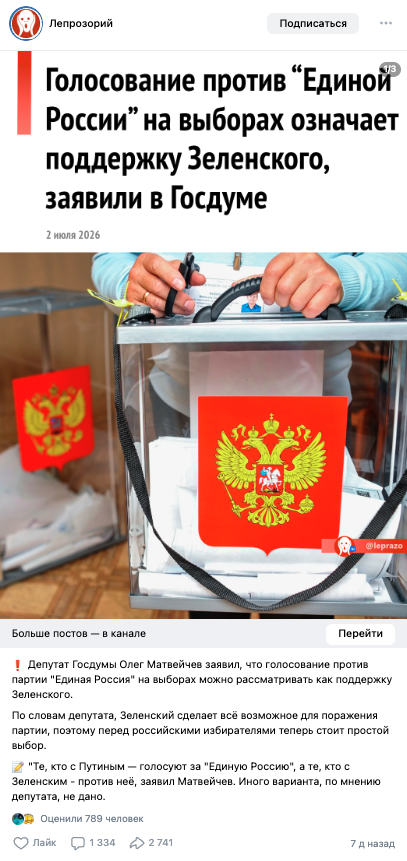
Thus, the absolute leader among topics discussed on social media was a statement by State Duma deputy Oleg Matveychev of United Russia. Of the top-10 posts of the week by views and engagement, four posts quote his words that voting for any party other than United Russia is a vote for Ukraine and Zelensky (and this is despite the fact that all parliamentary parties publicly support the special military operation, take part in humanitarian aid collections, and also nominate participants in military operations as candidates). It is noteworthy that this news generated explosive reach not only in public pages not directly connected to politics, but was also disseminated in some public pages of the “Overheard” network — these public pages are under pre-moderation and are clearly involved in the centralised dissemination of United Russia campaigning.
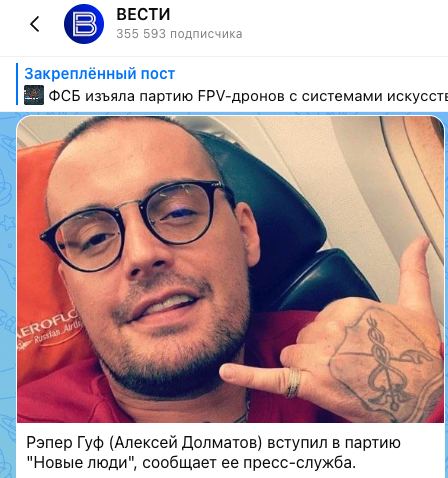
Parties tried to create news hooks in order to get into the agenda. For example, New People presented a party card to rapper Alexei Dolmatov (Guf) — an attempt to attract young audiences’ interest to political topics.
Engagement
Engagement indicators are falling along with the rest — this points to a natural fading of interest in the elections after the peak associated with the pre-election congresses of United Russia and the CPRF. Despite this, resonant events did still occur.
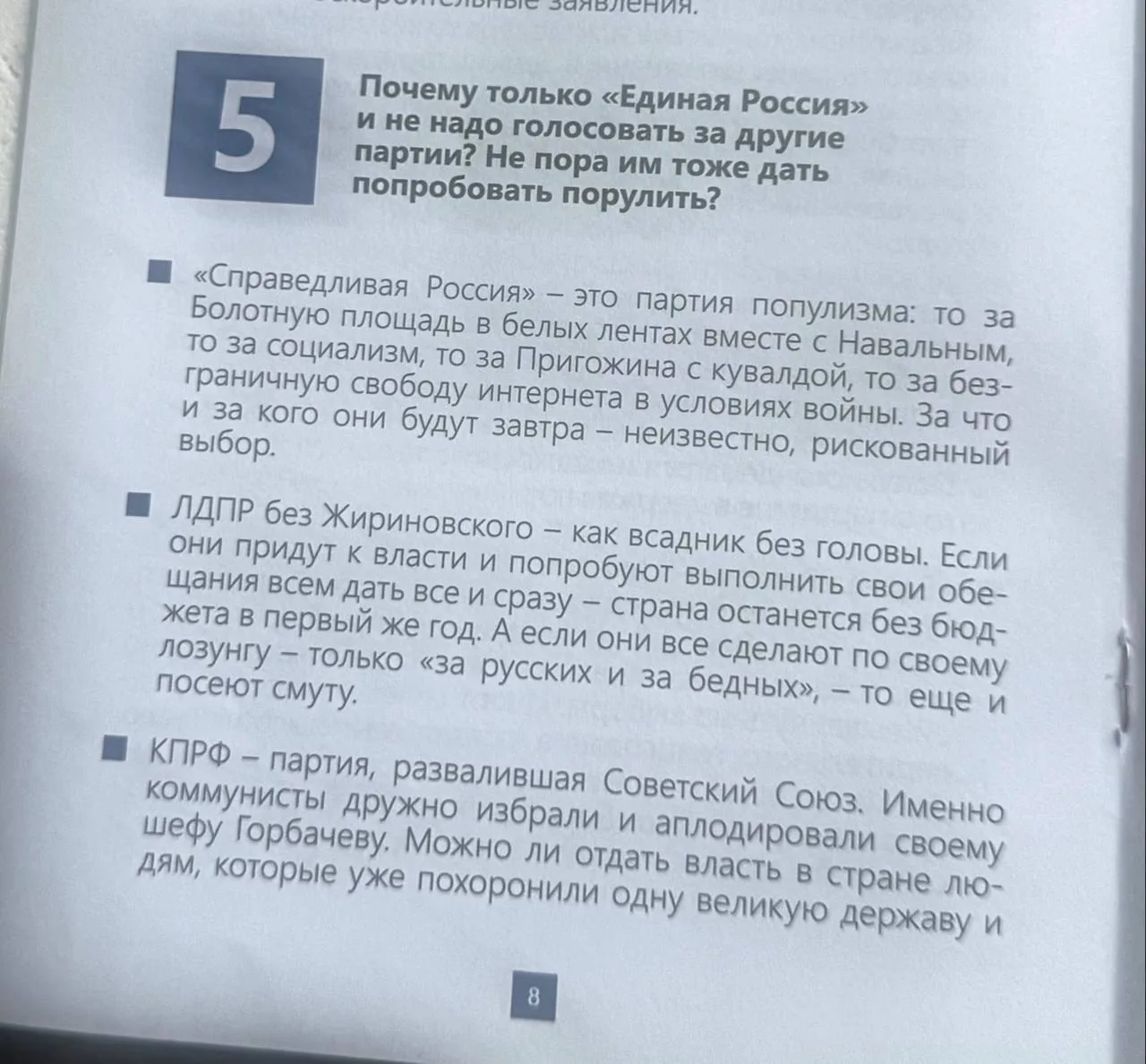
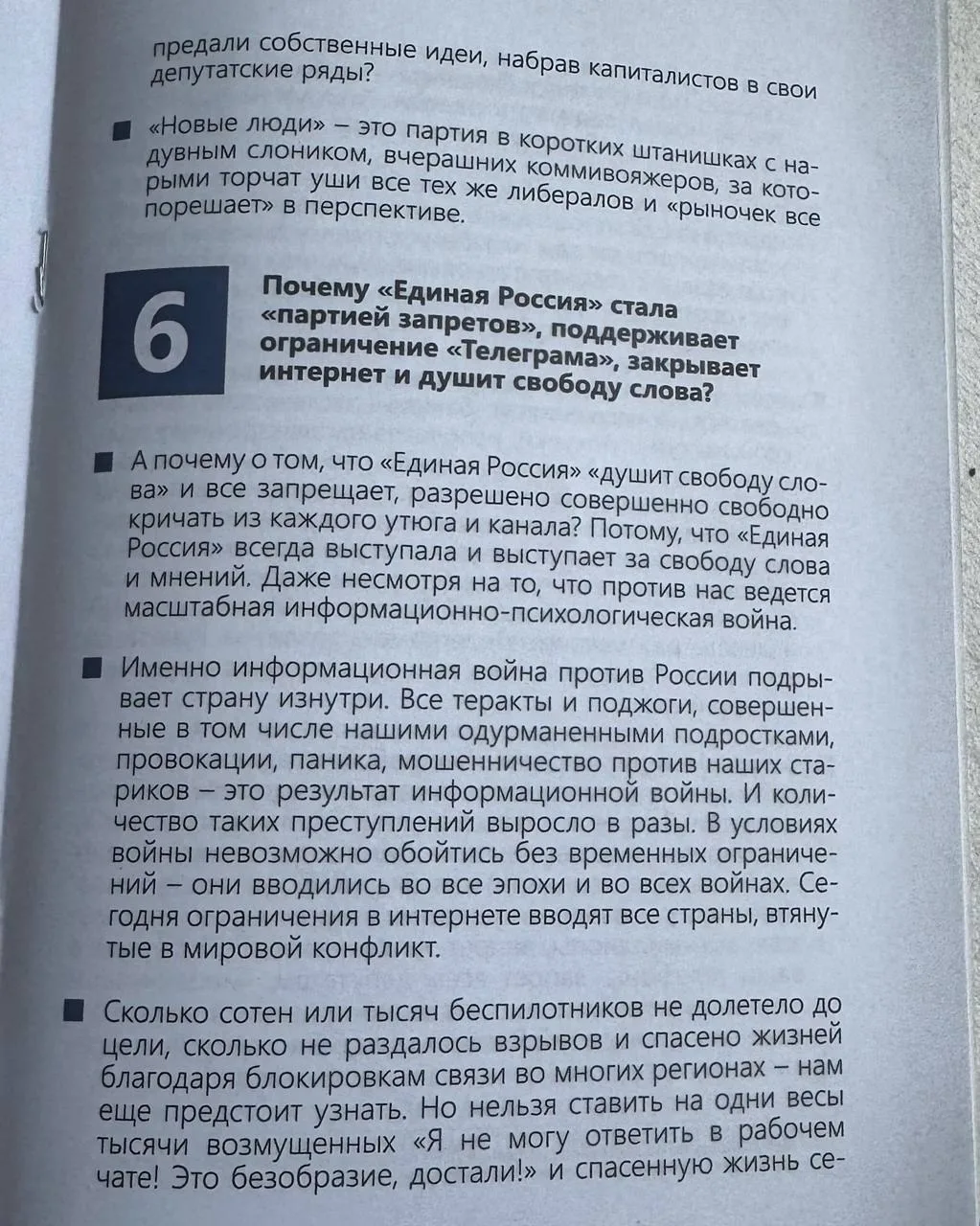
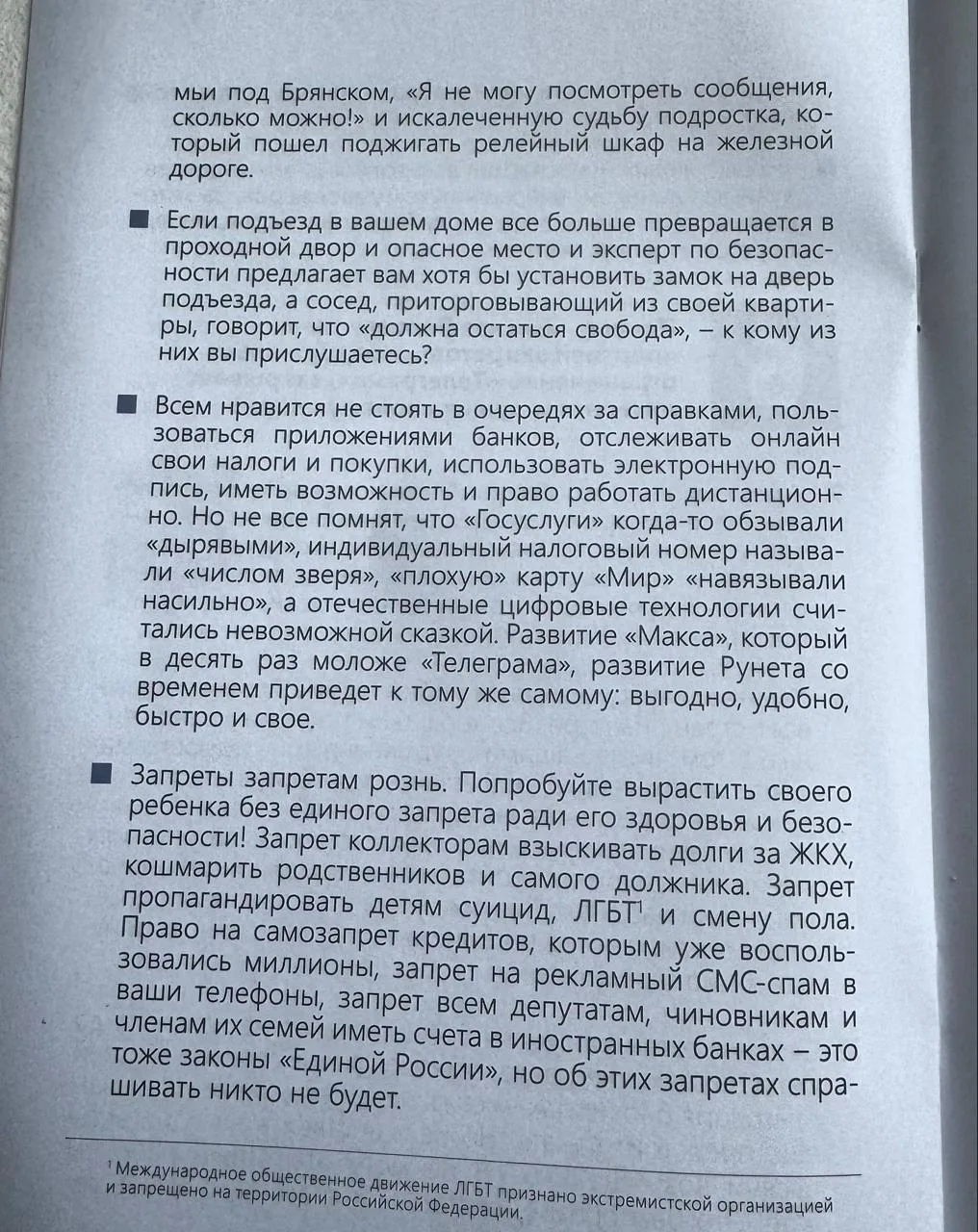
One such reason for discussion and reactions from social-media users was a United Russia manual on answering “tough” questions. Despite the fact that news of such an artefact first appeared in the information space back in May, after the pre-election congress it got a second wind — the news about the manual’s contents spread across major public pages and ended up in the top posts by views and engagement.
The manual brings together the sharpest questions put to the party and demonstrates the general logic of the answers. For example, the answer to the question of why United Russia initiates and supports internet blocks and bans contains a narrative comparing Russian citizens to children who need to be brought up (“try bringing up your child without a single ban”). Another example is the answer to the question of why other parties are not worthy of power: the LDPR without Zhirinovsky is a headless horseman; the CPRF destroyed the USSR “while applauding boss Gorbachev”; New People is a party in short trousers with an inflatable elephant; A Just Russia is a party of populists that nobody knows whom and when it will support (“one moment with Navalny, the next for Prigozhin with a sledgehammer”).
This is perhaps one of the first striking episodes where United Russia allows open criticism of the systemic opposition parties, directly naming them in its materials.
Dynamics of use of each social network
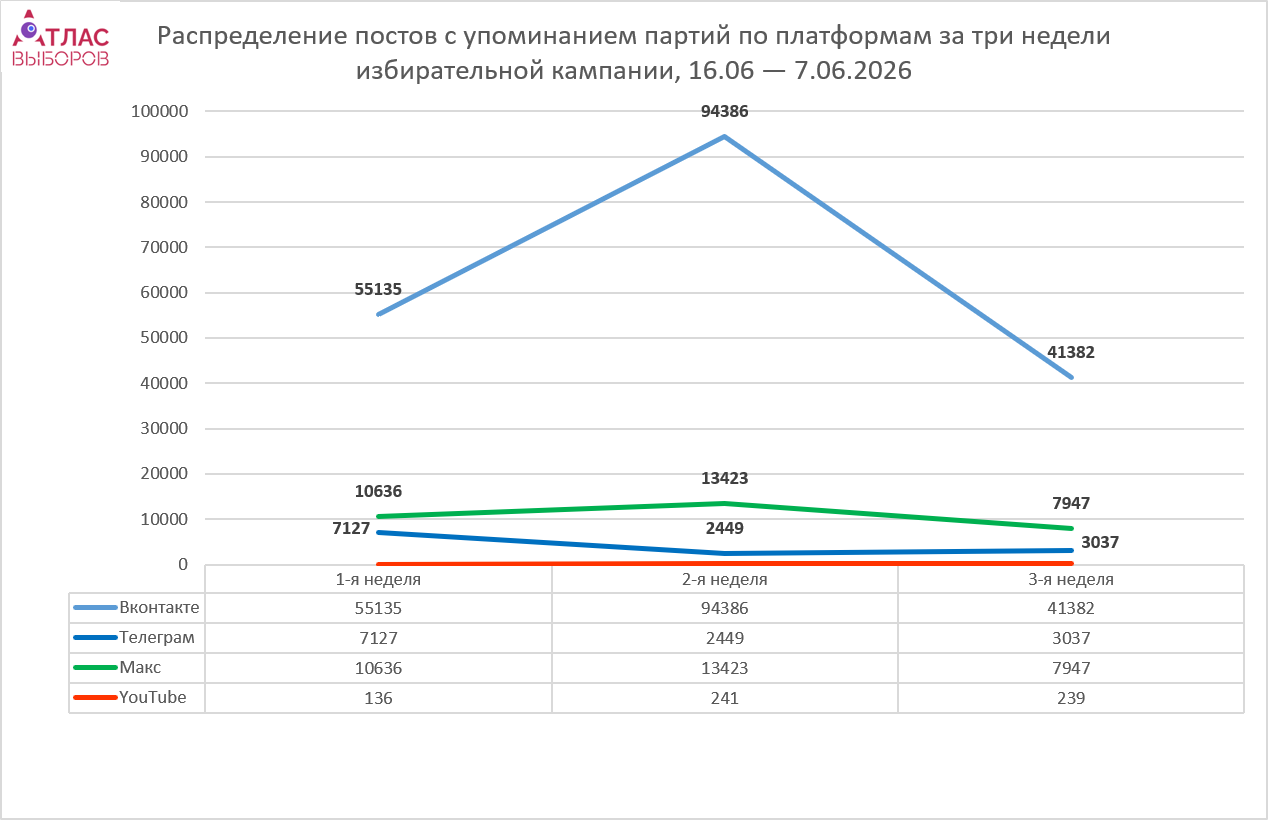
VKontakte’s share of the total volume of content continues to remain stable — slightly less than 90% of the volume of all mentions across the four social networks and messengers.
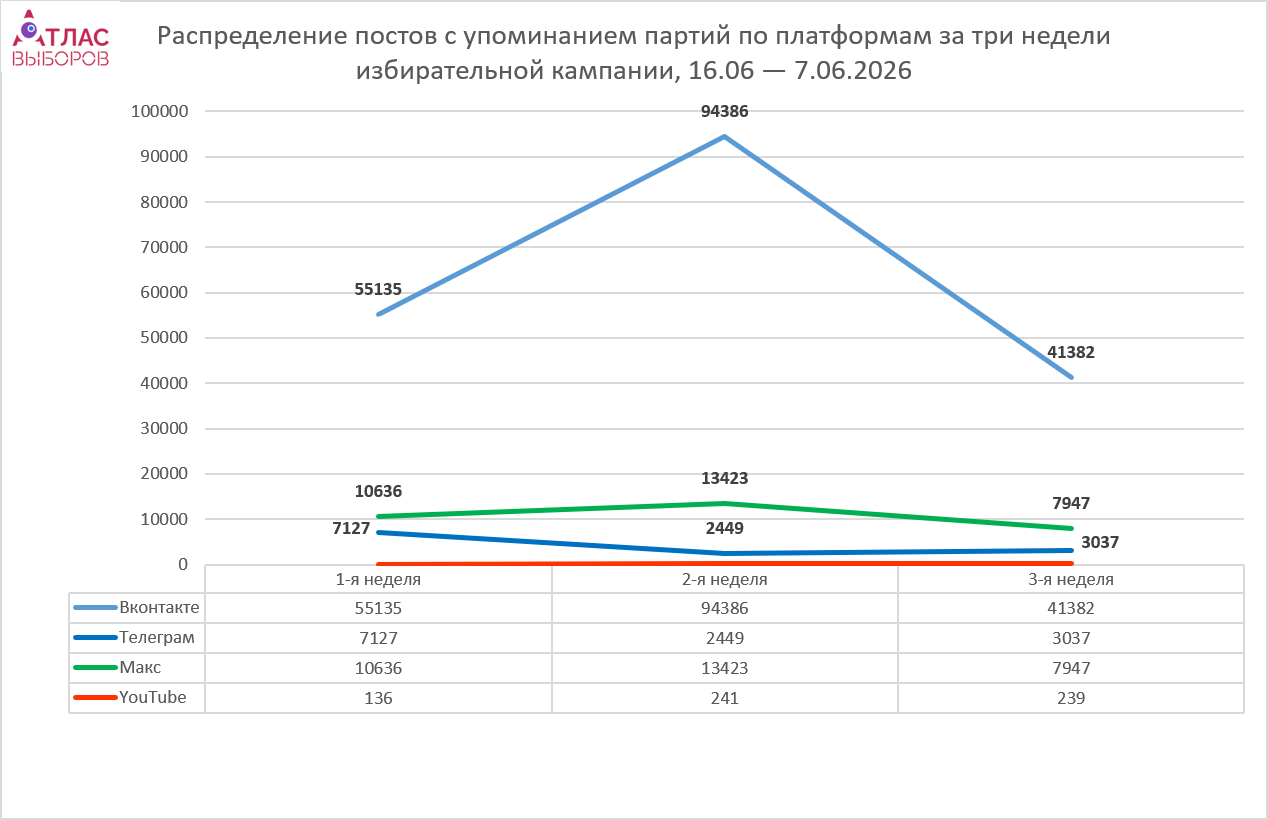
MAX and Telegram hold their positions, while YouTube remains a platform with a small share of use but with individual publications that garner a large number of views.
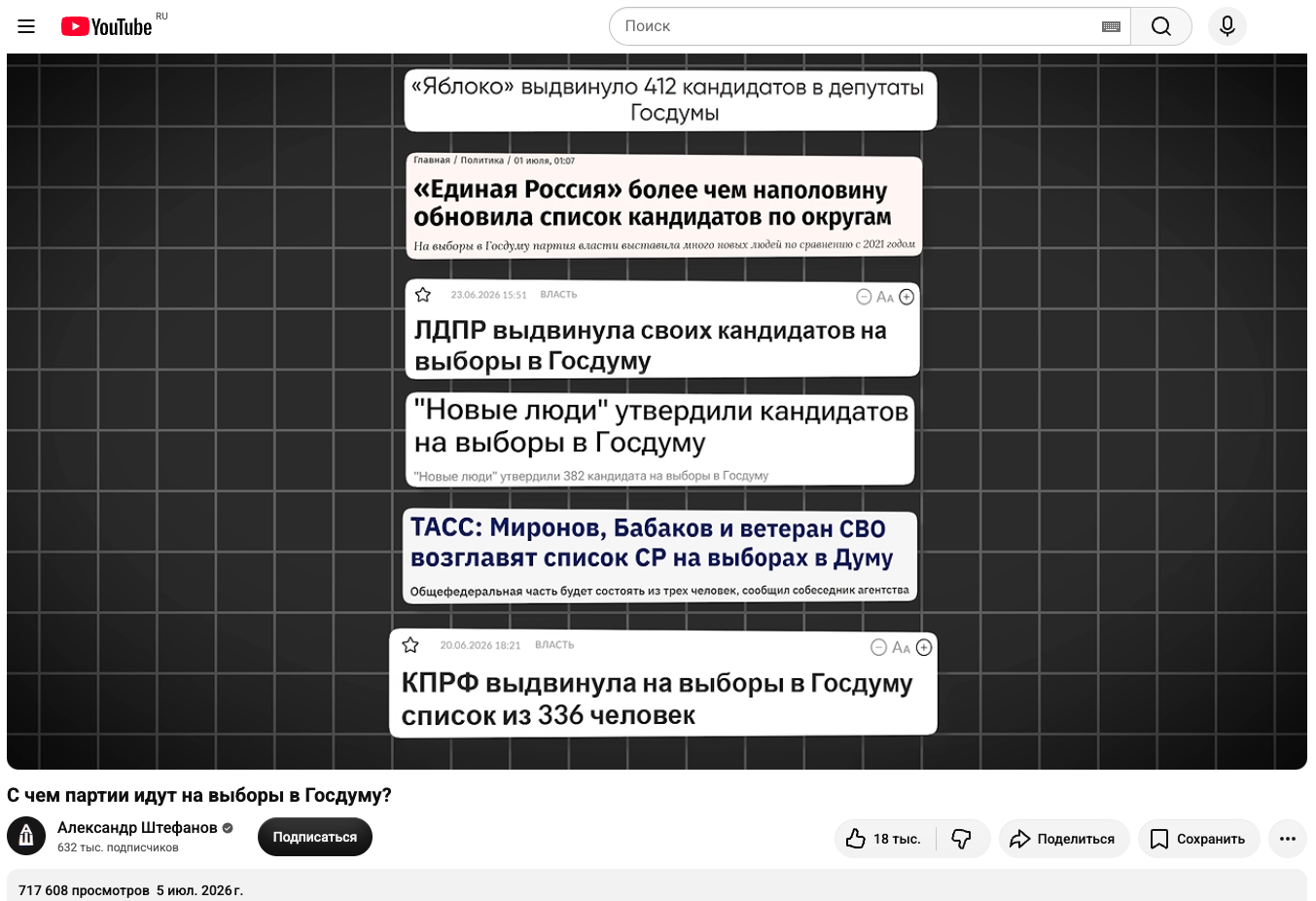
Thus, it was on YouTube that the week’s most popular publication appeared — an hour-long video by Alexander Shtefanov, who is recognised as a “foreign agent”, titled “What are the parties running on in the State Duma elections?”. The video appeared in the parsing output for all the parties mentioned in it. In five days, despite problems with access to YouTube in Russia, the video gathered more than 700,000 views, 19,000 likes and more than 3,000 comments. One should therefore not underestimate the influence of blocked social networks with a formally small number of posts on real political discussion inside the country.
Party initiatives
Traditionally, during the active pre-election period, parties increasingly begin to talk in the public domain about useful initiatives from their side. This affects citability and ensures a regular presence on the agenda. These initiatives also make it possible to understand which social groups the political parties are betting on.
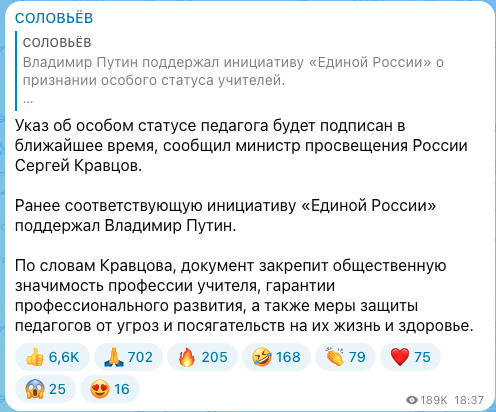
For example, during the United Russia congress, President Vladimir Putin supported the party’s initiative on recognising the special status of teachers, and a week after the congress the Minister of Education reported on a decree being prepared. Teachers and doctors represent a fairly substantial share of the party’s electorate. The initiative and its immediate implementation were widely covered by major public pages.
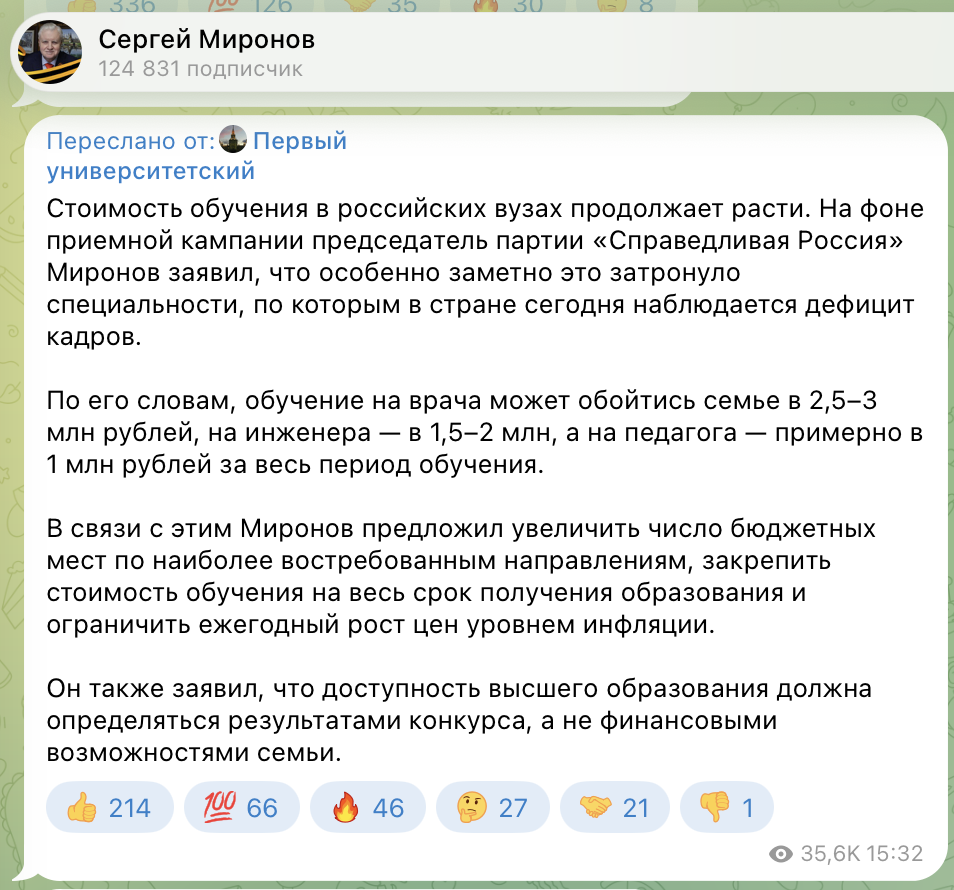
The topic of education also featured in the initiatives of A Just Russia: party leader Sergei Mironov proposed increasing the number of state-funded places in sought-after professions, since paid tuition at universities rises annually by the rate of inflation and is becoming less accessible. It is noteworthy that the news was published not on the politician’s personal channel but in one of the major education-focused public pages on Telegram, “First University”.
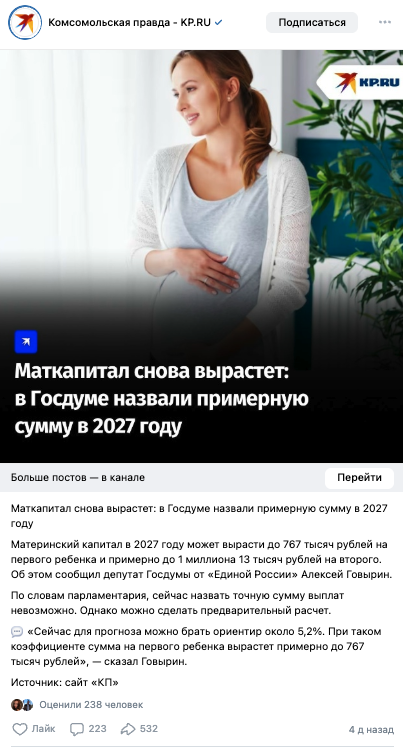
Continuing the theme of initiatives, another piece of news that also made the top-10 by user response is the possible increase of maternity capital in 2027.
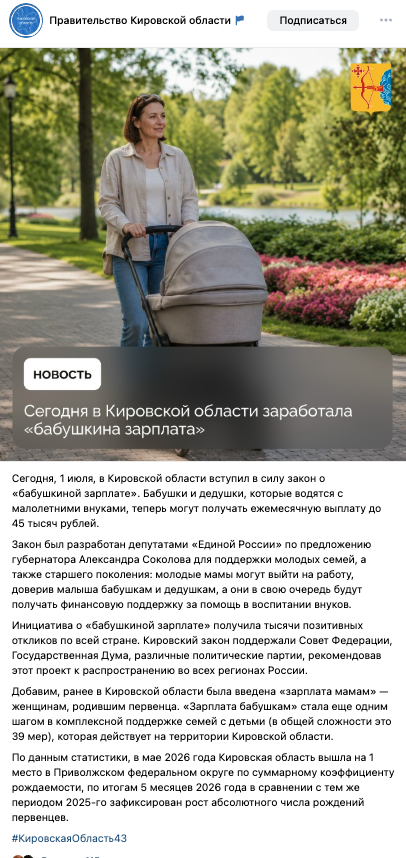
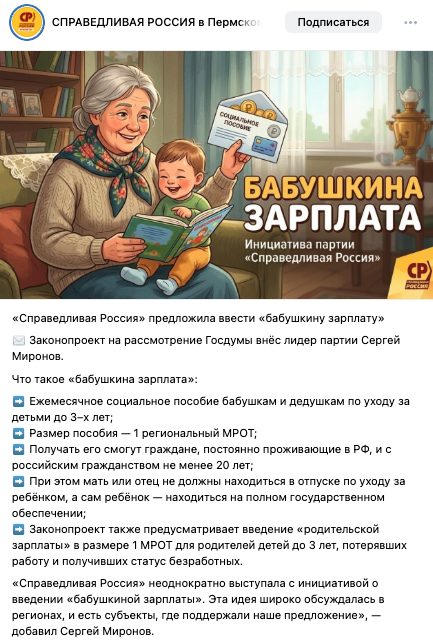
There are also initiatives that, on the one hand, already exist and, on the other, are simultaneously being pushed by two parties at once. This concerns the so-called “grandmother’s salary” — a payment to grandmothers and grandfathers who look after young grandchildren. It is noted that in Kirov Oblast such an initiative came into force thanks to the initiative of a United Russia deputy. A Just Russia introduced a bill of similar content in the State Duma and tried to publicise it.
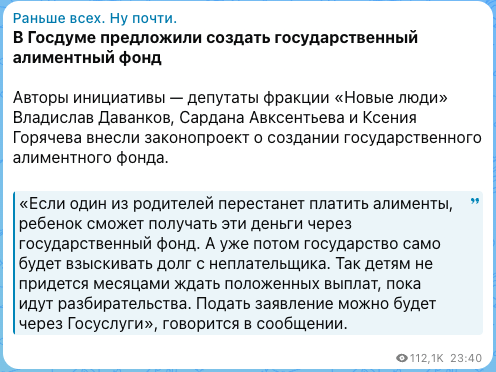
In relation to family well-being, another initiative was voiced, this time from New People, on creating a so-called “alimony fund”. A discussion unfolded in the comments about at whose expense the payments would be made.
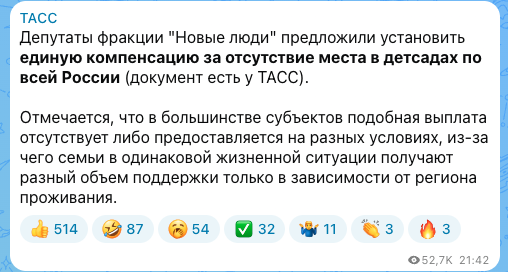
Such initiatives can be interpreted very ambiguously by voters, and there is a high probability of the event’s coverage acquiring a negative tone. The party is probably betting on support among middle-aged women, all the more so since another initiative that was actively covered is also linked to social problems — New People proposed paying families compensation for the lack of a place in kindergarten. At the same time, the news text indicates that such a measure is already in effect in most regions of Russia, with its own specifics in each.
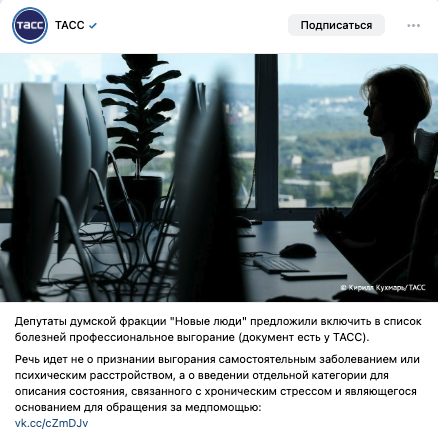
Another initiative of this party contains a proposal to include “burnout” in the list of illnesses. In this case, New People are unequivocally targeting the young and middle-aged electorate of large cities.
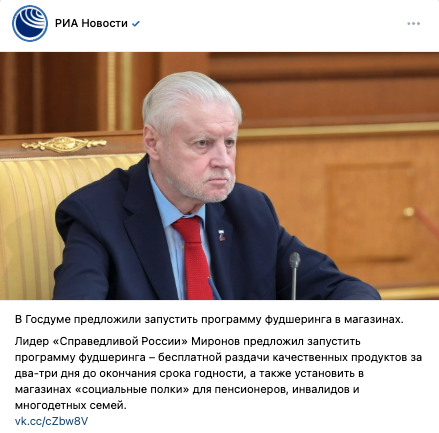
Alongside traditional and familiar social initiatives, there were also some rather idiosyncratic ones. For example, A Just Russia leader Sergei Mironov proposed a “food-sharing” programme in grocery stores, which consists of the free distribution of quality products nearing their expiry date to pensioners, disabled people and large families.
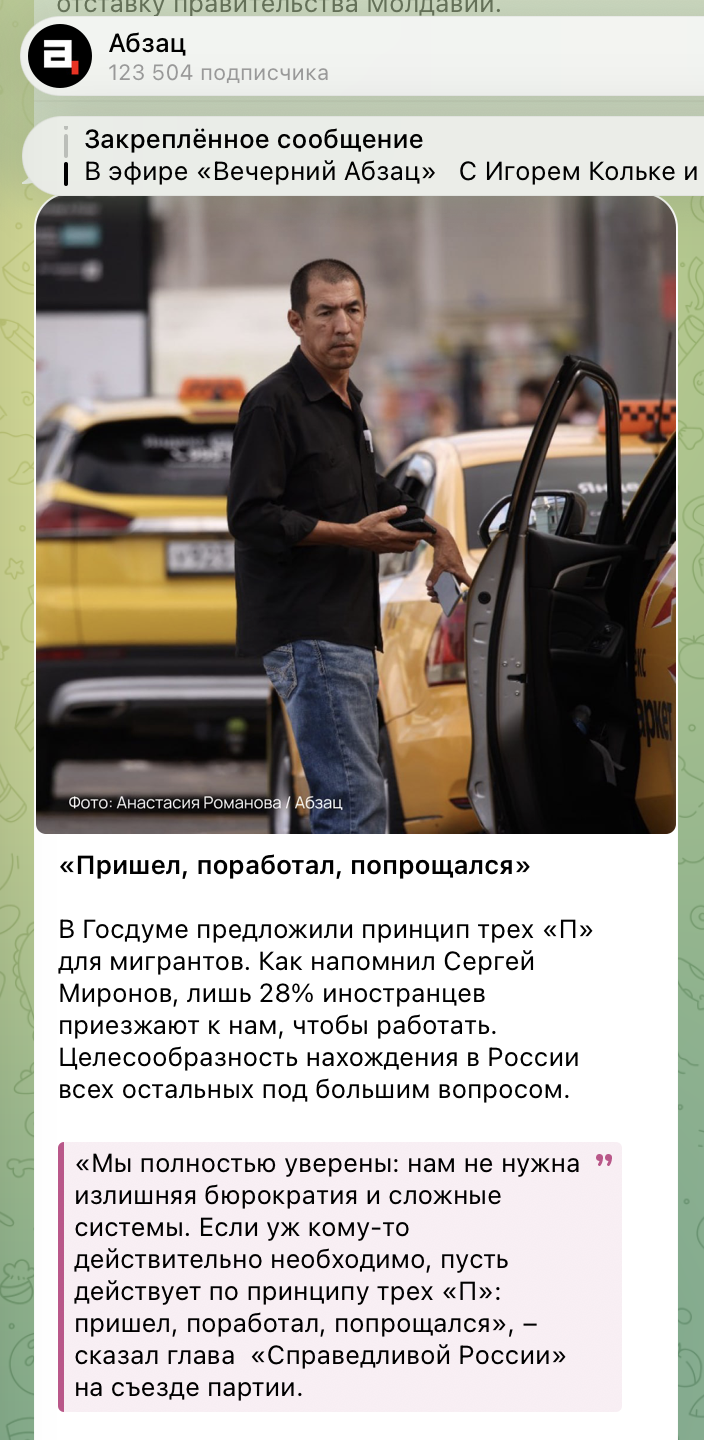
A Just Russia is also trying to interest nationalist-minded voters. Thus, Sergei Mironov proposed introducing for immigrants the “Rule of the Three Ps: came, worked, parted ways”, so that migrants do not stay living in Russia and do not bring their families into the country. This is not the politician’s only statement regarding immigrants: during the past week an initiative was voiced on restricting the sale of weapons to them.
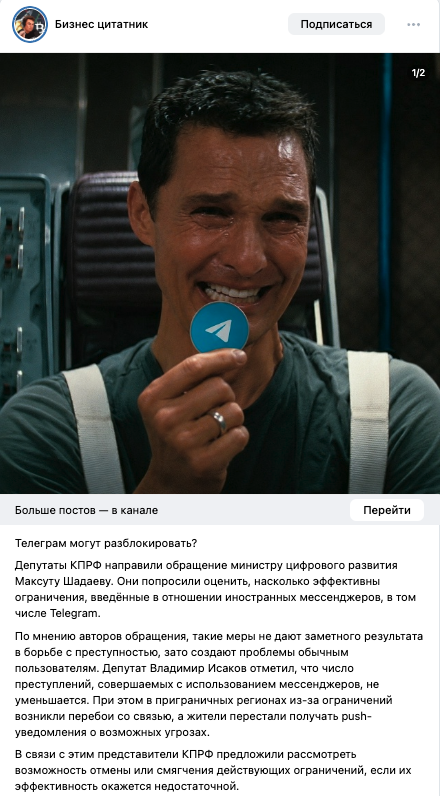
One topical initiative that received slightly above-average resonance is the CPRF’s proposal on unblocking Telegram. Despite the fact that access to the messenger is currently difficult and requires the use of additional services, political activity there remains at a high level (we see this on the basis of quantitative data in the dynamics).
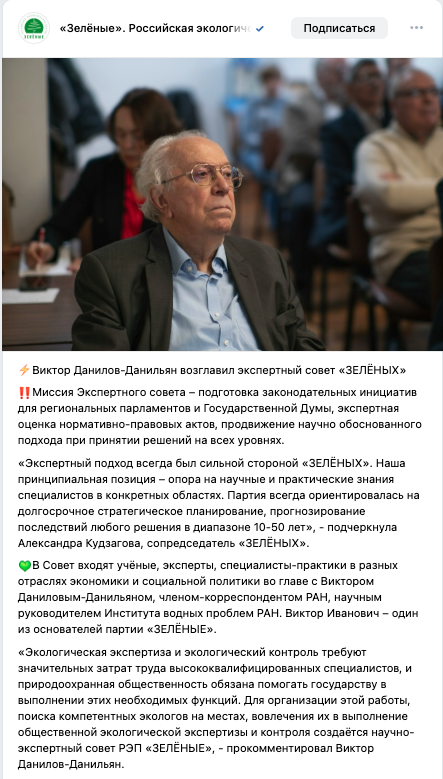
The Greens party is also striving to occupy its niche in the public field on the eve of the elections and announced the creation of an expert council that will, among other things, work on preparing legislative initiatives. Exactly which ones was not stated.
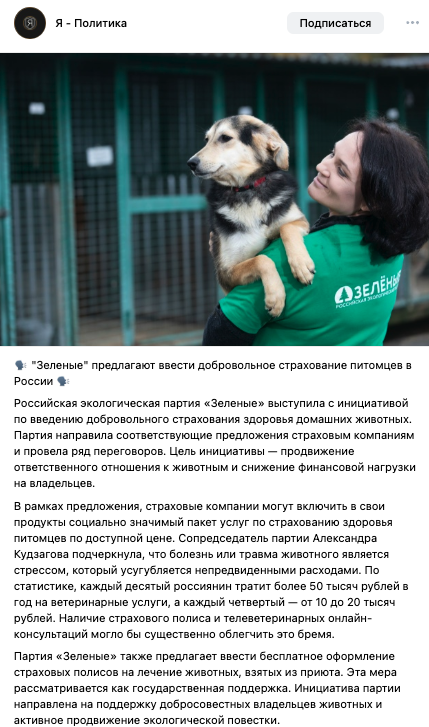
The Greens are also not staying on the sidelines of the general trend of proposing various initiatives for citizens — they proposed voluntary medical insurance for pets.
It is noteworthy that in their proposals the parties are largely placing the emphasis not so much on the substantive component of their initiatives as on provoking an emotion in the voter and staying in the public ear.
Methodology
To conduct the social-media monitoring, four platforms currently used by Russians were selected: VKontakte, MAX, Telegram, YouTube. Unfortunately, we have not yet been able to set up effective monitoring of Odnoklassniki and Instagram, which could significantly affect the overall data. If this can be done in the coming weeks, the data will be added.
The analysis used mentions of the 11 parties that have the right to nominate lists and candidates without collecting voter signatures: United Russia, the CPRF, the LDPR, A Just Russia, New People, Yabloko, Communists of Russia, the Party of Direct Democracy, Rodina, the Party of Pensioners, and the Greens. If other parties stand in the elections, they will be added to the monitoring.
We analysed posts on each platform, and we were interested in the following indicators:
number of mentions;
time devoted to the party;
tone of the information (positive, neutral, negative);
presence of direct speech by party representatives;
presence in the story of voters’ opinions about the parties;
characteristics of the parties voiced by the presenter or voice-over.