The Elections Atlas project has launched a weekly monitoring programme of federal television channels during the State Duma deputy election period. We will track how equitably the activities of election participants are covered on state-controlled federal television channels.
Television remains one of the main sources of information for many Russians. At the same time, society places a special role on the media — they are responsible for creating conditions for citizens to conduct public political discussion. Both the Russian Constitution and many international covenants require the media to take ethical and balanced positions and to cover the election process in a fair, balanced and impartial manner. Media representatives must not engage in campaigning.
The results of the media monitoring will be published weekly.
Main findings for the third week of the campaign
-
Based on the results of the first three weeks of the election campaign, during which the pre-election congresses of all 11 political parties entitled to nominate candidates without collecting voter signatures took place, it became obvious that television channels are not yet capable of observing the principle of equality of rights of candidates and parties when covering their activities. Of the five congresses that took place in the third week of the campaign, only the congresses of New People, A Just Russia and Communists of Russia made it onto the air. The congresses of the Party of Direct Democracy and the Green party were completely absent from the federal television agenda. Overall, since the start of the campaign, federal television channels have completely ignored the pre-election congresses of all six “small” parties, and the ruling party’s congress received a total of 1.3 times less time than the congresses of the other 10 election participants.
-
In the third week of the election campaign (29 June – 5 July 2026), the main news event was the start of registration of federal candidate lists with the Central Election Commission. Thanks to this, the range of parties represented on the federal television airwaves expanded noticeably: for the first time since the start of the campaign, the Yabloko, Rodina, Pensioners’ Party and Communists of Russia parties were mentioned, and New People and A Just Russia received significantly more attention.
-
New People became the leader of the third week of the elections in terms of the volume of airtime allocated by federal television channels. They were almost twice ahead of United Russia, the Communist Party (CPRF) and the SRs on this indicator. The remaining parties lagged even further behind. At the same time, United Russia retained the most favourable nature of coverage thanks to regular reports on the party programme and the participation of state leaders in party events. The LDPR, CPRF, New People and A Just Russia also received the opportunity to present their election programmes and candidate lists.
-
Another feature of the week was a noticeable increase in the number of reports devoted to the technical stage of the election campaign. Federal television channels covered the process of submitting documents to the CEC in detail, regularly reported on the sequence of party registration and emphasised the readiness of the electoral system to conduct the elections, including issues of international observation and ensuring the security of voting.
-
Reports about the elections became very brief and lacking in substance: the number of news bulletins with reports on this topic increased, while the airtime devoted to this topic simultaneously decreased. Only United Russia, New People and A Just Russia had an average report duration exceeding one minute. The remaining parties received only brief mentions with an average duration ranging from a few seconds to one minute — this did not allow the television channels to adequately reveal the essence of the activities and programmes of the election participants.
Number and content of news reports
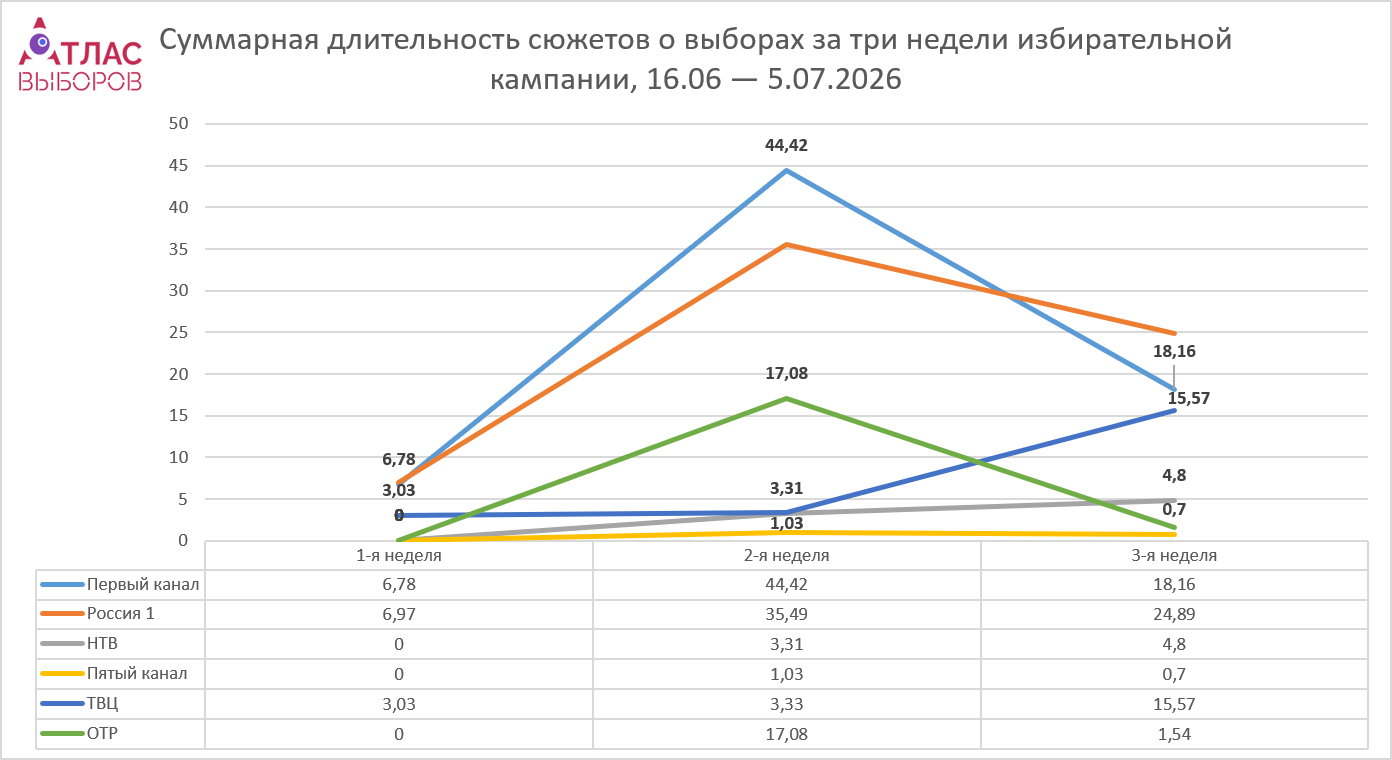
The attention of federal television channels to the elections in the third week of the election campaign was noticeably lower than a week earlier, when the United Russia congress took place. Even the presentation of documents by parties to the Russian CEC could not remedy this situation. In total, the six television channels devoted just over 65 minutes of airtime to this topic — 38% less than in the second week of the campaign, when 105 minutes were devoted to the elections. Only TVC showed a significant increase in attention — from three minutes to 15.6.
At the same time, compared to the previous week, the share of news bulletins containing mentions of the elections grew significantly. For example, on the Rossiya 1 television channel, the elections were mentioned in more than half of all news bulletins: in 56% versus 16% a week earlier. Channel One almost doubled this indicator — from 16% to 28%. The share of bulletins with reports about the elections also grew to almost 28% on the TVC channel, which had previously ignored the election campaign. At the same time, Channel Five and OTR remained practically indifferent to the main political event of the year. 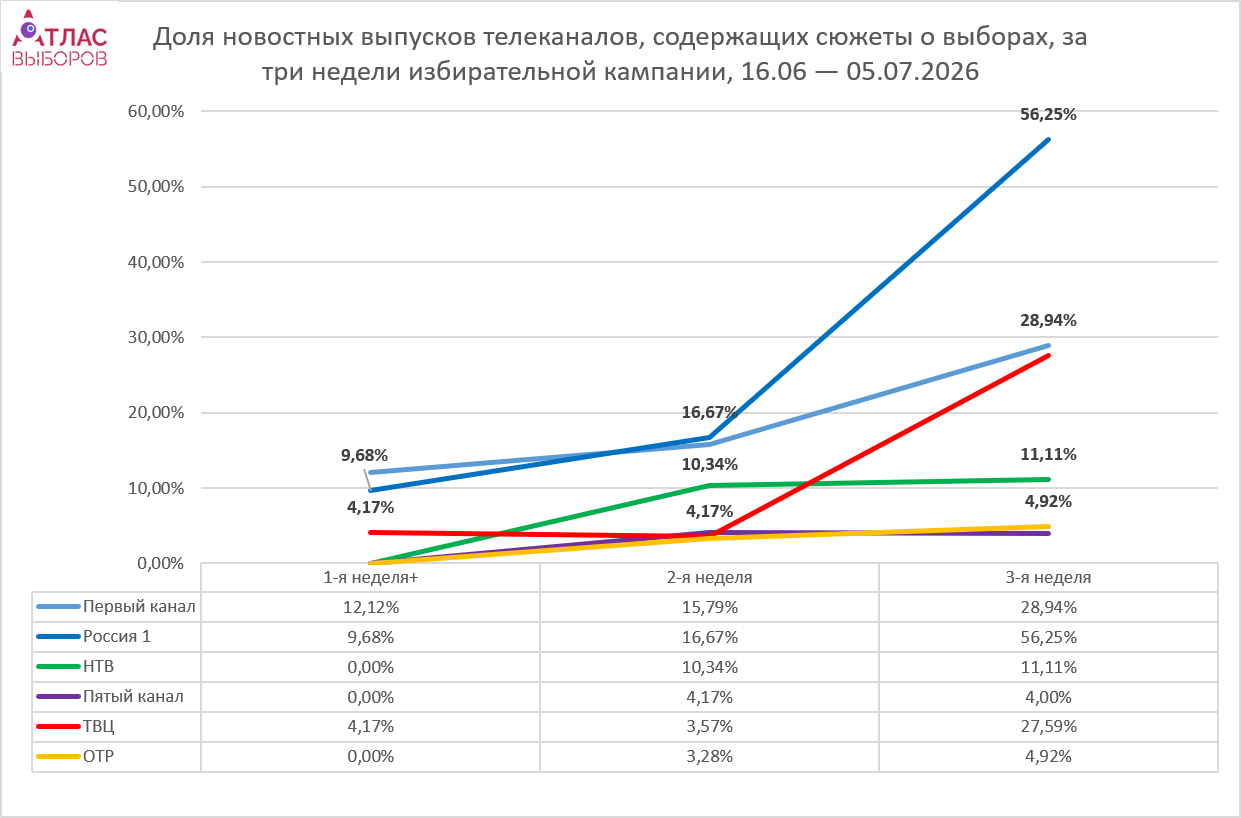
The main news event of the week was the start of the Central Election Commission’s acceptance of documents for the registration of federal candidate lists for the State Duma deputy elections. In this regard, federal television channels regularly reported on the submission of documents by political parties and the progress of preparations for the elections.
Distribution of airtime among parties
Unlike the previous week, when the television agenda was focused mainly around the congresses of United Russia and the LDPR, the main party events of the week were the pre-election congresses of New People and A Just Russia. It was they who became the leaders in terms of the volume of airtime allocated to them — television channels spoke about New People for a total of almost 20 minutes, and about the SRs for 13.5. The parties presented their federal candidate lists and the main provisions of their election programmes. At the same time, federal television channels reported on the submission of documents to the Russian CEC by the LDPR, CPRF, Yabloko and the Pensioners’ Party.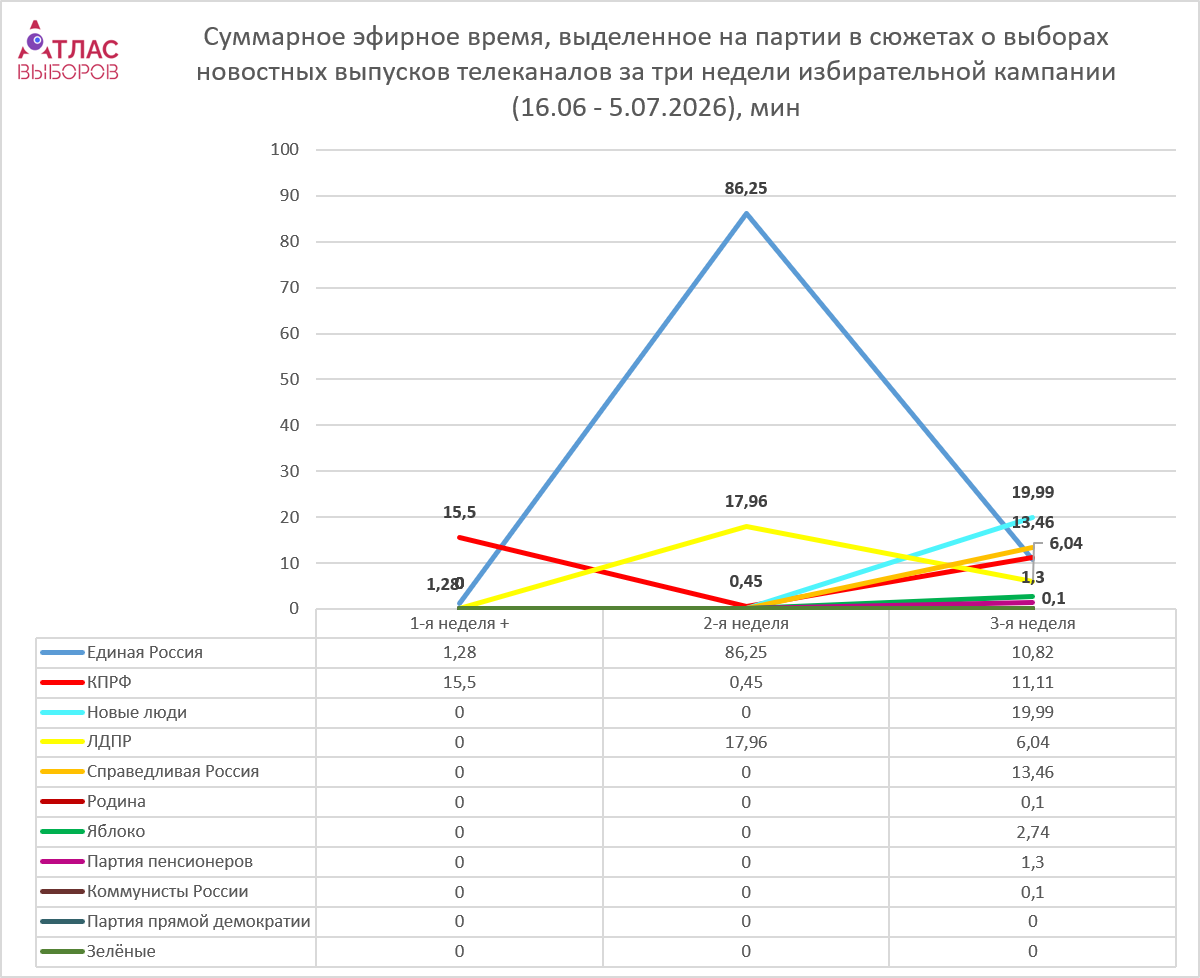
For the first time since the start of the campaign, Yabloko, Rodina, Communists of Russia and the Pensioners’ Party were presented on the air.
Unlike the previous week, when United Russia dominated the television airwaves, receiving more than 80% of the total airtime, in the third week the largest volume of attention went to the New People party, which held its pre-election congress and presented its programme. Second place in terms of airtime duration was taken by the A Just Russia party, which also held its congress this week. Next came the CPRF and United Russia, which moved to only fourth place in terms of coverage volume.
In terms of the number of mentions, New People also proved to be the leader, with the other parliamentary parties following in a tight group. 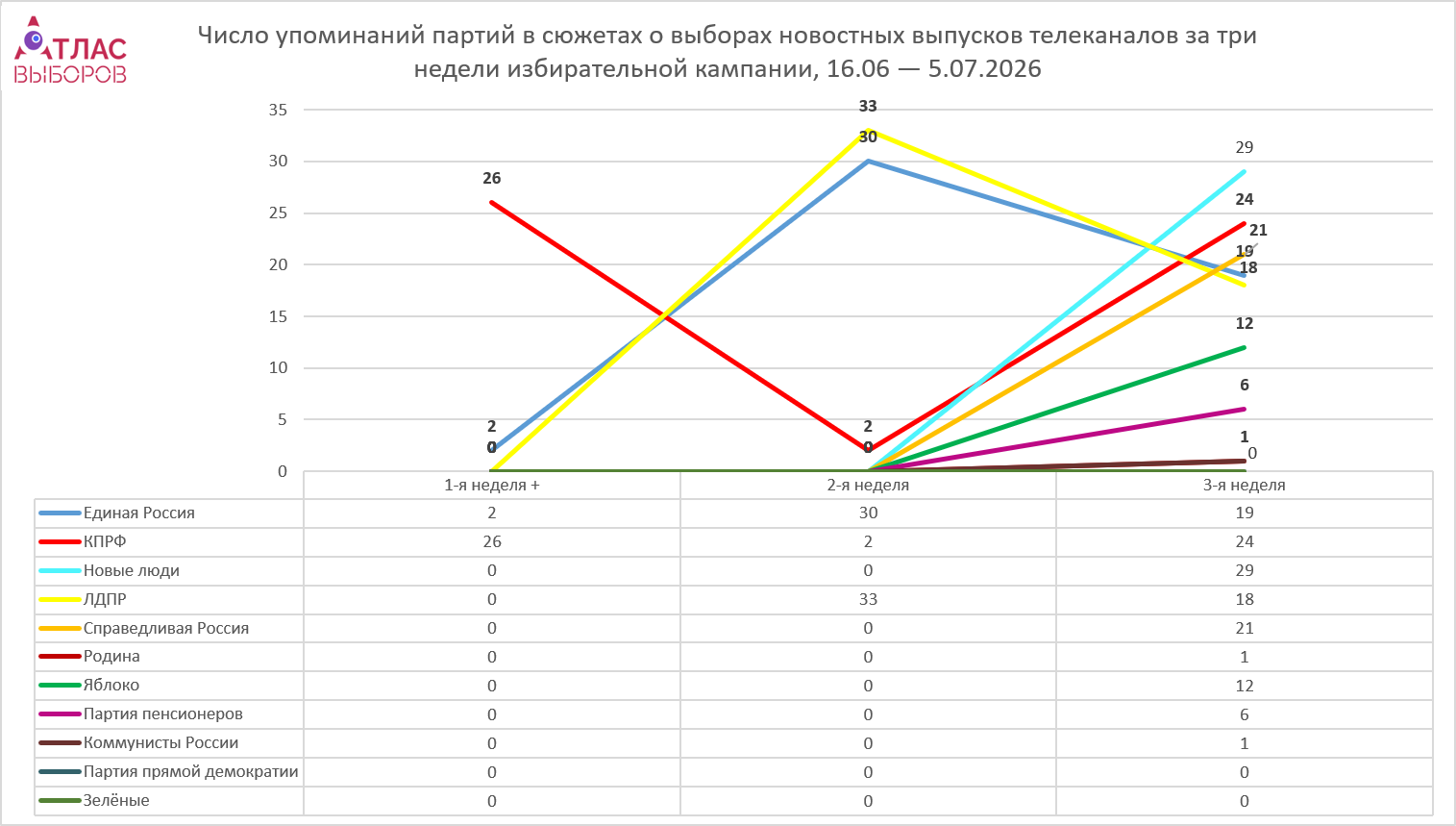
Among the “small parties”, Yabloko was mentioned most often, although these mentions were very brief. Reports devoted to the parties were generally very brief and lacking in substance. Only United Russia had an average report duration approaching two minutes. Also, the duration of reports about New People and the SRs, which held pre-election congresses, averaged between 1.5 and 2 minutes. All other parties received very brief mentions — from a few seconds to a minute. It is impossible to talk in detail about the activities and programmes of parties in such a time.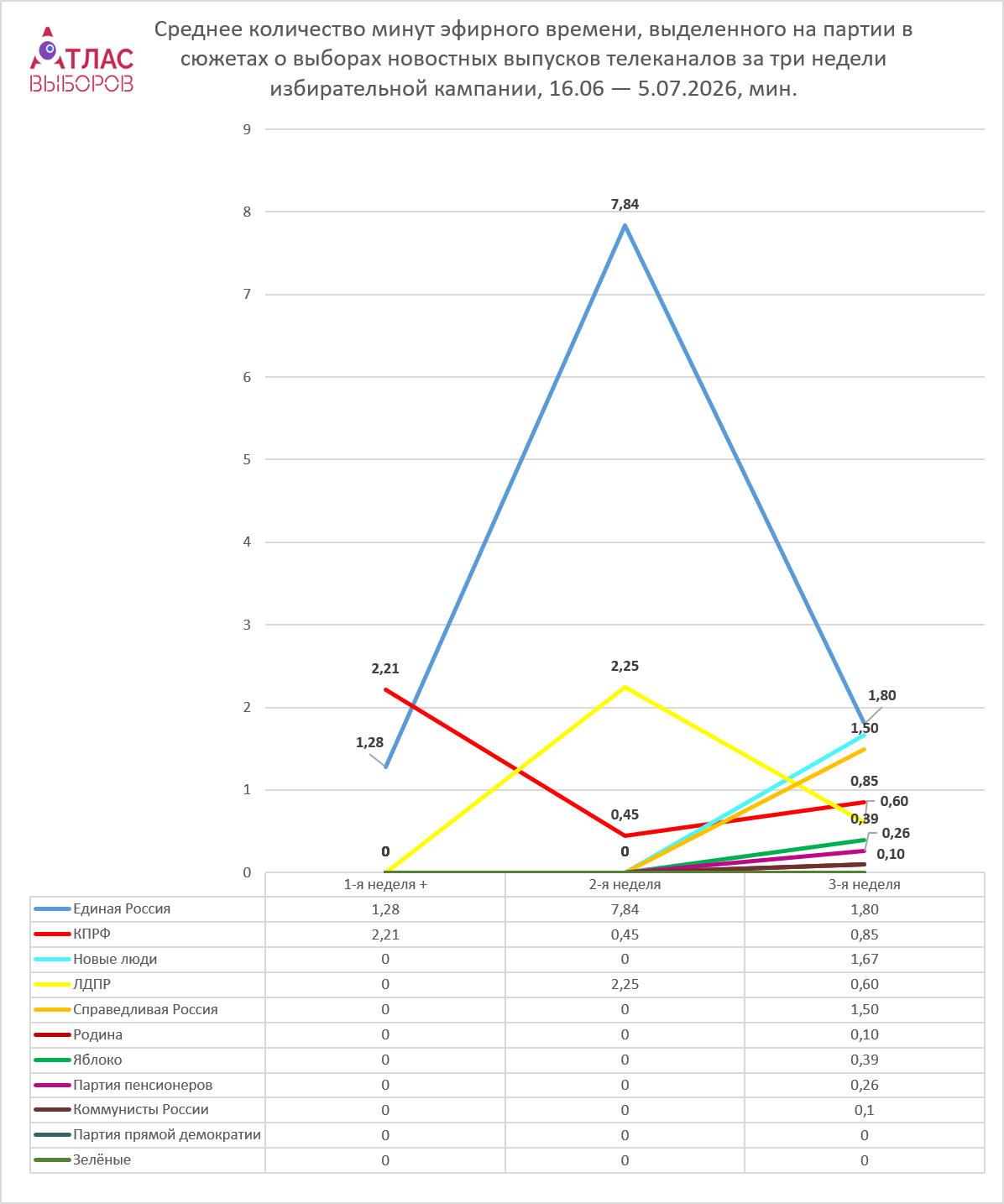
Thanks to the fact that this week all six federal television channels finally joined in covering the elections, the audience reached by the parties turned out to be more diverse. Only Rodina and Communists of Russia were mentioned on just one television channel — TVC. However, only one party — New People — was honoured with mentions on all six television channels. The SRs were mentioned by five television channels, the CPRF by four. 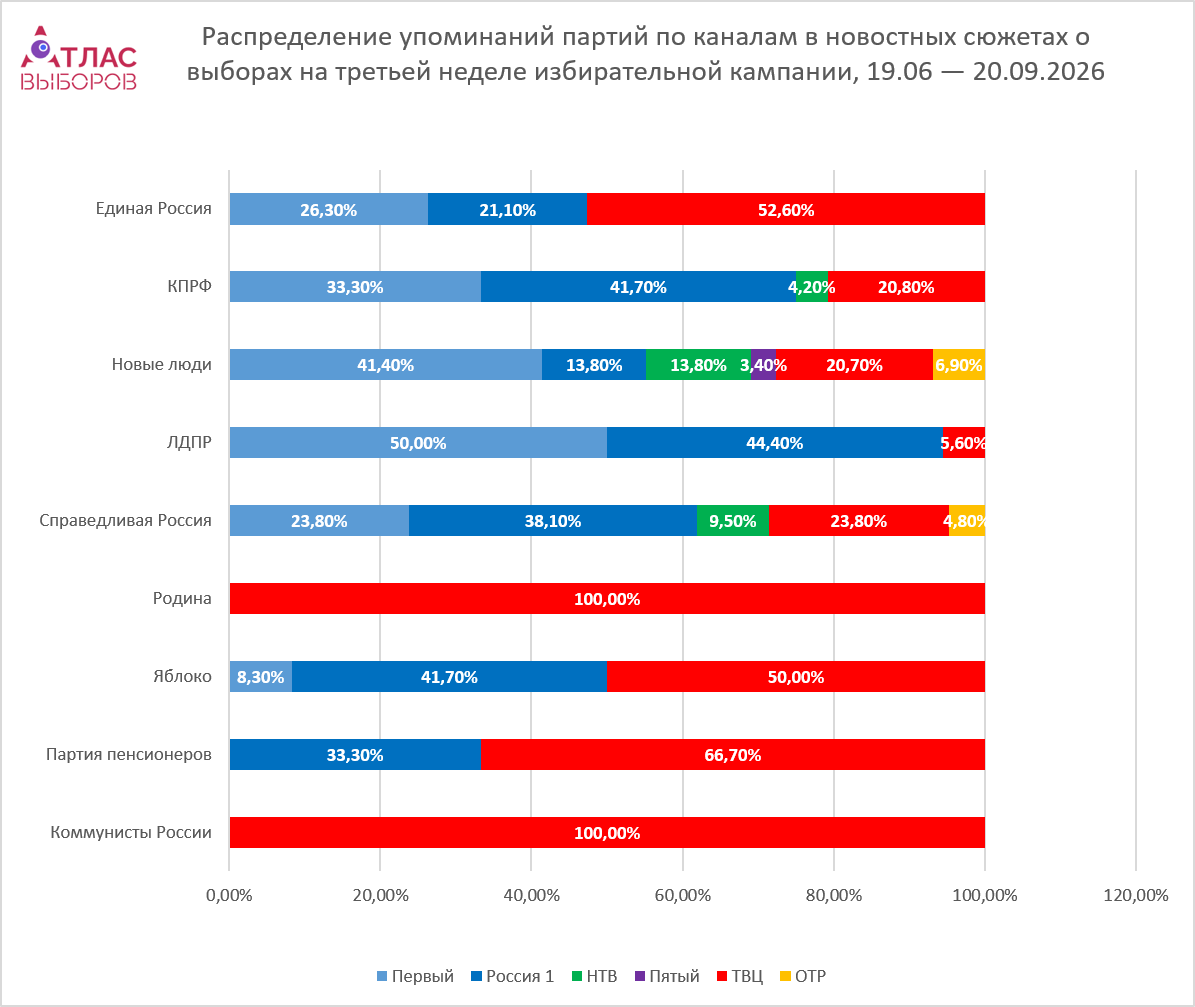
Results of coverage of all parties’ pre-election congresses
Since the congresses of the remaining five parties entitled to nominate candidates in the elections took place this week, we can sum up the results of the television channels’ coverage of these most important pre-election events and check their compliance with the principle of equality of rights of candidates.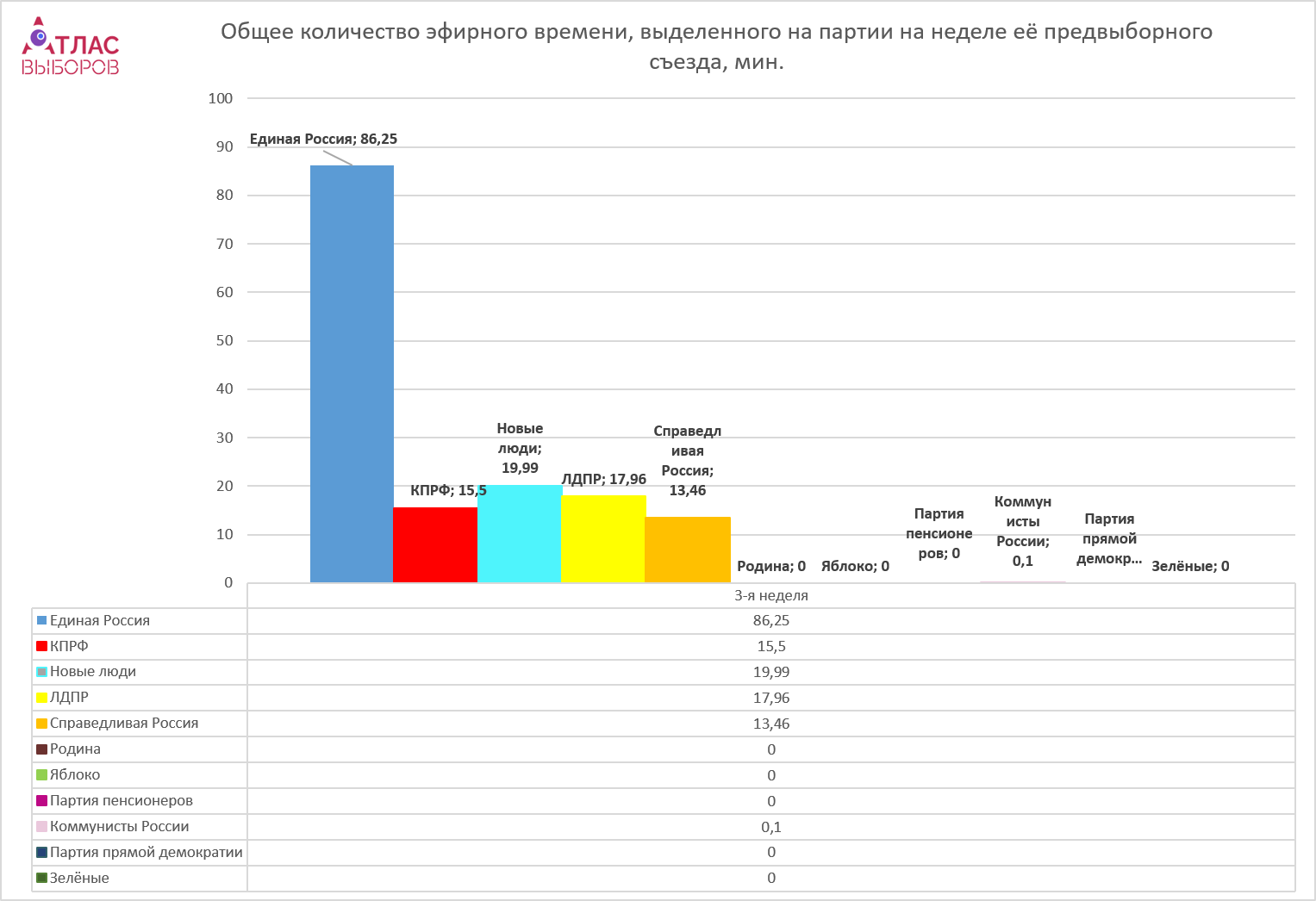
Of the 11 participants in the pre-election race, the congresses of six parties — more than half — were not mentioned at all on federal television. This honour, in violation of the principle of equality, was bestowed only upon the “parliamentary five”, and the United Russia congress received 1.3 times more attention than the congresses of the 10 remaining parties combined.
Tone of mentions
As in previous weeks, the activities of the parties that received mentions on the federal television airwaves were covered predominantly in a positive or neutral key.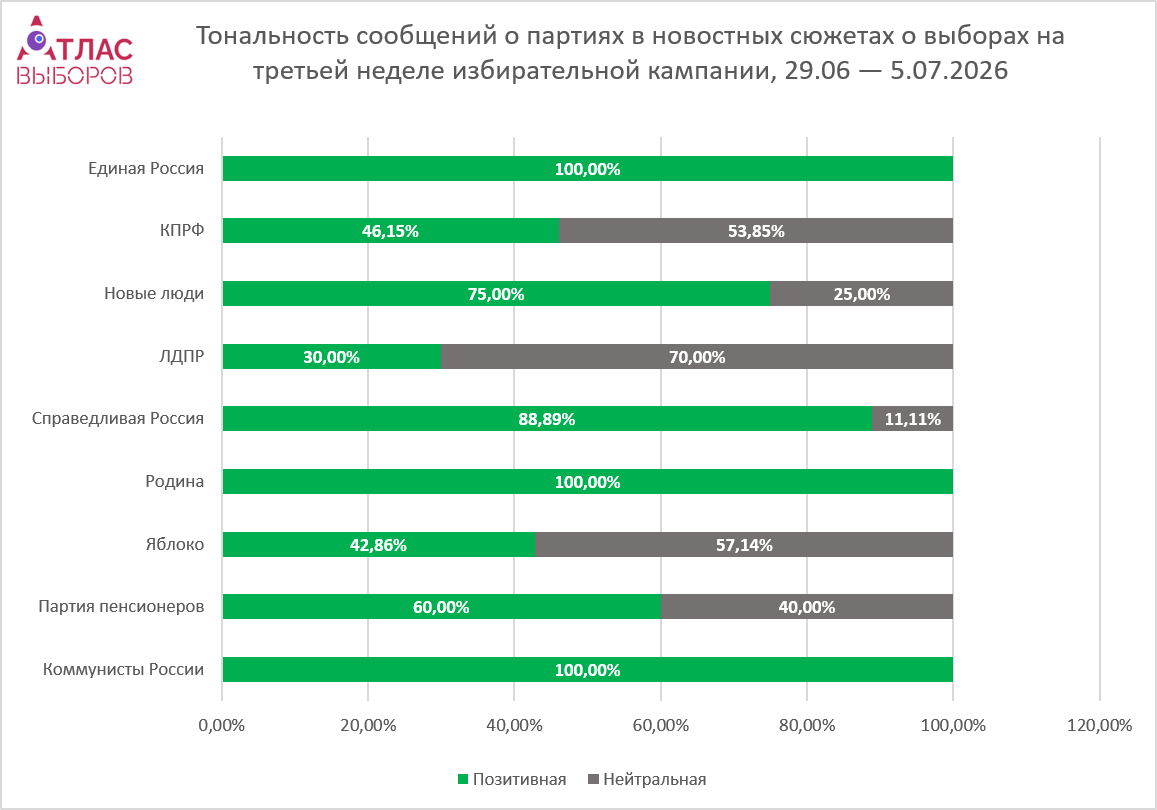
The coverage of United Russia’s activities was positive in all cases. For example, in a TVC report, the party was characterised as “the pillar of the state and the core of the country’s unity”.
Communists of Russia and Rodina also received 100% positive mentions, albeit brief ones — also on TVC.
A positive tone also prevailed in the coverage of the activities of New People and A Just Russia, which were given the opportunity to present their election programmes, candidate lists and leadership initiatives in detail. In particular, on the air of Rossiya 1, New People were characterised as a “young party” representing the “power of a new generation”.
The coverage of the CPRF’s work was predominantly neutral in nature. Most reports were devoted to the registration of the federal candidate list and individual events involving the party leadership.
The first mentions of the Yabloko and Pensioners’ Party were also kept in a neutral or positive tone; they concerned exclusively the submission of documents to the CEC. 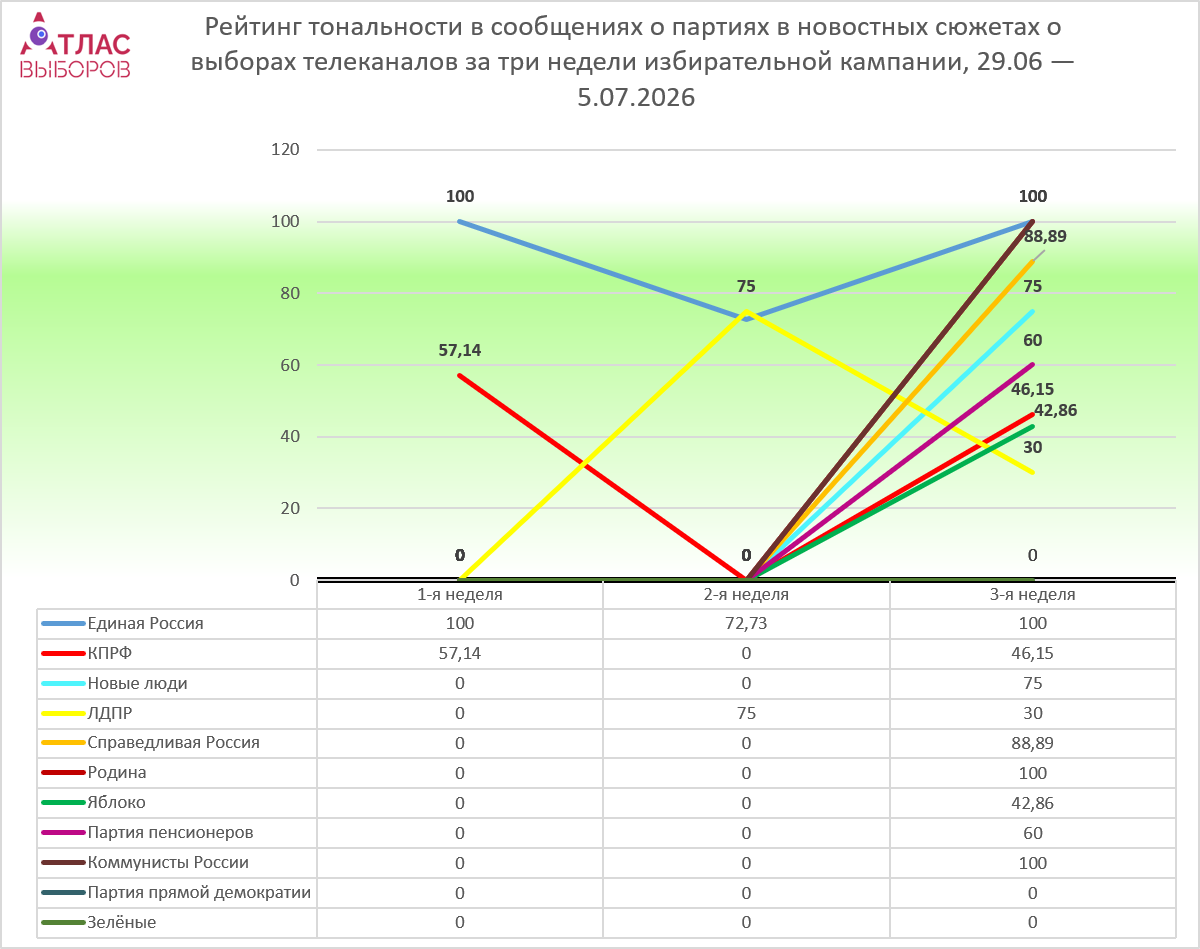
As in the previous weeks of monitoring, no negative or critical assessments of political parties were recorded in the news bulletins. For all three weeks, United Russia has remained the leader in the tone rating (the difference between positive and negative comments) — only in the second week did the LDPR slightly overtake it on this indicator, but that was a brief surge for now.
Party news events of the week
United Russia
Unlike the previous week, the party congress was no longer the central news event. The main attention was paid to the discussion of the formation of the party’s “people’s” programme. Channel One and Rossiya 1 reported on a meeting between Valentina Matviyenko and Vladimir Yakushev with activists of the party’s women’s movement, whose proposals are planned to be included in the programme. The reports emphasised support for the families of participants in the special military operation, issues of demography and healthcare, as well as the role of women in the party’s activities. On Rossiya 1, it was noted that United Russia can be called a “women’s party”, since the majority of its members are women.
CPRF
The main news event was the submission of documents to the CEC for the registration of the federal candidate list. Rossiya 1 reported in detail on the submission of a federal list of more than 500 candidates and the “Programme of Victory” election programme with which the party is going to the elections. Additional reports were devoted to the 70th anniversary of the newspaper Sovetskaya Rossiya and an exhibition marking the 100th anniversary of Fidel Castro, where Gennady Zyuganov made statements on issues of international politics and the special military operation.
LDPR
The LDPR was mentioned mainly in connection with being the first to submit documents to the CEC for participation in the elections. In the reports, the party was characterised as a consolidated political force and a contender for the status of the country’s second party. Individual reports were devoted to the initiatives of Leonid Slutsky, in particular the proposal to make 1 July the official Day of Combat Veterans.
A Just Russia
The party received noticeable coverage on federal television channels for the first time thanks to its pre-election congress. Television channels reported on the approval of the federal candidate list, the presentation of the election programme and the party’s social initiatives. The focus was on proposals to support participants in the special military operation, pensioners, doctors and teachers. A number of reports featured direct speech by Sergei Mironov, including his statements about the special military operation and external interference in Russian elections.
New People
The party’s pre-election congress was covered by several federal television channels at once. It was reported that the federal candidate list had been approved and that more than 380 candidates had been nominated for the State Duma elections.
The party was characterised as a young political force focused on supporting entrepreneurship and youth. Programme statements by party chairman Alexei Nechayev, devoted to the country’s development, generational change and the need for “living politics”, were also cited.
Yabloko, Rodina, Communists of Russia and the Pensioners’ Party
These parties appeared in the federal television agenda for the first time since the start of the election campaign. The only reason for their mention was the submission of documents to the CEC for the registration of federal candidate lists.
Methodology
Six federal television channels included in the first multiplex and enjoying the greatest popularity among viewers were selected for the media monitoring — Channel One, Rossiya 1, NTV, TV Centre, Channel Five, OTR.
On each of the six television channels, news bulletins available in video archives were analysed. For the third week of the election campaign from 29 June to 5 July 2026, 221 news bulletins were studied (Channel One — 38 bulletins, Rossiya 1 — 32 bulletins, NTV — 36 bulletins, TVC — 29 bulletins, OTR — 61 bulletins, Channel Five — 25 bulletins).
We analysed each news bulletin for the presence of reports about political parties. If there were reports about parties, we were interested in the following indicators:
- number of mentions;
- time allocated to the party;
- tone of information (positive, neutral, negative);
- presence of direct speech by party representatives;
- presence of voters’ opinions about the parties in the report;
- characteristics of the parties voiced by the anchor or voiceover.