The “Election Atlas” project has launched a weekly social-media monitoring programme for the State Duma election period. We will track how active election participants are in the online space. Like the monitoring of election coverage on federal television channels that started earlier, the reviews of party activity on social media will be published every week, but with a slight delay.
Today the internet is one of the main platforms from which Russians get information; they also use it to follow the news agenda. On the one hand, a significant share of platforms are officially blocked in Russia and Russians are, for example, prohibited from placing advertising on them. On the other hand, neither the platforms themselves nor the owners of large public pages are bound by the restrictions imposed on the media during elections. In particular, they are not obliged to ensure equal access for candidates and parties or to limit themselves in campaigning for specific political forces. At the same time, on domestic platforms there is a risk that Roskomnadzor will block public pages extrajudicially — yet some social networks remain outside the control zone of Russian oversight structures. This allows us to make the caveat that the space of the social networks under study is subject to censorship, while the media field of the other part of the platforms is not constrained even by formal guarantees of electoral rights. At the same time, social networks still offer opportunities to broadcast one’s ideas and communicate with voters in various creative formats.
The results of the social-media monitoring will be published weekly.
Main findings for the first week of the campaign
- At the start of the election campaign, voter interest in the elections is extremely low, and the activity of most parties in the social-media information space is practically invisible. The lead in the number of mentions held by A Just Russia and United Russia is largely artificial (especially in the first case) and is based on the centralised placement of information in party public pages or in public pages controlled by the authorities (for United Russia). These two parties account for around 80% of all content on the election campaign topic, but their qualitative impact differs: United Russia has high viewership and engagement figures (from both supporters and opponents), while A Just Russia has a large volume of content with minimal reaction to it.
- The other parliamentary parties are mentioned far less often, and the minor parties are not yet actually running campaigns.
- The greatest response from users is generated by posts mentioning United Russia (two-thirds of all reactions), and these can be positive, neutral or sharply negative in nature. One way or another, it is clear that the party’s name elicits a real, live response from voters. In second place on this indicator is the CPRF, followed at a short distance by the LDPR. The remaining parties arouse far less interest (though there is an assumption that New People are simply betting on resources we are not yet able to monitor).
Parties outside the “big five” collectively have less than 2% of posts mentioning their names and less than 1% of engagement, which makes them practically invisible.
Methodology
Four platforms currently used by Russians were selected for the social-media monitoring: VKontakte, MAX, Telegram, YouTube. Unfortunately, we have not yet been able to set up effective monitoring of Odnoklassniki and Instagram, which could significantly affect the overall data. If we manage to do so in the coming weeks, the data will be added.
The analysis used mentions of the 11 parties that have the right to nominate lists and candidates without collecting voter signatures: United Russia, the CPRF, the LDPR, A Just Russia, New People, Yabloko, Communists of Russia, the Party of Direct Democracy, Rodina, the Pensioners’ Party, and the Greens. If other parties stand for election, they will be added to the monitoring.
We analysed posts on each platform and were interested in the following indicators:
- number of mentions (posts) on social networks, broken down by political party;
- number of mentions, broken down by platform;
- engagement (reposts, reactions, activity in comments);
- duplicate posts, which very often indicate centralised dissemination of materials;
- key themes;
- use of administrative resources.
Because the election was called on Tuesday 16 June, the first week includes monitoring data from 16 to 22 June 2026. During this period, 175,659 posts on social networks were examined.
Party mentions: volume and content
According to the analysis of the information field in the first week of the campaign, United Russia and A Just Russia jointly generate 80.1% of all content.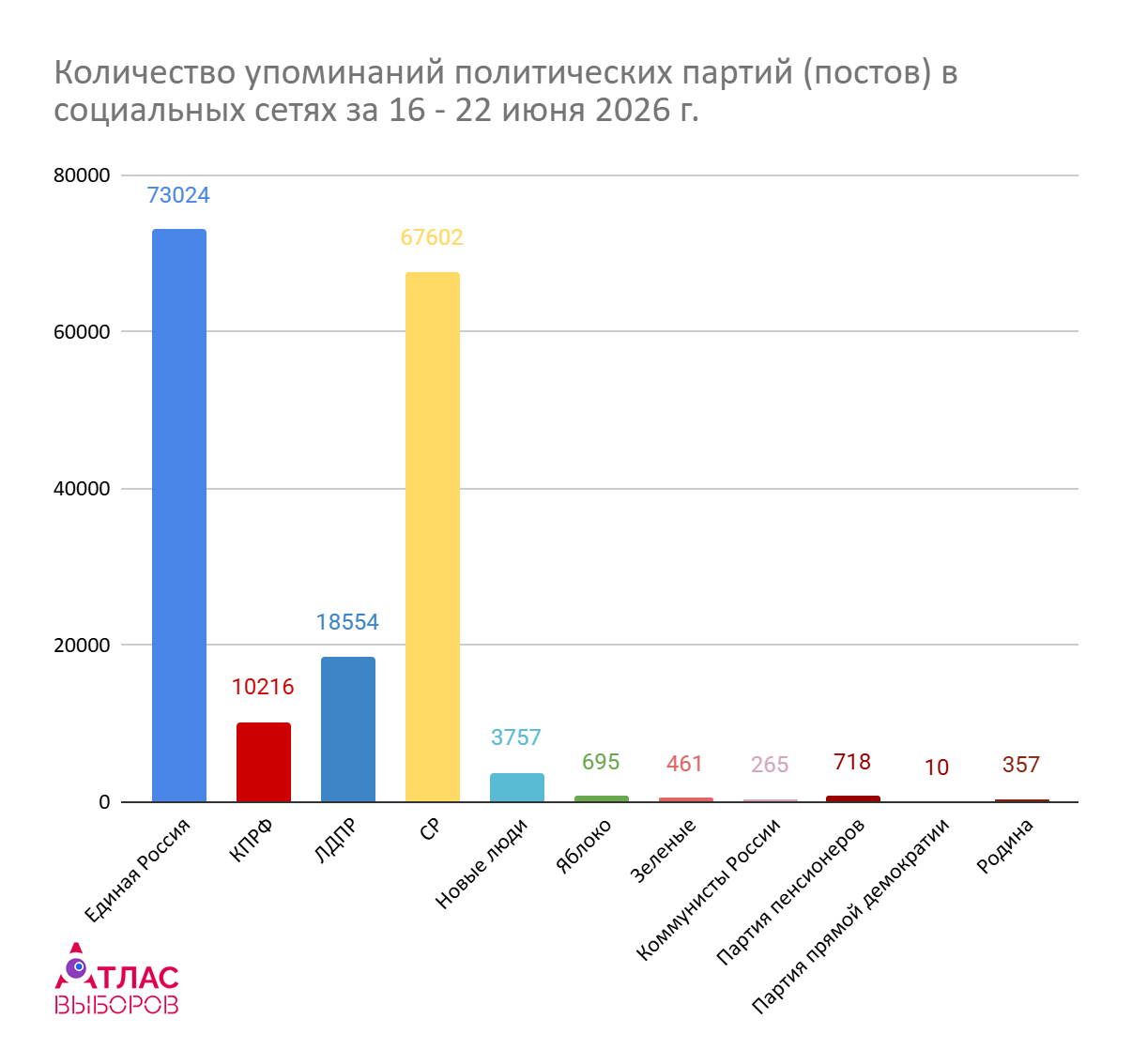
The top five are exclusively parliamentary parties:
- United Russia — 73,024 posts,
- A Just Russia — 67,602 posts,
- LDPR — 18,554 posts,
- CPRF — 10,216 posts,
- New People — 3,757 posts.
The remaining nine parties collectively account for less than 20% of posts. Thus, minor parties today are practically absent from the information field.
The dominance of United Russia and A Just Russia in the number of mentions requires explanation.
The secret of the large number of mentions of A Just Russia turned out to be very simple: the party has a large network of small party public pages (with 200–300 subscribers each), including party pages in individual villages. Therefore, any post is replicated across the entire network. For example, a post stating that education in colleges and technical schools should be free was reproduced verbatim on 16 June in 1,096 party public pages on VKontakte (it is the leader on this indicator for A Just Russia). Moreover, this wave began at 11:11:08 and ended at 11:32:46, meaning it took just over 20 minutes.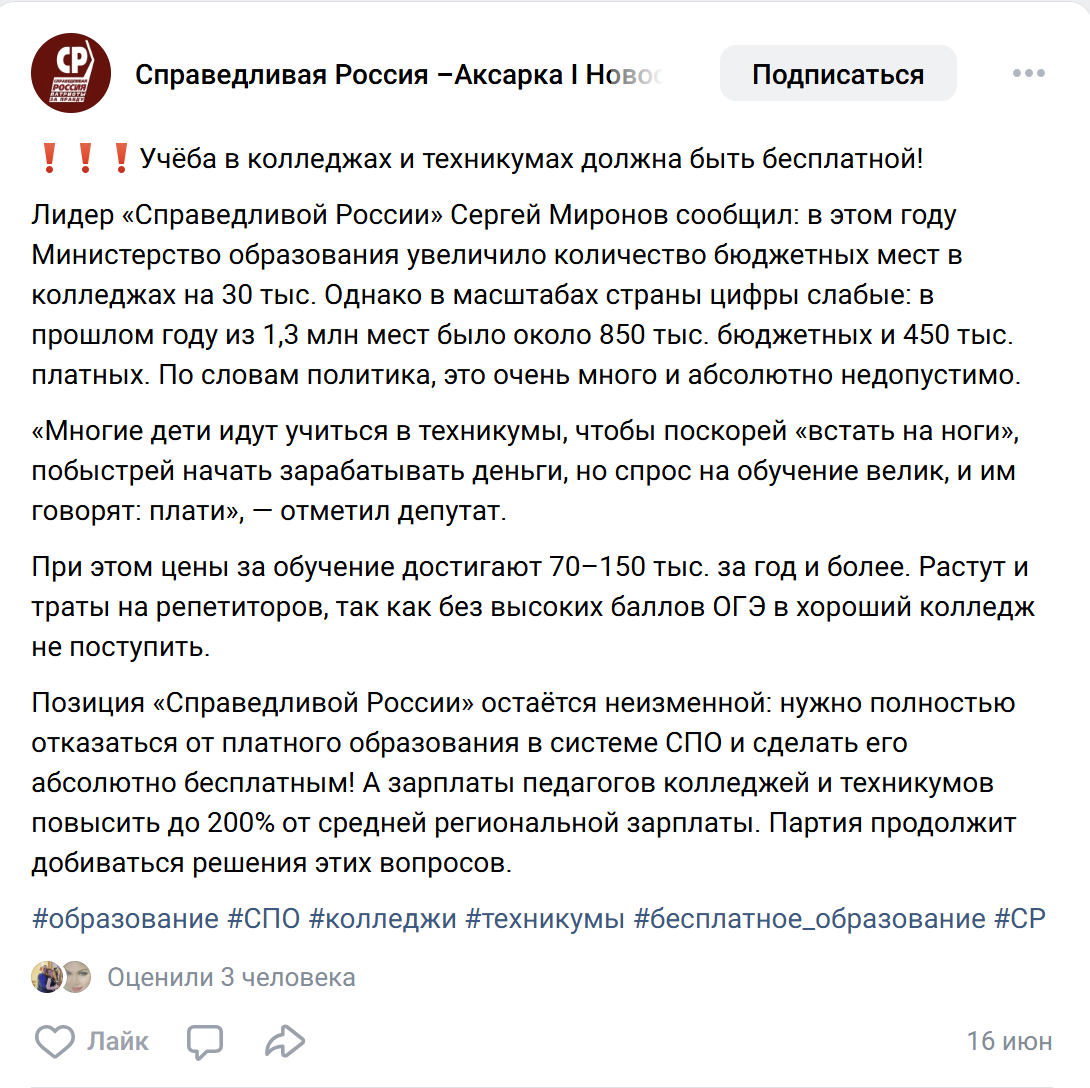
Such messages in total account for more than 90% of all mentions of A Just Russia. They ensure a relatively large reach but elicit little response from people — on average 2.4 reactions per post, so it is not easy to assess the effectiveness of such a strategy.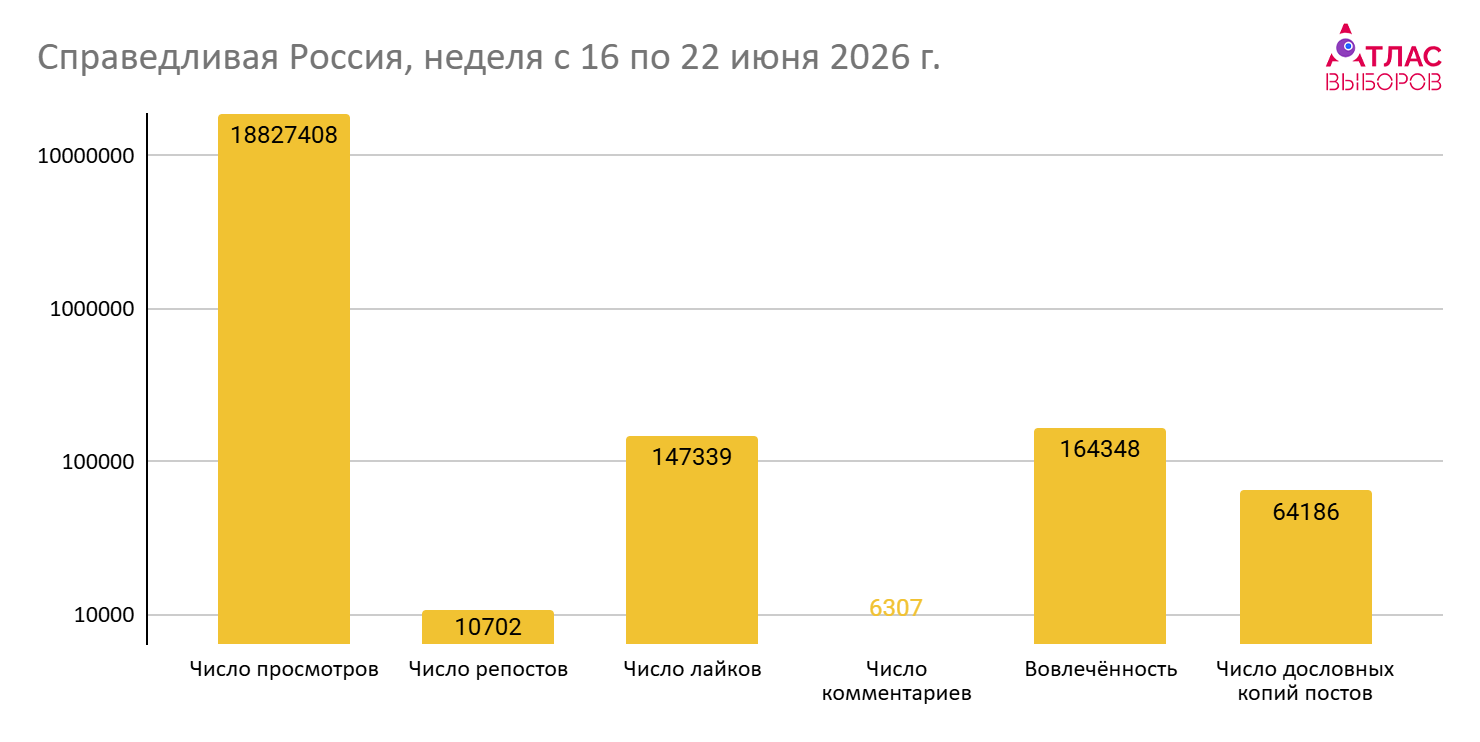
It is also telling that the SRs barely felt the impact of the election announcement — they have no pronounced peak in mentions on 16 June. They do, however, have a sharp drop at weekends.
A somewhat similar situation is observed with United Russia. The party also has a large number of identical posts, and in its case the use of administrative resources is also noticeable. For example, on 22 June a text was widely circulated relating to an event in memory of the start of the Great Patriotic War that United Russia held in Makhachkala, together with the Movement of the First, the Young Guard and Yunarmiya.
The post dedicated to this event (word for word) was published 4,050 times, and official accounts of schools, budget-funded institutions and administrations were actively enlisted for this.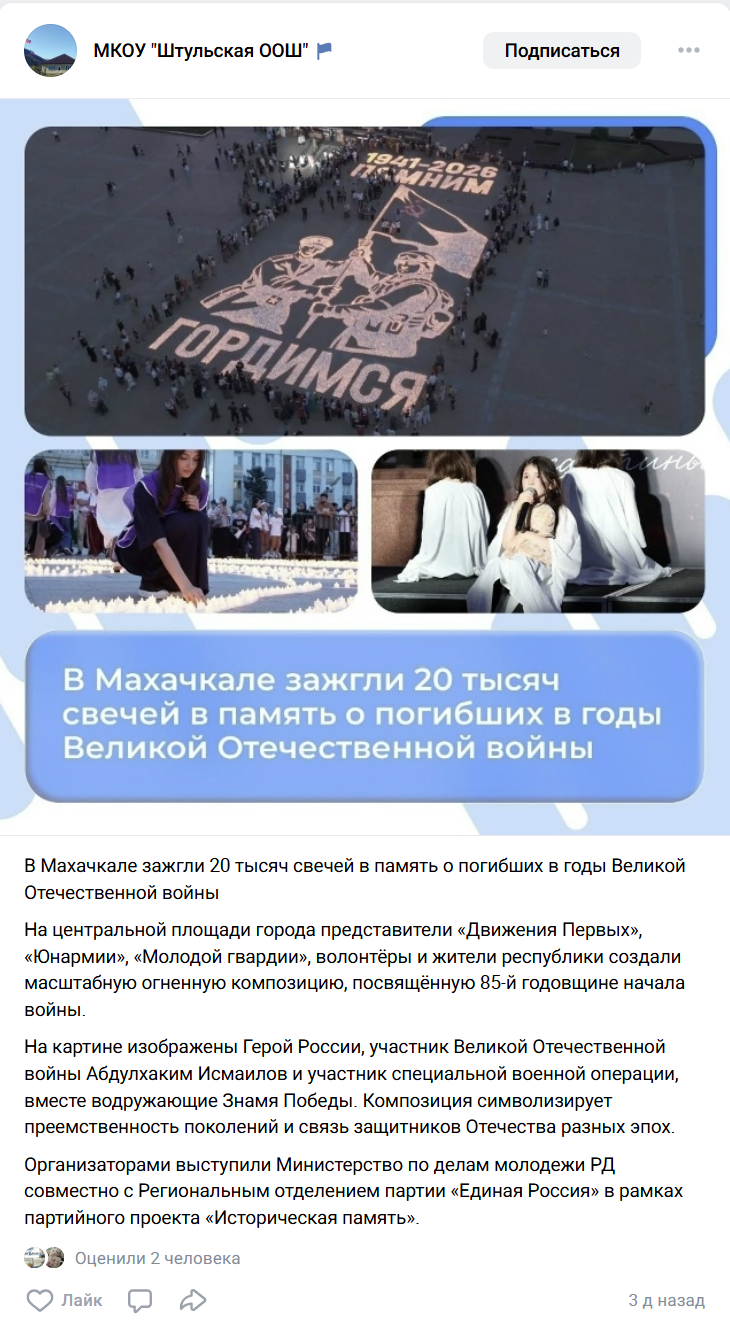
Similar campaign posts devoted to the formation of United Russia’s “People’s Programme” were also published centrally by official public pages of state and municipal institutions in Yakutia on 18 June.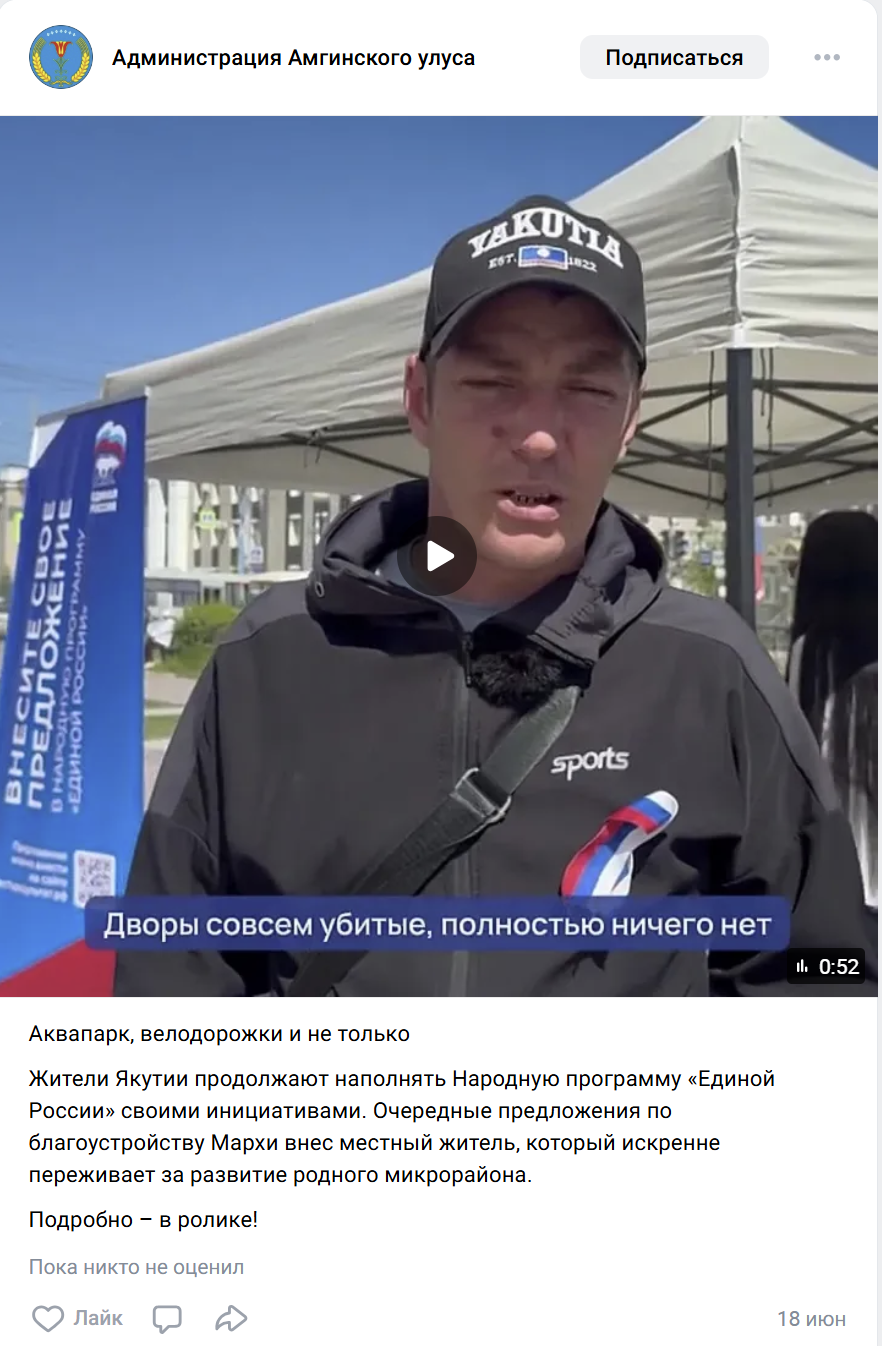
This information agenda is practically identical to what television viewers could see on federal television channels on those same days.
However, in the case of such publications the party faces the same problem as A Just Russia — reach is large but response is small. The artificial nature of this wave is also shown by the fact that United Russia’s mentions drop practically to zero at weekends.
The LDPR also has a network of official party accounts, but on a much smaller scale. In the first week of the campaign, apart from informational mentions about the start of the election, no text about the LDPR was reproduced identically more than 100 times — meaning the party’s account network is several dozen times smaller than those of United Russia and A Just Russia. On the other hand, the party is actively mentioned by news public pages, competitors from the CPRF and simply citizens. There was some growth in the party’s mentions on 19 June. The main theme of these mentions was the All-Russian Patient Forum held by the LDPR, but there were other themes too.
The CPRF had a clear peak in mentions on Monday 22 June, linked to the party’s pre-election congress held the day before. The party itself also does not overuse centralised posting. However, the network of “Overheard” public pages, presumably controlled by the Russian authorities, actively promoted the unsuccessful speech by party leader Gennady Zyuganov devoted to using funds from Russians’ bank deposits for economic development. This post was placed verbatim almost 150 times in public pages from different regions of the country.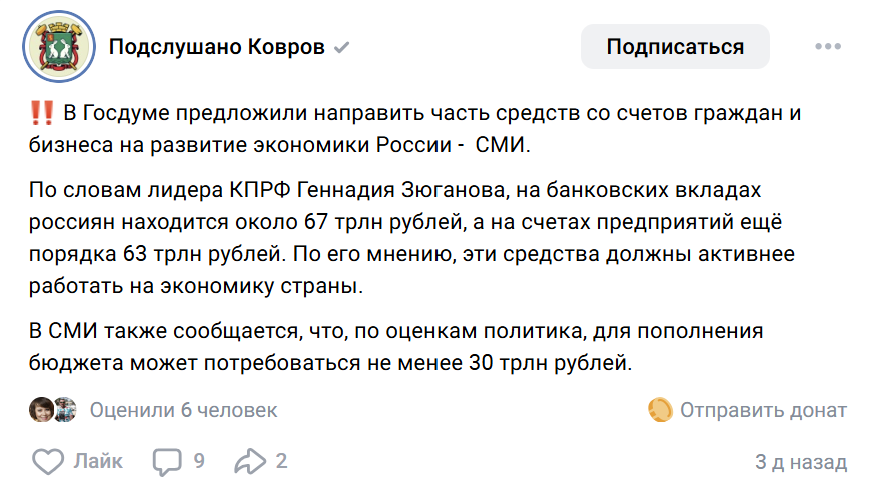
The party later had to justify itself and explain that it was not calling for these deposits to be seized.
A distinctive feature of New People’s strategy is that they are not so visible on VKontakte but actively use alternative platforms. The main themes are assistance to business (primarily small business, for example, “beauty industry professionals”) and to women in difficult life situations (single mothers, victims of domestic violence).
It is worth noting separately that all parties had a large spike in mentions on 16 June — the day the election was called. This is linked precisely to the large number of standard informational messages devoted to this event. In such posts all parties were mentioned together, separated by commas. Such messages contain no information about their substantive activities. For all minor parties, such messages accounted for a significant share of their mentions over the week.
Views and engagement
The mass dissemination of information in low-visibility party public pages did not give A Just Russia a real advantage in views over other parties.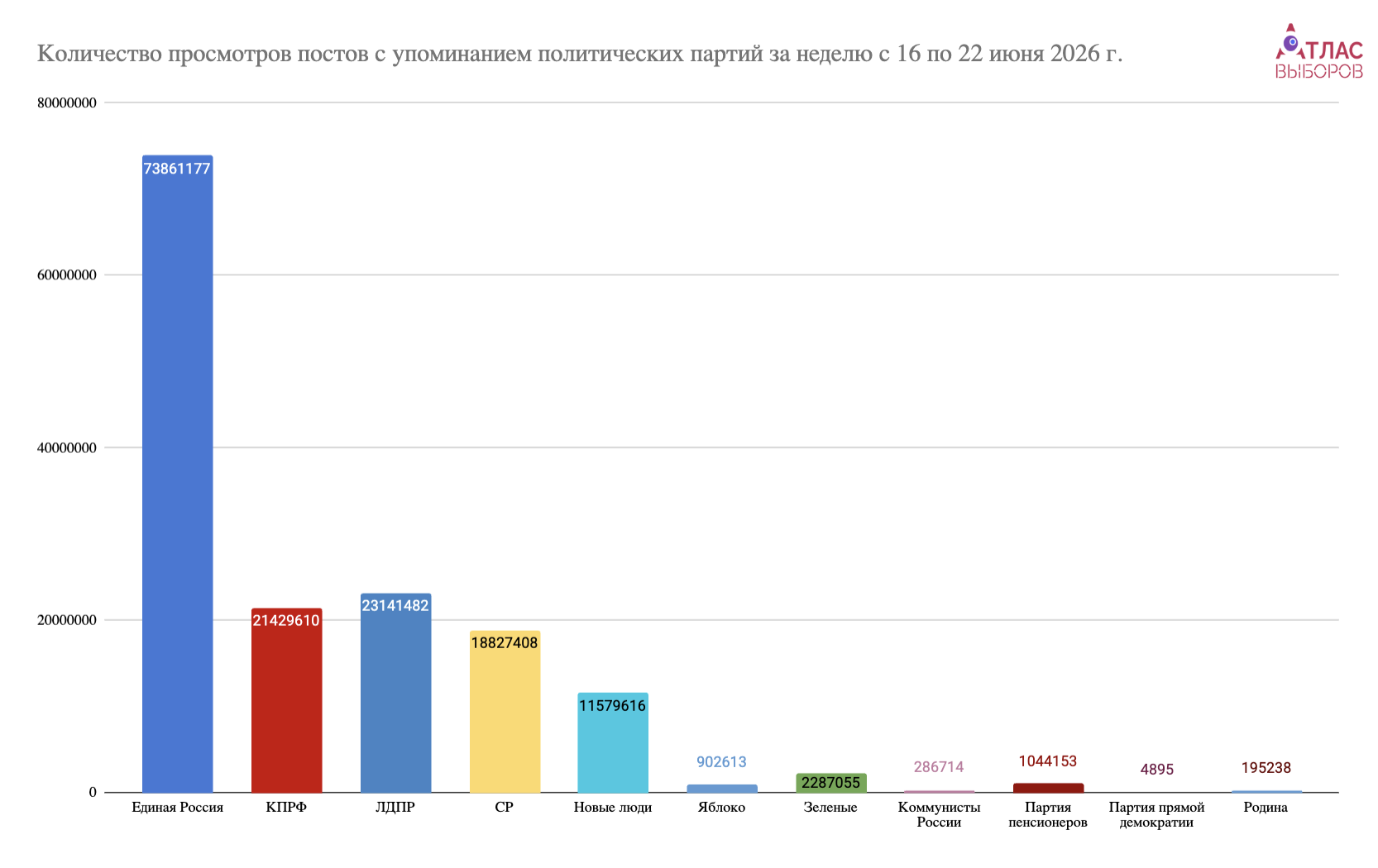
A noticeable lead is held only by United Russia, which in the number of views of posts mentioning it outstrips all other parties combined, securing total dominance in the social-media and messenger environment.
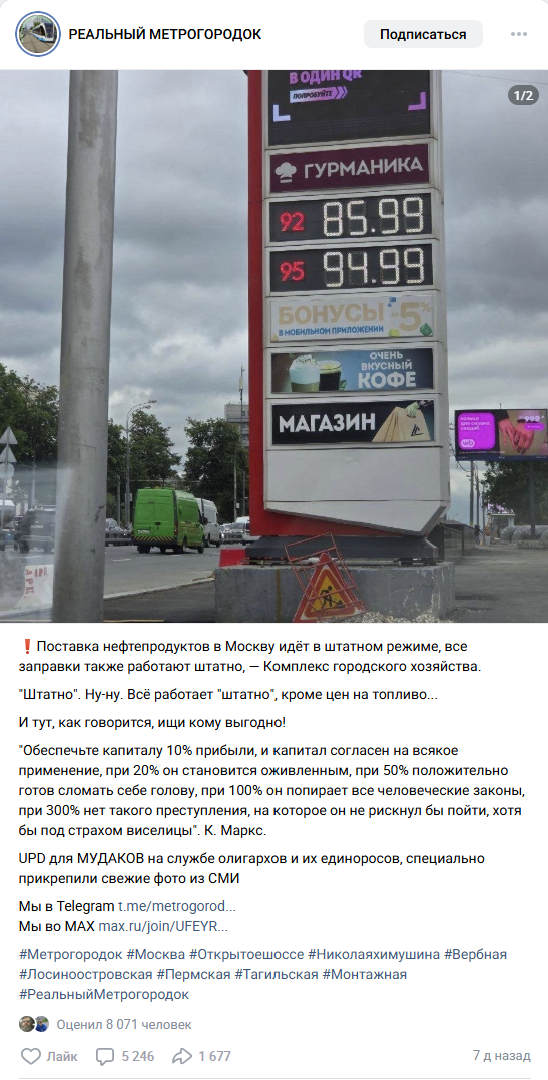
On the other hand, the engagement indicator — that is, the sum of different reactions (likes, reposts and comments) under posts mentioning parties — shows clear dominance by United Russia. This indicates that its publications receive not only mass replication but also a significant number of likes/comments. Discussions between supporters and opponents of the party often unfold under the posts, and the posts mentioning it can vary in tone. For example, the absolute leader in views and one of the leaders in engagement is a tone-neutral video by Dozhd on YouTube about a female United Russia deputy who died in the combat zone. Another example is one of the leading posts in negative tone by views and engagement on VKontakte, devoted to fuel problems in Moscow.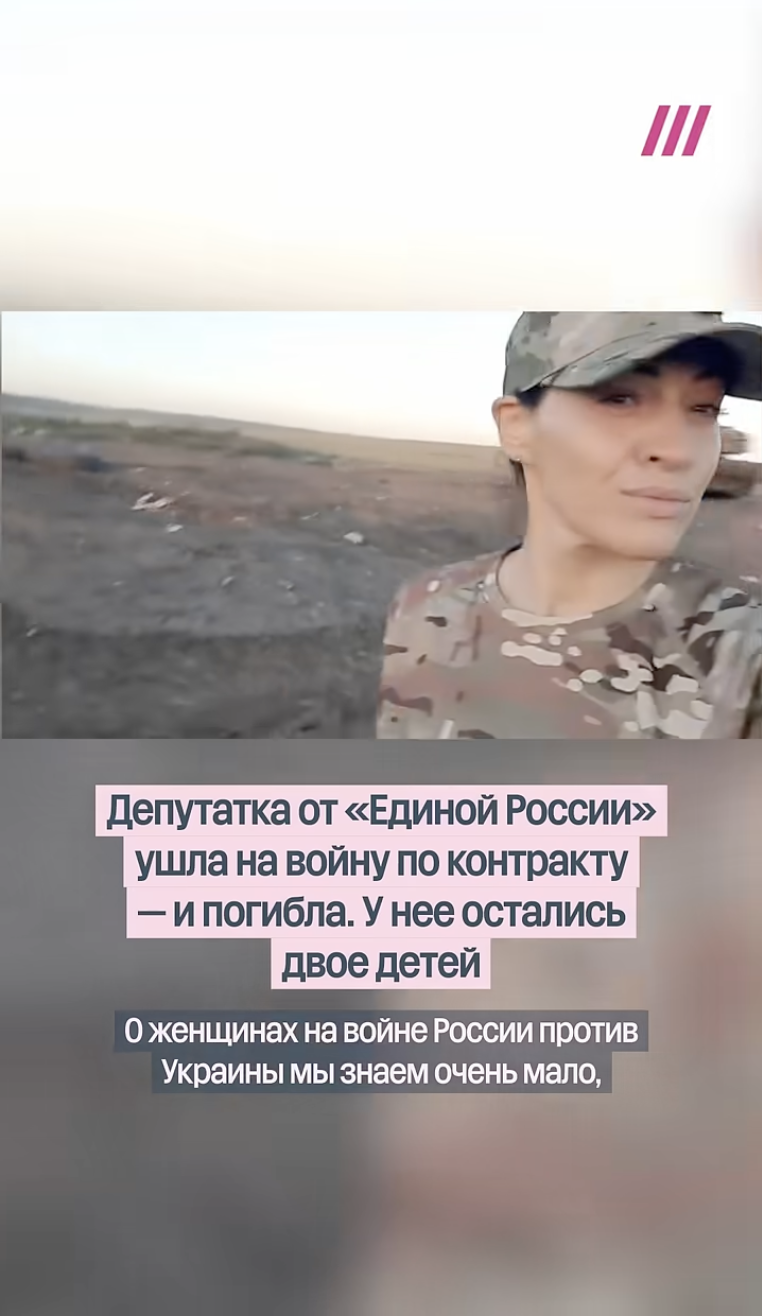
A Just Russia has an engagement of just 4.8% — practically on a par with New People, who have orders of magnitude fewer posts and copies. As we wrote above, the party’s quality of interaction is low: reposts are not accompanied by likes or comments — this is “empty” traffic.
The CPRF and the LDPR, with modest volumes of posts, demonstrate higher engagement than the SRs; their audience reacts to content far more actively. Admittedly, the CPRF also has a lot of negativity because of the aforementioned statement by Gennady Zyuganov.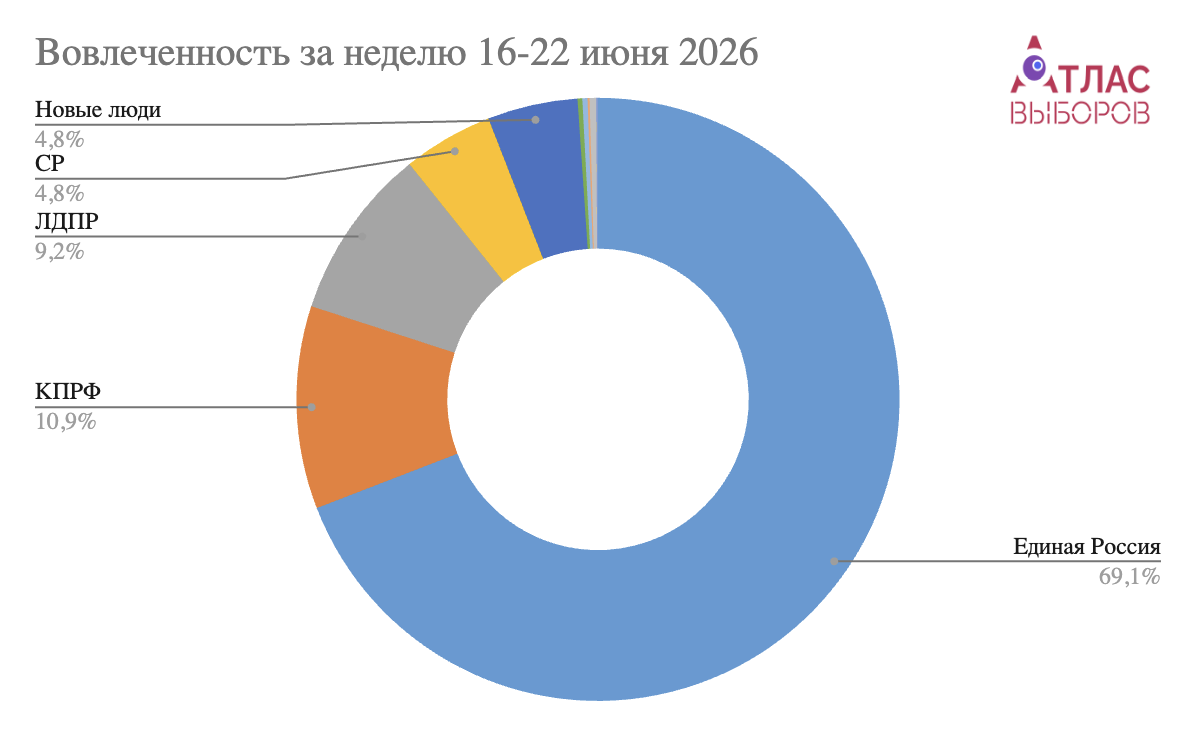
Undoubtedly, part of the engagement (especially likes and comments) may also be generated by bots or artificially inflated. However, at present this indicator looks far more adequate for understanding the real activity of parties and voter interest in them than the number of mentions.
Party strategies for using platforms
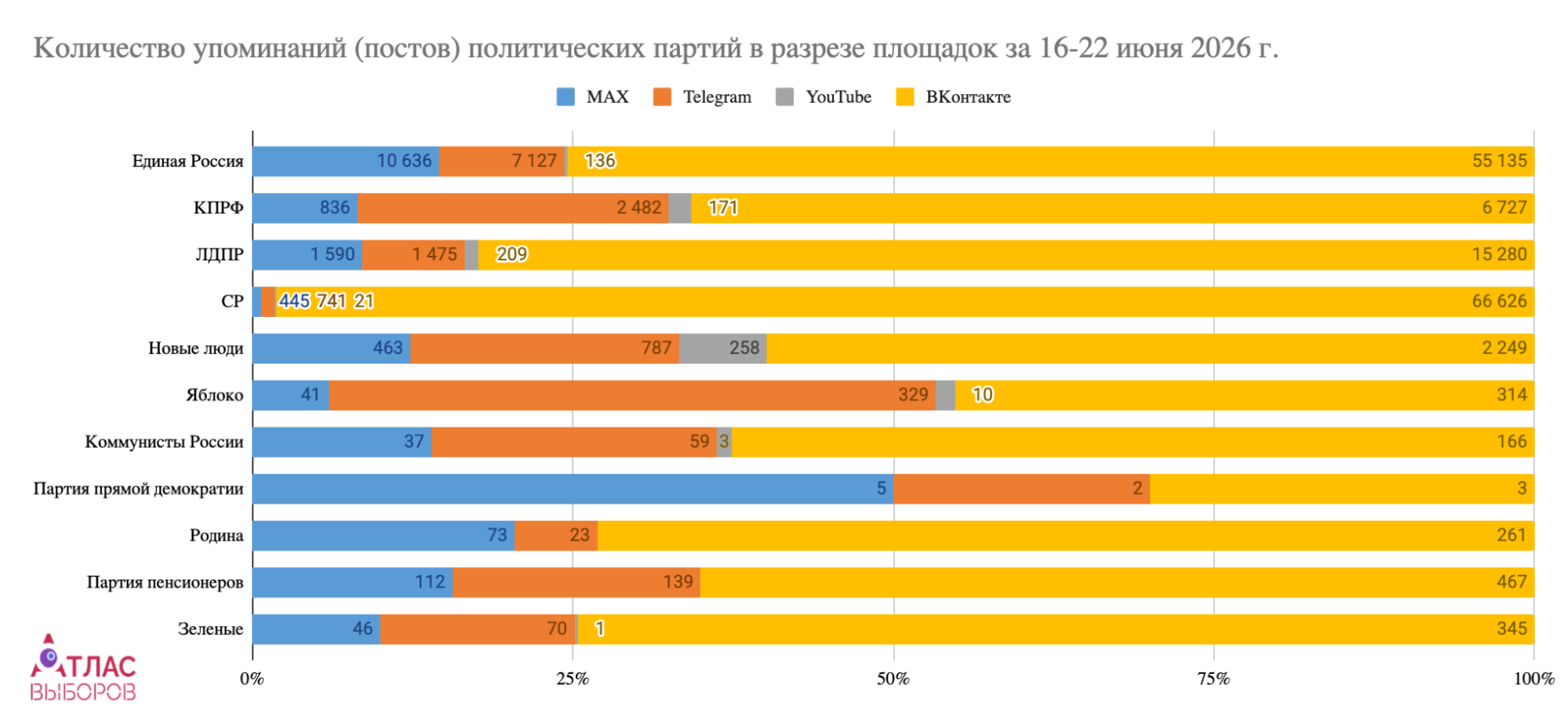
The overwhelming share of the information activity we identified is concentrated on the VKontakte network. It is worth recalling once again that we have not yet been able to set up monitoring of Odnoklassniki or the social networks Facebook and Instagram, which are banned in Russia. In this situation VKontakte unquestionably dominates.
Nevertheless, even such a limited approach gives some idea of the parties’ strategies for using information channels.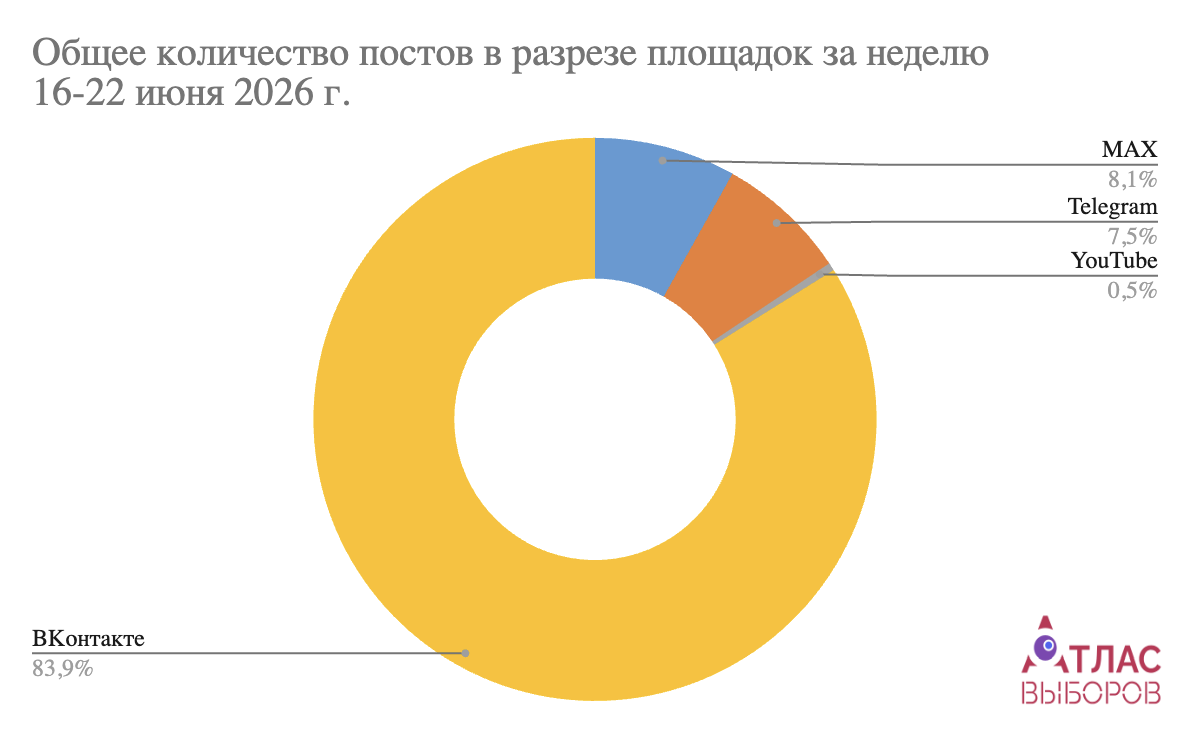
United Russia uses a balanced approach:
- VK — 55,135 (75.5% of its posts);
- MAX — 10,636 (14.6%);
- Telegram — 7,127 (9.8%);
- YouTube — 136 (0.2%).
Such diversification of channels allows it to work with different audiences.
A Just Russia is almost completely confined to VKontakte:
- VK — 66,626 (98.6% of its posts);
- Other platforms — less than 1.4%.
Such mono-channel reliance creates risks in the event of failures, restrictions or algorithm changes. And other metrics also show its limited effectiveness.
The LDPR and the CPRF show a moderate result in the distribution of information flow and, unlike the previous parties, use YouTube more actively:
LDPR
- VK — 15,280 (82.4%);
- MAX — 1,590 (8.6%);
- Telegram — 1,475 (7.9%);
- YouTube — 209 (1.1%).
CPRF
- VK — 6,727 (65.8%);
- Telegram — 2,482 (24.3%);
- MAX — 836 (8.2%);
- YouTube — 171 (1.7%).
New People stand out for their share of YouTube (258 posts, 6.9% of their publications), which indicates a bet on video content and a youth audience.
The remaining parties have extremely low activity on all platforms, and their presence on YouTube and MAX is entirely sporadic.