Russia’s party system is unstable and subject to constant fluctuation. After the Federal Law “On Political Parties” was adopted, the number of parties eligible to take part in elections reached 46 by 2004. A process of party liquidation was then launched, and in 2009–2011 only seven registered parties were active. After the 2012 reform the number of parties began to grow again, reaching a peak in late 2015–early 2016 — 75 parties eligible to take part in elections. Then the process of reduction resumed.
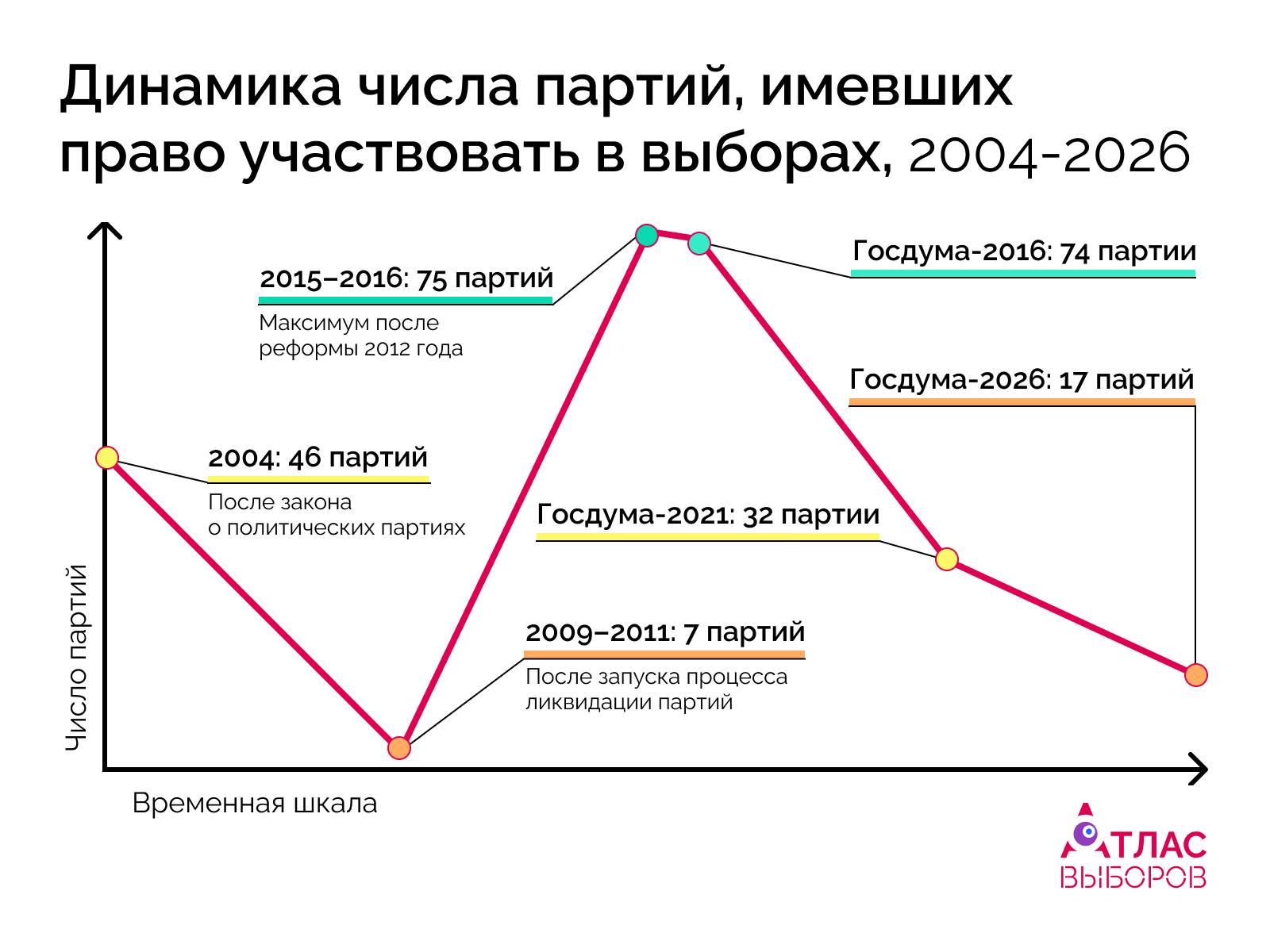
In the 2016 State Duma deputy elections, 74 political parties were eligible to participate. In the next elections in 2021 — only 32 parties. Thus the number of parties more than halved over those five years (a 2.3-fold decrease).
Over the next five years the number of parties fell to a slightly lesser degree, but still very substantially. At the time the State Duma elections were called (16 June 2026), only 17 parties remained on the list of parties eligible to take part in elections. That is, the number of parties shrank by a further factor of 1.9.
So what happened to the 15 parties removed from that list?
Which parties departed
Only one party decided to dissolve voluntarily — “Green Alternative” (it is in the process of liquidation and still appears in the register of registered parties, but has already been removed from the list of parties eligible to take part in elections). The Party of Growth also effectively opted for voluntary liquidation — its leadership decided to merge with “New People”, but they preferred not to spend effort and resources on the liquidation process, and formally the party was liquidated by the Supreme Court.
In total, 13 parties were liquidated by the Supreme Court, including:
- due to insufficient participation in elections: “Party of Social Reforms — Profit from Natural Resources — to the People”, the International Party of Russia, “Good Deeds…”, “Alternative for Russia (Party of Socialist Choice)”, “Civic Force”, “Civic Initiative”, “Russian All-People’s Union” (seven parties in total);
- due to an insufficient number of regional branches: PARNAS, the Party of Growth (two parties);
- due to failure to submit the information required to amend the Unified State Register of Legal Entities: “People’s Patriotic Party of Russia — Power to the People” (one party);
- due to failure to remedy the violations that served as grounds for suspending its activity: the Party of Small Business of Russia, the Party of Business, the Party of Social Protection (three parties). The last party still remains in the register of registered parties, because the decision on its liquidation has not yet entered into force, but its activity was suspended, so it is no longer on the list of parties eligible to take part in elections.
Plus the activity of the “Civic Platform” party was suspended by a Supreme Court ruling (it still appears in the register of registered parties, but has already been removed from the list of parties eligible to take part in elections).
Which parties remain
A separate question: parties eligible to take part in State Duma elections without collecting signatures. This privilege is held by parties represented in the State Duma or in at least one regional parliament. In 2016 there were 14 such parties, in 2021 — also 14. Now there are only 11 such parties.
These are the five parliamentary parties (United Russia, the Communist Party (CPRF), the LDPR, A Just Russia, New People) and six parties represented in regional parliaments (“Communists of Russia”, “Yabloko”, the Russian Party of Pensioners for Social Justice, “Rodina”, “The Greens” and the Party of Direct Democracy).
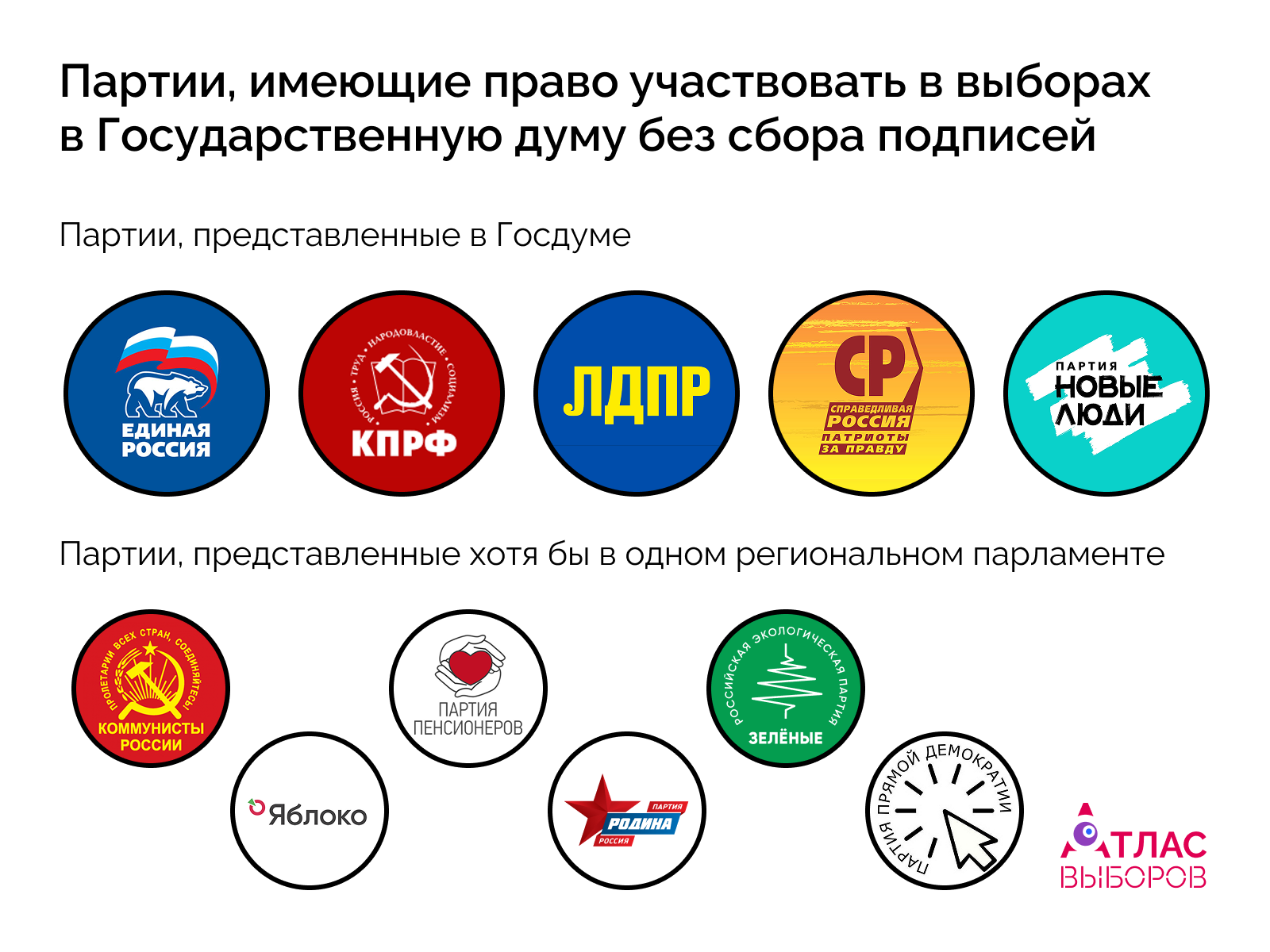
In 2016 and 2021, all parties that held the privilege took part in the State Duma elections, and only those parties. It is entirely possible that the same will happen this time.
Six more parties remain that need to collect signatures in order to take part in the Duma elections. These are the Democratic Party of Russia (DPR), the Party of Progress, the Russian Party of Freedom and Justice (RPFJ), “Party For Justice!”, the Cossack Party of the Russian Federation and the Party of Russia’s Rebirth. The threat of liquidation for insufficient participation in elections already hangs over five of them (all except the RPFJ).
Liquidation of parties for insufficient participation in elections
As for parties being liquidated for “non-participation in elections”, this wording can mislead the uninitiated. In reality it is not about total non-participation in elections, but about insufficient participation. The law requires that within seven years a party must take part either in one of the federal campaigns, or in gubernatorial elections in at least 10% of regions, or in regional parliamentary elections in at least 20% of regions, or in municipal elections in at least half of the regions.
At the same time, the law does not clearly stipulate how the seven-year period is to be counted. It is easy to understand that the first seven-year period is counted from the date of the party’s registration (although, in our view, it would be more correct to count it from the date the party obtained the right to take part in elections).
In the period 2019–2022, 30 parties created in 2012–2015 were liquidated for “non-participation in elections” — they were unable to accumulate the required level of electoral participation during the first seven-year period of their existence. But in 2025 the process of liquidating parties on the “second round” began, that is, parties that had already once successfully passed the electoral participation test.
And a question arose (independent experts had raised it in advance, knowing it would inevitably arise): how should the seven-year period be counted for such parties?
Two approaches are possible. The first approach was proclaimed in a letter published by one of the founders of the “Democratic Party of Russia”, Andrei Bogdanov, in October 2019. If this publication is to be believed (and we have no reason not to believe it), on 16 October 2019 the Ministry of Justice sent a letter to DPR chairman Timur Bogdanov in which it explained: “The 7-year period provided for by paragraph 2 of Article 37 of Law No. 95-FZ is calculated from the moment the record of state registration of the political party upon creation is entered, and thereafter every 7 years respectively.”
It follows from this text that the DPR, registered in May 2012, was supposed to undergo its first check after May 2019 (and it passed it successfully), and the next check should take place only after May 2026. The same applies to the Party of Progress (formerly the Party of Social Networks, then “Civic Position”) and “Party For Justice!” (for the latter the deadlines are after June 2019 and 2026).
Did these parties pass the check? And were there such official checks? We know nothing about this. Unfortunately, neither the Ministry of Justice nor the CEC informs the public of the results of such checks (obliging legislators did not bother to require them to do so, and they themselves do not consider it necessary to share such information). Only in respect of parties whose electoral participation is deemed insufficient do we learn the results of such checks — and even then only from Supreme Court rulings. And if the CEC and the Ministry of Justice consider that electoral participation was sufficient, we are not told.
Nevertheless, the CEC does provide information on parties’ electoral participation in its interactive reference guide. And from that reference guide, as well as from other information on the CEC website, we know that neither the DPR, nor the Party of Progress, nor “Party For Justice!” took part in the 2021 Duma elections or the 2024 presidential elections. These three parties also did not take part in the main regional parliamentary elections in the period 2019–2025. In the same period the DPR took part in gubernatorial elections in three regions, the Party of Progress — in one region, and “Party For Justice!” did not take part in those elections either.
Information on the degree of parties’ participation in municipal elections and by-elections to regional parliaments is less clear. However, from the same interactive reference guide we know that in the period 2019–2025 the DPR did not nominate a single candidate in municipal elections, apart from regional centres. And in regional centres in 2020 it had 22 candidates, but all in one region. In regional parliamentary elections this party had a total of ten registered candidates, that is, knowingly fewer than the required number of regions.
As for the Party of Progress, in the period 2019–2025 it did not have a single candidate registered in municipal elections, and had only eight candidates registered in regional parliamentary elections.
The situation for “Party For Justice!” is little better. In regional parliamentary elections in the period 2019–2025 it had 13 candidates registered, in elections of deputies of regional centres — 23 candidates, in other municipal elections — 17 candidates. So one does not even need to ascertain in how many regions the party took part in elections: it is clear that its tally is no more than 13 regions for regional elections and no more than 40 for municipal ones (in reality fewer).
So we can only wait for the Ministry of Justice to file lawsuits in the Supreme Court for the liquidation of these three parties.
But another approach is also possible. The law, after all, simply states that a party must take part in elections “for seven consecutive years”, not during discrete seven-year periods. It should follow from this that parties older than seven years ought to be checked annually — such a check being a simple matter, since the CEC “has all the moves recorded”.
And the most amusing thing is that in respect of three other parties the Ministry of Justice applied precisely that approach, having “forgotten” about its letter to Bogdanov.
The “Civic Force” party was registered in June 2012. In 2019 it successfully passed the check, because it took part in the 2016 Duma elections. By the logic of the “letter to Bogdanov” it should have been checked next in that same year 2026 (for the period from July 2019 to June 2026). However, the Ministry of Justice checked it in 2024 for the period from 11 September 2017 to 30 September 2024, and on the basis of that check the party was liquidated by the Supreme Court.
The “Civic Initiative” party was registered in May 2013. In 2020 it successfully passed the check, because it took part in the 2018 presidential elections. But the Ministry of Justice conducted the next check not in 2027, but in 2025 — for the period from 25 March 2018 to 27 March 2025. Why precisely from 25 March 2018? Obviously because the presidential elections in which “Civic Initiative” took part were held on 18 March 2018. That is, in this instance the Ministry of Justice effectively decided that the seven-year period should be calculated from the moment of the party’s last participation in federal elections (for “Civic Force”, as we can see, it also granted a one-year deferral).
It is interesting that representatives of “Civic Initiative” cited the Ministry of Justice’s letter of 16 October 2019. However, the court ruling states: “The assertion by the Party’s representatives of the need to calculate the seven-year period established by paragraph 2 of Article 37 of the Federal Law ‘On Political Parties’ from the day of registration and thereafter every seven consecutive years cannot be recognised as sound, because it is based on an erroneous interpretation of substantive law… The letter of the Ministry of Justice of Russia dated 16 October 2019 No. 11-130247/19 is a specific reply to an inquiry from the leadership of another political party and does not concern the Party’s activity.” The court thereby acknowledged that different interpretations of the law are possible in respect of different parties.
A similar situation arose with the “Russian All-People’s Union” (ROS) party. It was registered in June 2012. In 2019 it successfully passed the check, because it took part in the 2018 presidential elections. And the next check occurred not for the period from June 2019 to June 2026 (as had been promised to the DPR), but also not for the period from March 2018 to March 2025 (as happened with “Civic Initiative”). For some reason it was for the period from 8 July 2018 to 16 July 2025. Here one can only speculate: after the Ministry of Justice’s lawsuit for the liquidation of “Civic Initiative”, a reasonable question arose: why had no such lawsuit been filed against ROS, which was in absolutely the same position. And the Ministry of Justice was forced, a month late, to also file a lawsuit for the liquidation of ROS.
If this approach had been applied to the DPR, the Party of Progress and “Party For Justice!”, they should have been liquidated considerably earlier (most likely back in 2021 or 2022), since they effectively stopped taking part in elections from 2014 (when the signature-collection requirement was reinstated).
A question remains regarding two more parties. The RPFJ took part in the 2021 Duma elections, so it can exist quietly until 2028. But the situation with the Cossack Party of the Russian Federation and the Party of Russia’s Rebirth is more complicated. These parties were registered in 2013. In 2020 they successfully passed the electoral participation check, because they managed to take part in municipal elections in more than half of the regions. And what about the subsequent years?
Both parties take practically no part in regional elections. As for municipal elections, the Cossack Party of the Russian Federation took part in them fairly actively in 2019, with 89 registered candidates (according to our data, in 42 regions). But in 2020 — only 14 candidates, in 2021 — eight, in 2022 — 25 (but at least 23 of them in one region), in 2023 — none, in 2024 — four, in 2025 — 16. That is, for the period 2020–2025 it has an insufficient number of regions, and in 2026 it needs either to take part in the Duma elections or to become more active in municipal ones.
As for the Party of Russia’s Rebirth, the peak of its activity in municipal elections came in 2018. In 2019 it had only one registered candidate, in 2020 — eight, in 2021 — none, in 2022 — 28, in 2023 — 14, in 2024 — 11, in 2025 — three. That makes 65 candidates in total. Here one needs to ascertain whether these candidates were in different regions or the same ones, but the resources available to us do not allow an answer to that question. So we cannot say at present whether the Party of Russia’s Rebirth has a sufficient number of regions where it took part in municipal elections.