In December 2021, State Duma deputies Dmitry Lameikin and Dmitry Vyatkin (the “DumaBingo” project classifies the latter as part of the FSB interest-lobbying group) introduced a relatively small bill proposing to add a new article on remote electronic voting to the legislation.
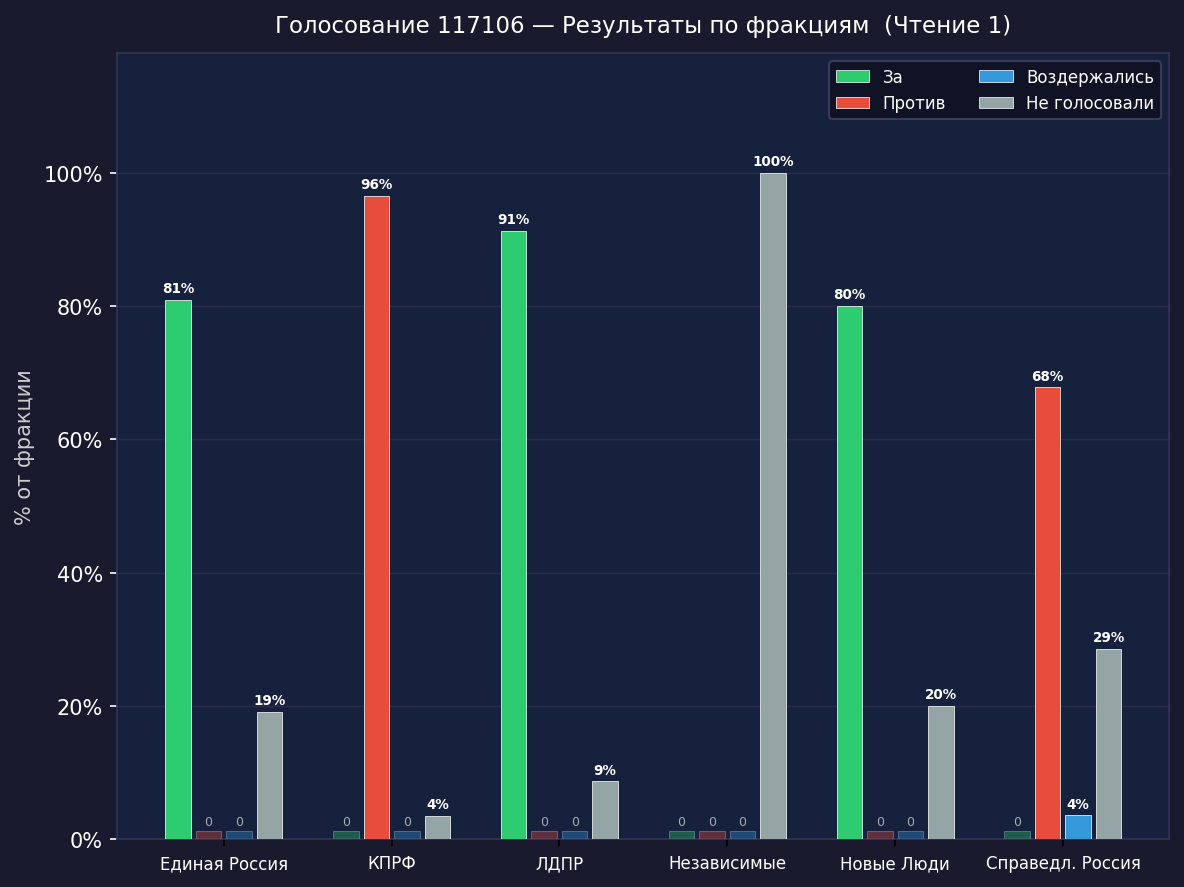
In January 2022, this bill — which later became Federal Law No. 60-FZ of 14 March 2022 — was adopted at first reading. United Russia voted in favour; the LDPR and New People also supported the initiative. The Communist Party (CPRF) and A Just Russia — For Truth voted against. This did not affect the outcome, since United Russia held an absolute majority sufficient to pass any law. Nevertheless, the vote revealed the existence of disagreements on the substance of the proposed changes.
In February 2022, Russia launched its “special military operation”.
After that, deputies Lameikin and Ivlev introduced amendments to the bill, as a result of which its length increased roughly twenty-fold: from nine thousand characters to 186,000 characters. This technique is often used to ensure that significant and potentially contentious legislative changes pass with less public notice. That is exactly what happened: against the backdrop of the outbreak of war, the law was adopted with virtually no public discussion.
Most likely, such an expansion had been planned from the outset: preparing amendments of this volume takes time, and the bill was already adopted at second reading on 10 March.
Restrictions for “extremists”
The expanded version of the bill included numerous changes, but for now we will focus on two of them.
The first is the restriction of the electoral rights of persons convicted under articles of an extremist nature: they were barred from standing for the State Duma for five years after the removal or expungement of their conviction. This provision clearly had very specific political targets: in the summer of 2021, the Anti-Corruption Foundation (FBK) was designated an extremist organisation, and the legislator sought to exclude the possibility of persons associated with it from participating in elections. This concerned tens, if not hundreds, of thousands of activists across the country.
At the same time, a ban was introduced on standing for president for persons linked to “extremist” organisations. Here the period of the ban — five years for a founder or leader and three years for an ordinary participant — is calculated not from the moment the conviction is removed or expunged, but from the date on which the organisation was banned as extremist.
Over the previous ten years, 3,363 people were convicted under “extremist” criminal articles. The statistics for analogous administrative offences are more striking — in 2020 alone, 4,096 people were convicted for producing or distributing extremist materials, as well as for promoting or publicly displaying extremist symbols.
The main problem with the restrictions for “extremists” lies in the very broad (arguably even undefined) definition of “involvement” in extremist activity — even online support or donations made before the organisation was banned can be treated as such. And although “involvement” in such an organisation must be established by a court, the law does not specify a concrete procedure — and subsequent law-enforcement practice has shown that this is by no means mandatory. This manifested itself very starkly, for example, in the elections of deputies to the Berdsk city council in Novosibirsk Oblast, where several candidates were stripped of their passive electoral rights without a court decision.
The abolition of PSG as a weakening of oversight
The second change concerned the abolition of the ability of candidates to appoint members of election commissions with consultative vote rights (PSG) to lower-level commissions: precinct, territorial and district commissions. The ability to appoint PSG to election commissions of the constituent entities of the Federation and to the CEC was retained, but the practical significance of this right is considerably smaller.
A PSG is a commission member who has the right to participate in its meetings and to review documents. Unlike a commission member with a decisive vote, a PSG does not vote at meetings and does not issue ballots. Nevertheless, their status provided significant opportunities for monitoring how the commission works and what decisions it takes.
In practice, PSG represented one of the most effective instruments for monitoring the electoral process. If a candidate, especially an opposition one, had an active and qualified PSG at a polling station, the opportunities for falsification were substantially reduced. With sufficient procedural grounds, such a representative could identify a violation in a timely manner and bring it to public attention.
The majority of falsifications in Russian elections occur either at the level of precinct commissions — through ballot-stuffing, “carousels” or count distortion — or at the level of territorial commissions, where manipulation of protocols is possible. It is precisely in these links of the system that the legislator abolished the possibility of appointing PSG.
How the factions voted
Some parliamentary parties supported a decision that also restricted their own capabilities. PSG were important not only for the non-systemic opposition, which usually has little chance of even reaching candidate registration, but also for the so-called systemic opposition — the parliamentary parties represented in the State Duma besides United Russia. In this sense, it is particularly interesting to see how these parties voted on a bill that also limited their own oversight instruments.
The CPRF took the most consistent position. Of the 57 Communist deputies, at least 55 voted against the bill at all its stages — from the first to the third reading. Only one CPRF deputy once supported one of the amendments at the second reading.
A Just Russia — For Truth ranked second in terms of opposition. At the first reading, of the faction’s 28 deputies, 19 voted against, one abstained, and eight did not take part in the vote.
Before the second reading, two intermediate votes took place: first on the table of amendments, then separately on the amendment to the Federal Law “On Basic Guarantees of Electoral Rights of Citizens”. In other words, the bill was adopted in parts.
At this stage, A Just Russia’s voting looked less definite. Six deputies voted for the table of amendments, only one voted against, 15 abstained, and six did not vote. On the amendment to the law on basic guarantees, three deputies voted against, 15 abstained, and 10 did not take part.
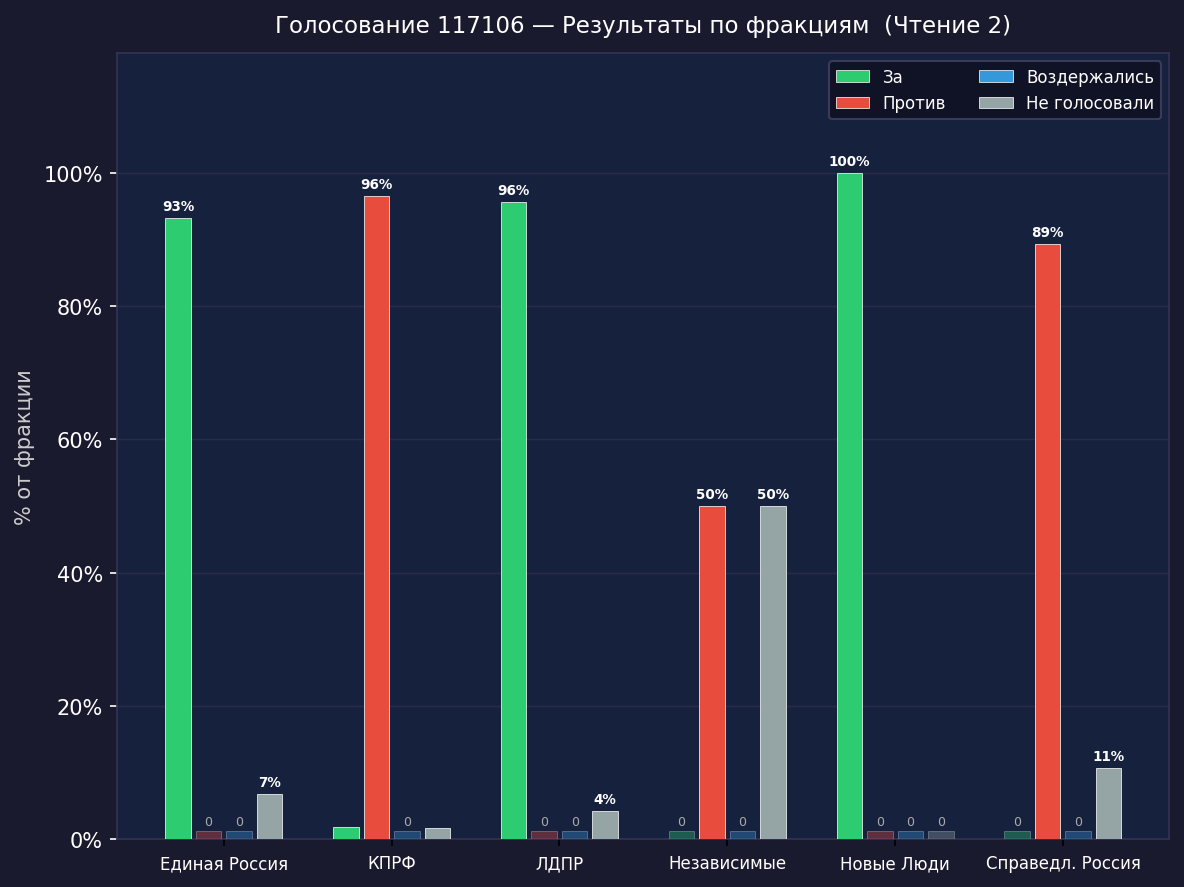
However, later, when voting on the bill at the second reading as a whole, the faction again took a more definite position: 25 votes against, three did not vote.
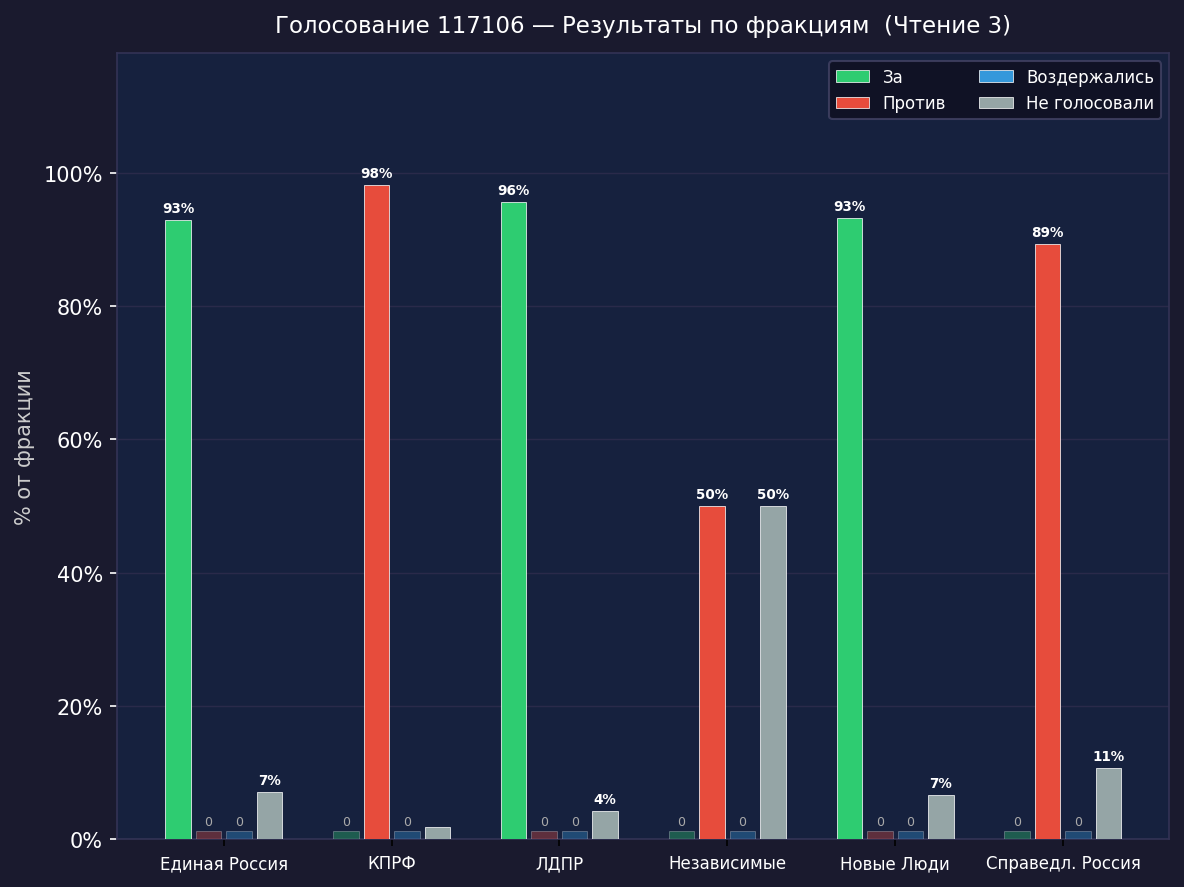
The third reading took place the very next day, 11 March 2022. And at this stage, A Just Russia again voted against the law: the same 25 votes against and three non-participants.
It is difficult to explain the faction’s vacillation before the second reading. The logic of the voting appears unclear. It is possible that the deputies did not receive an unambiguous position from the party leadership and voted situationally, without fully grasping the content of the bill.
The LDPR, which most often votes in agreement with United Russia, behaved differently. At the first reading, 21 deputies of the faction voted in favour, two did not take part. By the second reading, however, it apparently became clear that the bill also affected the LDPR’s own interests, and the faction attempted to demonstrate a restrained distance. Only one deputy voted for the table of amendments, 22 did not take part. On the amendment to the law “On Basic Guarantees…”, not one of the 23 LDPR deputies took part in the vote.
Nevertheless, at the next stage, when voting on the bill at the second reading, 22 LDPR deputies again supported it, and only one did not vote. A similar picture repeated itself at the third reading.
The New People party, which positions itself as a technocratic opposition, also demonstrated duality. At the first reading, 12 deputies voted in favour, three did not take part. On the table of amendments — 13 in favour, two did not vote. On the amendment to the law on basic guarantees, only two deputies supported it, while 13 preferred not to take part in the vote. A direct vote against was probably seen as too risky for them, but open support also raised doubts.
However, at the second reading, all 15 New People deputies voted for the bill as a whole. At the third reading, the picture was close to ordinary support: 14 votes in favour and one non-participation.
As a result, the law was adopted, and the electoral rights and capabilities of Russian citizens were further restricted. This was accomplished not only by United Russia, but also by deputies from formally opposition parties — the LDPR and New People.