In autumn 2026, elections to the State Duma will take place. Ahead of the parliamentary renewal and as election campaigns get underway, DumaBingo recounts the stances deputies took on the most contentious issues.
The report focuses on the legislative activity of the State Duma of the eighth convocation (2021–2026) in the sphere of environmental protection. The authors selected five legislative initiatives that, in their assessment, have inflicted or are capable of inflicting the greatest damage on environmental regulation. They analysed the history of their drafting and passage, their key provisions, the composition of their sponsors and the interests linked to them, as well as voting results broken down by faction.
Initiatives examined:
1. Restriction of public environmental review (PER)
The law introduced a unified state exam and a register of public experts engaged in independent oversight of environmentally hazardous activity. “Foreign agents” and representatives of international organisations cannot be included in the register, and oversight of its maintenance was transferred to Rospotrebnadzor.
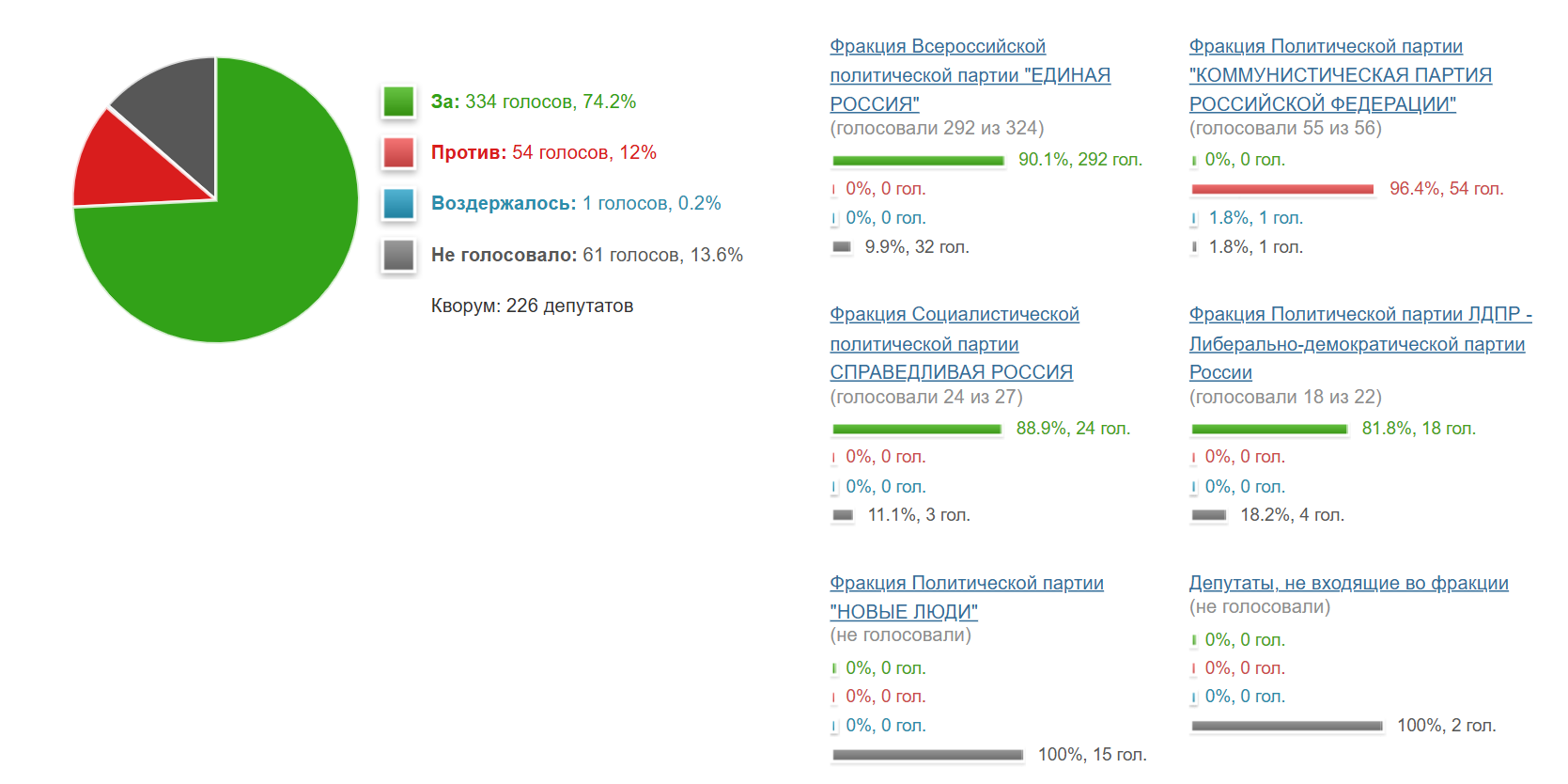
Dozens of environmental organisations opposed it; in parliament their criticism was voiced by deputy Oleg Mikhailov of the Communist Party (CPRF). After lengthy discussions, only one of the disputed points was removed, and the bill itself was adopted: 334 in favour (United Russia, LDPR, A Just Russia), 54 against (CPRF); New People skipped the vote.
2. On forest felling around Lake Baikal
One of the most contentious laws of the eighth State Duma, unofficially dubbed the law “on clear-cutting at Baikal”. After more than three years of debate, the document that became law weakens the lake’s protection regime in favour of infrastructure and tourism development along the shoreline.
The bill split parliament and even broke party discipline inside United Russia: members of the environmental committee Vyacheslav Fetisov (United Russia), Oleg Mikhailov (CPRF) and Anatoly Greshnevikov (A Just Russia) pointed to lobbying disguised as concern for citizens. Nevertheless, the bill was adopted: United Russia, the LDPR and New People voted in favour. The CPRF, A Just Russia and two United Russia representatives voted against.
3. Changing the boundaries of protected areas
A government bill is under consideration that would allow a special commission to remove plots of land from the boundaries of specially protected natural areas (SPNAs) for “economic use”.
The entire “parliamentary opposition” came out against the document in a consolidated manner, pointing to the law’s lack of thorough preparation and its environmental and corruption risks. The bill was adopted at first reading by the votes of United Russia; A Just Russia voted mostly against, the CPRF partly against and mostly did not vote, the LDPR and New People abstained.
4. Regulation of hunting and the hunters’ lobby in parliament
The bill originally envisaged the introduction of testing of hunters’ knowledge by regional authorities. By the second reading, deputy-hunters pushed through amendments adding a second stage: before sitting the exam, an applicant must obtain a certificate of “practical skills” from other hunters and hunting organisations.
The lobbyists managed to establish a mechanism that only formally performs oversight functions, while in reality allowing hunters to earn income through the confirmation of skills. The amendments passed unnoticed. Result: 378 in favour, 0 against, supported by all factions.
5. Taking of Red Book animals
Protection of endangered species has been removed from the level of federal law: the government is now entitled to establish the procedure for their taking through its own resolutions. These changes were adopted without discussion: right at the end of the session, amendments unrelated to the bill’s original subject appeared inside a voluminous bill and went unnoticed by anyone.
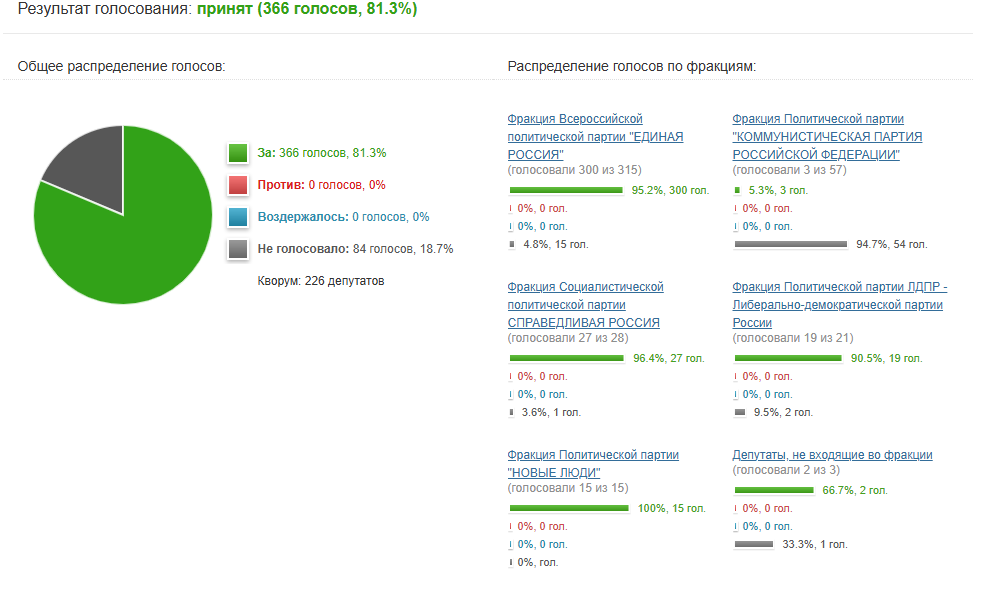
In June 2026, the government used its new powers and approved a new procedure that, in the opinion of ecologists and scientists, permits the shooting of rare species. At the vote, the law received 366 votes in favour and none against; the CPRF faction mostly skipped the vote.
Main conclusions:
The State Duma supports the government’s course of backing business to the detriment of the environment. All five initiatives share one feature: a specific sectoral interest is discernible behind each, be it developers, the tourism, extractive or hunting business. This aligns with the government’s broader course: environmental policy must be pursued without risks to economic growth.
The monopoly of United Russia: the fate of any vote is decided by United Russia representatives. They hold a constitutional majority (72% of seats), so their unanimous support alone is sufficient to pass any law.
The relevant committee is a venue for debate. The Committee on Ecology includes several deputies who defend the interests of nature — Oleg Mikhailov, Anatoly Greshnevikov, Vyacheslav Fetisov. In the State Duma, they and some of their colleagues voice the position of the environmental community. However, they rarely express the committee’s common position — it is chaired by United Russia member Dmitry Kobylkin, who usually supports contentious initiatives.
Deputies from single-mandate districts are freer than “list deputies”. Despite strict party discipline in some Duma factions, on environmental issues an independent position was most often expressed by deputies elected from single-mandate districts. In rare cases, this trend was observed even within the ranks of United Russia.
Publicity and exposure increase the chances of resistance inside the State Duma. The three initiatives that received broad public resonance attracted votes “against” and provoked genuine polemics within the lower chamber. But when lobbyists manage to push through amendments without the attention of the environmental and scientific community, as well as the media, deputies approve bills without even asking questions about them.
“Pure politics is being made out of ecology”: deputies versus public ecologists
In 2023, a law was adopted that changed the rules for admitting citizens to participate in public environmental review (PER) — independent oversight of environmentally hazardous activity. Its authors were United Russia deputies Alexander Kogan, Bekhan Agayev and Maxim Ivanov, as well as Yevgeny Markov of the LDPR.
The law introduced a qualification exam for admission to the review, stripped foreign agents and employees of international organisations of the right to participate in it, and also prohibited the transfer to third parties of project documentation subject to PER.
The main sponsor of the changes was United Russia deputy Alexander Kogan. In the past, he was involved in state policy in the construction sphere, served as ecology minister of Moscow Oblast and as an adviser to the region’s governor Andrei Vorobyov, whose family is linked to the country’s largest developer, Samolyot Group. Kogan’s wife and daughter are also linked to the construction business.
The deputy explained the changes as a defence of the economy, since, according to him, PER is used to pressure business. His party colleague Dmitry Vyatkin clarified: “How many investment projects in areas that are very sensitive for our country [...] were either substantially slowed down or not implemented at all. The damage to our economy may run into trillions of roubles.”
Parliamentarians placed part of the blame for this on foreign organisations and their activists “who ostensibly fight for the environment”. According to the deputies’ design, by making access to PER more difficult they are eliminating the risks of political conflicts: “The task is to move all questions connected precisely with the discussion of environmental reviews out of the political channel and into the expert channel. This is the most important question we need to resolve, because, unfortunately, today pure politics is being made out of ecology.”
Finally, the deputies critically described PER as a “revolving door”. Kogan and Vyatkin noted that previously public organisations could involve any person in a review, “even one who has no knowledge whatsoever”. The examination established by the law, in their view, will make the institution more “transparent, understandable and systemic”.
What is the danger of this law?
The law became deputy Kogan’s second attempt to complicate the procedure for access to PER. In 2022, he proposed allowing only Public Chambers controlled by regional authorities to initiate it and involving only state-certified experts in it, but after a wave of criticism the bill was withdrawn.
That same year, the deputy and his colleagues submitted a new version of the document for consideration, which was opposed by representatives of 44 regional environmental organisations (according to other information — more than 65). In their view, the changes threaten the institution of PER, depriving it of independence — the fundamental principle of public oversight. This will allow business and the authorities to approve environmentally hazardous projects without the risk of public exposure.
Some of the ecologists’ arguments were voiced during the first reading by deputies from the “parliamentary opposition” factions. The most detailed criticism was presented by CPRF deputy and member of the Committee on Ecology Oleg Mikhailov. He stressed that the document practically repeats Kogan’s previous bill.
The deputy reiterated the thesis that the changes undermine the independence of PER: through the expert certification procedure, government bodies will gain the ability to influence public oversight. He pointed out that restrictions on the transfer of project documentation subject to PER could prevent the public from learning about plans to build hazardous environmental facilities near their place of residence or on other vulnerable territories.
Finally, following the ecologists, the deputy criticised the proposal to create a single expert commission in cases where several applications are received to review a facility. Interested clients will be able to register their own NGOs ready to conduct a review in their interests, and then independent experts will be forced to merge with them without the ability to prepare an alternative finding. As a result, this became the only provision that did not make it into the final version of the law.
During the first reading, deputies Georgy Arapov of New People, Sergei Leonov of the LDPR and Andrei Kuznetsov of A Just Russia also drew attention to some of these arguments. However, their speeches were not critical in nature; the parliamentarians merely asked clarifying questions and proposed changes for the second reading.
For example, Kuznetsov, on behalf of his faction, supported the initiative, noting: “Colleagues, let us make a vow to ourselves that we will not restrict our citizens in matters of public oversight of the environment, that we will give them the opportunity at least to talk about it, to declare, to hold some actions and so on.”
At the third reading in 2023, only Mikhailov spoke on the substance of the bill: he expressed the view that the requirements for public experts had become stricter than those for experts of the state environmental review (SER). Moreover, PER findings, unlike SER findings, have no legal consequences and are merely advisory in nature.
As a result, the law was adopted by 292 votes of United Russia, 18 votes of the LDPR and 24 votes of A Just Russia. 54 CPRF deputies voted against and one abstained. New People, in its entirety, skipped the vote.
The main change depriving PER of independence has not yet entered into force — according to a government resolution, experts without official certification and without inclusion in the register will be able to participate in reviews until 1 March 2027.
“Do you hear how Baikal is weeping?” — the main environmental conflict of the outgoing State Duma
From 1 March 2026, clear-cutting of dead forest is possible in the Central Ecological Zone (CEZ) of Baikal if it has lost its “useful functions” and selective felling cannot ensure its effective replacement.
The law on this was introduced in 2022 by seven senators and fourteen State Duma deputies, the majority of whom are United Russia representatives from the Baikal region. Some of them are linked to businesses engaged in construction or logging in Irkutsk Oblast and Buryatia. Among them are deputies Sergei Ten, Alexander Yakubovsky, Maria Vasilkova, Anton Krasnoshtanov and senator Sergei Brilka.
The authors and supporters of the law claim it will help meet the needs of residents of 159 settlements on the territory adjacent to the lake. According to them, the environmental protection status makes it impossible to expand cemeteries, build electricity networks, treatment facilities, firebreaks and roads there.
They present the changes as safe for the lake’s ecosystem, since the government will determine the plots for felling based on the decision of a specially created commission that will include representatives of the State Duma, the Federation Council, the Presidential Administration, the government, the FSB and the authorities of Irkutsk Oblast and Buryatia. If the Russian Academy of Sciences (RAS) gives a positive opinion, they will be able to consider the draft list of lands.
The heads of Irkutsk Oblast and Buryatia were the most clearly interested in the law’s adoption. Special economic zones (SEZs) of the tourism type, in which businesses have already invested, have been established on the shore of Baikal in their regions. However, due to the environmental protection status, construction of many facilities could not begin.
Who came out against?
The discussions took more than three years; during this time the original version of the bill was almost completely rewritten, but its main and most dangerous provision was preserved. It is possible that the bill’s progress was drawn out because of a large-scale public campaign against the felling. The law split the deputy corps and provoked sharp criticism even from some members of United Russia.
A petition against the felling was signed by more than 100,000 people; it was criticised by the Civic Chamber of the Russian Federation, UNESCO, scientists of the RAS, ecologists and human rights defenders. Dozens of articles analysing the bill and business’s interest in it appeared in the media.
87 ecologists sent a letter against the law to Vladimir Putin. Appeals were sent to State Duma Speaker Vyacheslav Volodin from the environmental community, scientists and even the head of the Presidential Human Rights Council, Valery Fadeyev. All of them asked for the felling to be abandoned and pointed to the numerous risks of this bill.
In response to the resistance against the bill, Greenpeace’s activities were declared undesirable in Russia at the demand of a number of State Duma deputies. Later, threats of being declared “foreign agents” were made to other independent experts and scientists who spoke out against it. During one of the speeches in the State Duma, deputy Sergei Ten said: “we declared [Greenpeace] an undesirable organisation, but, as they say, the cause, unfortunately, lives on.”
How was the law adopted?
Presenting the bill at first reading, its supporters in the person of Sergei Ten, Dmitry Kobylkin and Zhanna Ryabtseva insisted that it does not permit clear-cutting. They stressed — at times very emotionally — the need to solve the infrastructure and everyday problems of the citizens of the Baikal region.
Detailed criticism was delivered by several deputies from the Committee on Ecology and prominent defenders of Baikal: Vyacheslav Fetisov of United Russia, Oleg Mikhailov of the CPRF and Anatoly Greshnevikov of A Just Russia. They pointed to the risks of felling for the lake’s ecosystem, the document’s contradictions with Russian legislation, procedural violations and attempts to lobby business interests under the guise of concern for citizens.
In response, the chief lobbyist for the felling, Sergei Ten, accused opponents of the changes of attempting political PR on the Baikal issue and of being out of touch with the real state of affairs: “It causes surprise, if not indignation, the resistance that is put up by practically the same so-called environmental organisations or their representatives when practically every one of the indicated decisions on the development and ecologisation of Baikal is adopted.”
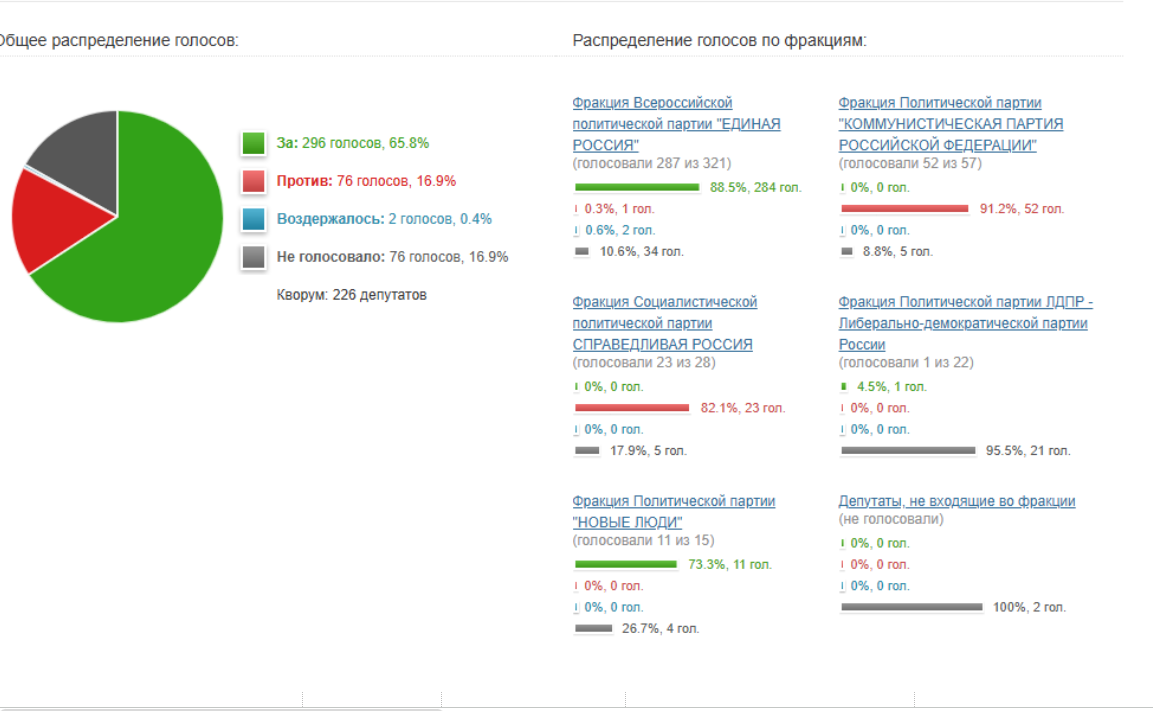
Despite the sharp debate, the bill was adopted at first reading just a few weeks after its introduction. Votes in favour were cast by 284 deputies from United Russia, 11 from New People and one from the LDPR. 52 CPRF deputies and 23 A Just Russia members voted against, while the majority of LDPR representatives — 21 people — skipped the vote. Already at this stage, three United Russia members did not support the bill, thereby violating strict intra-party discipline.
According to deputy Dmitry Kobylkin, to prepare the document for the second reading, the Committee on Ecology he chairs held 60 meetings and discussions with the participation of deputies from the Baikal region, the Ministry of Natural Resources, scientists, the Civic Chamber and regional authorities. However, the new version did not stop the criticism.
The initiative’s movement resumed only at the beginning of 2025, when Vladimir Putin responded to a request by the head of Buryatia, Alexei Tsydenov, to finalise Baikal legislation. The president instructed that the revised bill be adopted, after which discussions resumed. Both the government and the Duma Committee on Ecology recommended its adoption.
During the final reading in December 2025, the polemic continued in the State Duma. Supporters of the bill called the main difference of the new version the complete rejection of the clear-cutting mechanism. Their other arguments remained the same. This time, Minister of Natural Resources of the Russian Federation Alexander Kozlov, the heads of Irkutsk Oblast and Buryatia, as well as other high-ranking representatives of federal and regional authorities, arrived at the session to support them.
Vyacheslav Volodin also joined them. Previously he had claimed the position of an arbiter during the law’s drafting, but at the final plenary session he began threatening its opponents, accusing them of opposing the basic rights of Baikal residents: “Those who sing from Greenpeace’s hymn sheet, go and register yourselves as foreign agents right away.”
Among the law’s opponents, Greshnevikov and Mikhailov again spoke most vividly, as did a number of CPRF deputies. They voiced the concern of the environmental community: the new version of the bill preserves the possibility of felling by using a different legal mechanism — the transfer of forest fund lands to lands of other categories for the creation of necessary facilities. This made it possible to remove plots from the protection of forestry legislation.
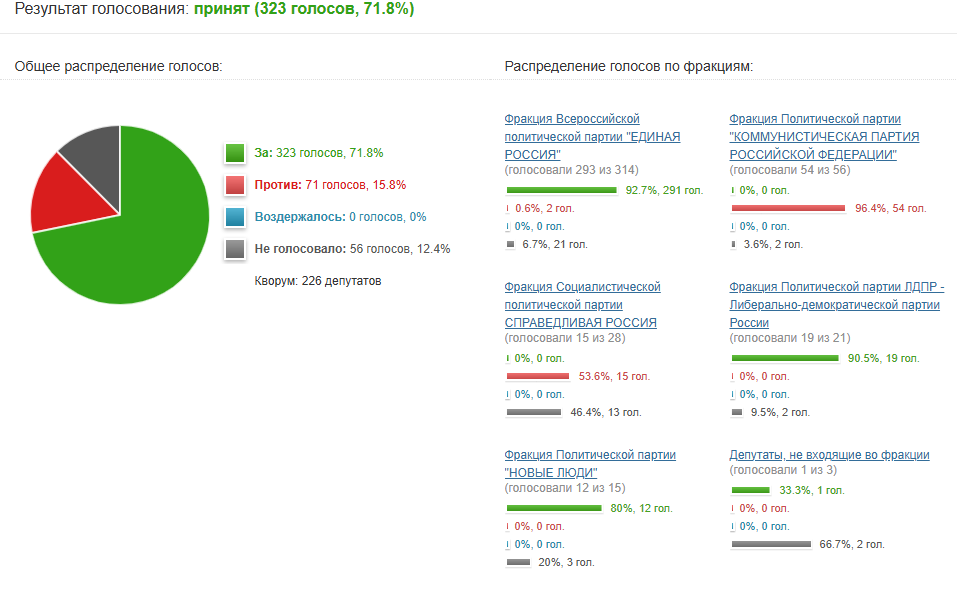
After a lengthy discussion, the law was adopted at the second and third readings. United Russia cast 91 votes in favour, the LDPR — 19, New People — 12. 54 CPRF deputies and 15 A Just Russia members again voted against. Two United Russia members — Vyacheslav Fetisov and Nikolai Buduyev — also voted against. The latter was listed as one of the bill’s authors but subsequently became its public opponent.
What will happen to Baikal?
The document entered into force in March 2026. Soon after its adoption, tourism projects on the lake shore began to expand: the government decreed the creation there of a third SEZ, “Baikal Shore”. According to opponents of the law, the construction of tourism infrastructure, forest felling and the increase in tourist flow will cause irreparable harm to Baikal’s ecosystem.
They note that a practice of abusing clear-cutting has long been established in Russia: 90% of such felling is unjustifiably ordered in healthy forests where it is not required. Oversight of felling decisions also did not inspire experts’ trust — it may be susceptible to corruption. There will be no ecologists or scientists among the members of the commission that will make the decisions.
When approving felling, the commission must rely on the RAS’s opinion; however, as of December 2025, the academy had not developed criteria for this. Moreover, among the high-ranking officials sitting on it are specialists loyal to the felling. Thus, despite numerous protests among its members, the organisation’s vice-president Stepan Kalmykov endorsed the bill on behalf of the RAS.
Because of the felling at Baikal, the fire hazard increases: people will be able to access previously hard-to-reach forests; unscrupulous businesses may try to burn down forest for its subsequent sale; due to the emergence of dry, wind-swept spaces in place of cleared trees, fire will spread faster.
In addition, the operation of heavy machinery and the ploughing of soil will lead to its contamination and erosion, which will destroy the potential of Baikal’s natural ecosystem. As a result of the works, forest organic matter and biogenic elements will enter the lake and bloom there, exacerbating the already acute problem of the proliferation of dangerous algae.
Threats to natural areas across Russia
At the beginning of 2026, the State Duma approved a government bill allowing the boundaries of specially protected natural areas (SPNAs) to be changed. According to the document, land plots that have “lost their environmental protection value” may be excluded from SPNAs for “economic use”.
Decisions on this will be made by a special commission. At the federal level, it will include State Duma deputies, senators, and representatives of the government, the Presidential Administration and the FSB. The composition of regional-level commissions is unknown.
The authorities presented several explanations of why these changes are necessary. Minister of Natural Resources and Environment of the Russian Federation Alexander Kozlov said that the current law on SPNAs regulates the creation of new areas but does not contain a mechanism for changing the boundaries of already existing SPNAs.
He proposed creating one in order to build facilities for defence and security, as well as for the socio-economic development of regions, on protected areas. Changing SPNA boundaries must also be permitted in cases where an area has “lost its environmental protection status due to natural causes”.
During the discussion in the State Duma, Kozlov repeatedly stressed the main idea of the bill — it “is necessary so that the state has the right — not the obligation, but precisely the right — to make decisions”.
Former LDPR deputy and former deputy minister of natural resources Yevgeny Markov insisted that the proposed mechanism would be used only in exceptional cases, since it implies a “fairly complex procedure” and “a whole series of protective mechanisms” — this should prevent the unjustified removal of lands from SPNAs.
The conclusion of the State Duma Committee for the Development of the Arctic, which supported the bill, states that the document’s goal is the socio-economic development of northern regions through the extraction of minerals.
What is the danger?
Representatives of civil society, ecologists, scientists, some heads of SPNA directorates, a representative of the Presidential Administration and many State Duma deputies came out against the bill. During the discussion of the document at first reading, representatives of the “parliamentary opposition” expressed similar arguments as to why the changes would create risks for the protected area system in Russia.
The main concern was summed up in his speech by A Just Russia member Anatoly Greshnevikov: “Under the guise of implementing projects of state significance, practically any commercial projects will be implemented: extraction of minerals, timber harvesting, placement of industrial and sports facilities, landfill sites. Officials at all levels, with predatory zeal, will shrink and dismantle the country’s protected area fund piece by piece.”
In speeches from the factions, LDPR representative Vladimir Sysoyev called the proposal “raw and unworked-out”, Communist Oleg Mikhailov called it “utterly repulsive”, and New People deputy Georgy Arapov stressed the similarity of criticism from the Committee on Ecology, the factions and the Civic Chamber.
Following environmental organisations, deputies repeatedly drew attention to the vagueness of the wording in the bill.
Thus, the bill lacks criteria for “facilities of federal significance” that are permissible to place on SPNA territory. Parliamentarians drew attention to the corruption risks that such wording could engender. A Just Russia member Andrei Kuznetsov stressed: “You say that [the bill] will be protected from corruption, yet on the other hand, it contains concepts that will do everything to ensure it exists.”
Deputies considered the grounds for development in the event of “irreversible complete loss of environmental protection significance” to be an equally abstract formulation. The bill also contains no explanation of this provision. Moreover, New People members Arapov and Oleg Leonov noted that nature can recover naturally even after fires and floods, and it is impossible to establish the fact of “complete loss”.
Many other specific observations were also made. Sysoyev drew attention to their number in the official conclusions on the bill: “The conclusion of the relevant committee — on 19 pages, the conclusion of the Presidential State-Legal Directorate — on 14 pages, the specially reasoned opinion of civil society, the conclusion of the Civic Chamber — on 20 pages.”
Among the bill’s other shortcomings: fire risks, the existence of analogous mechanisms in other laws, the absence of criteria for the sufficiency of SPNA area and strict regulation of tourism in nature reserves, the minimum official level of government representatives on the commissions is not stipulated, nor is the participation of ecologists and scientists in them. The possibility of the commission making decisions by absentee voting was called impermissible.
Reacting to colleagues’ disagreement, United Russia member Vladimir Burmatov stated: “It jarred me today that some are proposing we now take, so to speak, an ostrich position, bury our heads in the sand and pretend before the elections that the problem does not exist, well, sort of let’s leave everything as it is. Colleagues, we cannot leave everything as it is.”
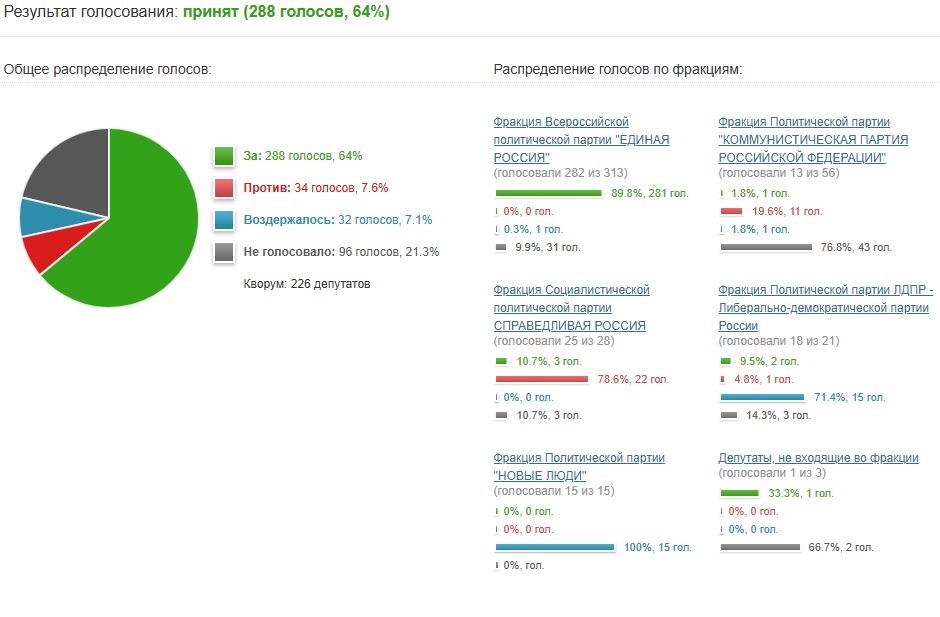
At the first reading, 281 United Russia deputies, one Communist, three A Just Russia members and five LDPR members voted for the bill. Otherwise, the opposition factions stated in their concluding speeches that they were not ready to support the initiative. At the vote, 22 deputies of A Just Russia and one CPRF representative voted against — the Communists mostly skipped the vote. In the LDPR, 15 people pressed the “abstain” button; among New People — 15.
What happens next?
Reacting to criticism from deputies, Minister Kozlov repeatedly proposed discussing their remarks in detail during preparation for the second reading. It is obvious that the bill will be substantially reworked, but its main goal will remain the same — to lift the ban on removing territories from SPNAs. Whatever its final text, the document will most likely become law, since the State Duma almost always approves government proposals.
As many deputies noted, the law opens up the possibility for developing natural areas. Projects for the extraction of minerals, construction of roads, hotels and tourism clusters on the lands of nature reserves and national parks in the Republics of Komi and Adygea, Krasnodar Krai, the Moscow region, Chukotka and other regions are widely known. All of them turned out to be frozen due to the environmental protection status of the territories.
The proposed procedure provides no guarantees for making environmentally sound decisions; it is susceptible to corruption and lobbying. Uncontrolled construction will lead to the fragmentation of natural areas in Russia, thereby destroying the habitats of rare species and animal migration routes. According to Greshnevikov: “We will lose not only territories, we will lose the habitats of those rare, Red Book animals for whose sake these wild nature reserves were created.”
Finally, the bill threatens the international protection of natural areas in Russia. In response to Vladimir Sysoyev’s proposal to exclude SPNAs with UNESCO World Heritage status from the law’s effect, Minister Kozlov proposed adding the opposite for the second reading: “Article 13, which we have provided for, makes possible the emergence of legislation of the Russian Federation that will take precedence over those norms and that international law that today dictates terms to us. […] We are a country that does not have this right, that is, specialists from other states, other institutions determine these tasks for us. Well, let us make it so that this right appears.”
The quiet lobbying of hunters in the State Duma
All the bills mentioned provoked resistance even at the consideration stage. Because of this, some of them could not be adopted on the first attempt, discussions dragged on, generated sharp debate and a split within the deputy corps — in the current State Duma this happens extremely rarely.
However, not all proposals dangerous to the environment became laws amid wide publicity and close public attention. Some of them remained unnoticed, and, despite their potentially negative impact, deputies adopted them indifferently. What changed?
In 2021, the government introduced a bill tightening the procedure for citizens to obtain a hunting permit (the legal right to hunt). Previously, it was sufficient merely to sign a document acknowledging knowledge of the rules without any confirmation. According to deputy Zarif Baiguskarov, because of this, previously “about 50,000 violations are detected annually [...] in connection with the incorrect use of weapons, with illegal hunting and so on. Of course, people get injured, die while hunting”, “people do not know what the Red Book is and which animals are listed in the Red Book, people do not know how to orient themselves.”
From 1 September 2025, a mandatory check was established. To obtain a hunting permit, applicants must pass a test of knowledge of the hunting minimum administered by regional authorities.
By the second reading, deputies introduced amendments and complicated the procedure by adding a second stage to it. To be admitted to the test, one must “confirm practical skills”. This can be done only through hunter-mentors, legal entities or individual entrepreneurs with the right to conduct hunting management, or through a large self-regulatory organisation (SRO) of hunting users.
They can independently establish the procedure for checking skills, the results of which are not monitored. No liability is provided for confirming non-existent skills.
As a result, during the second and third readings, none of the deputies spoke against it or asked questions — the law was adopted unanimously, as happens in the State Duma most often.
The changes for the second reading were prepared by deputies who themselves engage in hunting. Their chief lobbyist is United Russia deputy Vladislav Reznik, a trophy hunter and co-founder of the “Mountain Hunters Club” (KGO). In the lower chamber, he heads the inter-faction working group on improving legislation in the field of hunting, and his son and business partners are engaged in business in this sector.
Besides him, United Russia members Igor Shubin, Mikhail Kislyakov, Alexander Sholokhov, Dmitry Valuyev, Dmitry Kobylkin — the head of the Committee on Ecology, Alexei Chepa of A Just Russia and Rifat Shaikhutdinov of Civic Platform (a member of the LDPR faction in the State Duma) also engage in hunting.
The mechanism they proposed created a new source of income for hunters and hunting organisations. This creates risks of corruption and commercialisation in the issuance of hunting permits. Paid services for preparation for certification and remote processing of skill certificates have already appeared on the market. For example, one service offers to issue a document based on an online test with an unlimited number of attempts.
The law also creates risks of market monopolisation: the lobbyists established strict qualification requirements for the SRO of hunting users. To confirm hunters’ skills, it must unite no fewer than 250 legal entities or individual entrepreneurs and have branches in more than 75 constituent entities of the Russian Federation. No organisation in Russia has yet received this status. Moreover, as the sole contender for this role in 2023, the Rosokhotrybolovsoyuz (RORS) was proposed. At that time, it was headed by deputy Reznik’s former assistant Tatyana Aramileva — she was the one who nominated her own organisation’s candidacy.
Reacting to the bill, relevant environmental organisations, experts and the media paid attention only to the second stage of certification — the exam in regional government bodies. This novelty received a restrainedly positive assessment, capable of influencing hunters’ competence. The first stage of the procedure, controlled by the hunting community, received no publicity whatsoever.
Who threatens Red Book animals?
The emergence of a new source of income for hunters is not the lobbyists’ only success in the current convocation. In 2025, the State Duma approved a law by which the government vested itself with the authority to establish the procedure for taking Red Book animals. The changes were approved unnoticed, without any public or expert discussion.
In its original version, the document did not touch on hunting issues at all and was devoted to the timelines for providing certain state services. A week before the State Duma went on summer recess, the government introduced amendments on Red Book animals into the bill. Previously, they had not been mentioned at any stage of the law’s discussion, as a result of which the Duma Committee on Ecology was not even involved in their expert review.
The government did not comment in any way on why these changes were needed. They were hidden inside a document of 200 pages and 70 articles amending 68 laws, which was adopted just nine days after their introduction. It is possible that, within such a compressed timeframe, none of the deputies even had time to familiarise themselves in detail with the bill’s content.
Even during the first reading, Communist Vyacheslav Markhayev voiced his suspicion: “In a string of an unjustifiably large number of initiatives — on 278 pages — collected into a single bill and having different subjects and spheres of legal regulation… Either this is a lobbying initiative, or a hasty one. It is strange that the explanatory note consists of only three pages and on three pages — a list of federal laws that must be amended, there are 57 of them. […] Would you not like, without haste, to break your initiatives into homogeneous groups and consider them separately?” The deputy received no answer to his question.
At the final reading, the document was adopted unanimously; 366 deputies supported it. Only CPRF representatives skipped the vote, though why is unknown. During the first reading, their disagreement with the initiative concerned precisely its original design, not hunting issues.
What happens next?
When the opportunity for parliamentary debate had already passed, the government used its new powers and on 1 June 2026 published a new procedure for the taking of Red Book animals. It establishes the cases in which hunting is permissible and also introduces the issuance of permits through Gosuslugi.
The Ministry of Natural Resources and Rosprirodnadzor stated that the changes do not expand the grounds for issuing hunting permits but merely alter the procedure for their provision and oversight. However, representatives of the environmental community expressed concerns about these measures.
Regardless of the possible consequences of the changes, their legal meaning is simple: the highest legislative barrier that directly protected rare species was removed, and regulation was pushed down to the lower and less public level of government by-laws.
The main concern of the resolution’s opponents is the threat of a reduction in the numbers of endangered species. The RAS drew attention to the fact that the new procedure replaces the current term “obtaining” of rare species with the more dangerous “taking”, which implies not only the capture of animals but also their shooting or capture with subsequent killing.
The “Earth Touches Everyone” project also calls dangerous the provision permitting taking “for the purposes of conserving wildlife objects” — these purposes are not specified in any way and open up opportunities for corrupt decisions.
The resolution also permits the taking of rare animals for the purposes of monitoring population status. Experts insist that this may lead to their death, especially since modern methods allow monitoring without killing.
The amendments may benefit structures linked to deputy Reznik and his former aide Tatyana Aramileva. Aramileva now heads the hunting department of the Ministry of Natural Resources — she was appointed to that post just two months before the State Duma passed the law on the Government’s new powers. The official previously stated that “hunting is the most effective mechanism for protecting rare and endangered species.”
Reznik, for his part, proposed introducing “conservation hunting, i.e. trophy hunting” for Red Book species, so that the proceeds from hunting permits could fund projects to protect rare species — an idea he has been promoting since at least 2018. The adopted amendments could bring its implementation closer.