The “Atlas of Elections” project has launched a weekly monitoring programme of federal television channels during the State Duma deputy election period. We will track how equitably the activities of election participants are covered on state-controlled federal television channels.
Television remains one of the main sources of information for many Russians. At the same time, society assigns a special role to the media — they are responsible for creating conditions for citizens to engage in public political discussion. Both the Russian Constitution and many international pacts require the media to adopt ethical and balanced positions and to cover the course of elections in a fair, balanced and impartial manner. Media representatives must not engage in campaigning.
The results of the media monitoring will be published weekly.
Key findings for the second week of the campaign
- Attention to the elections increased significantly during the second week of the election campaign, with television channels devoting a total of 105 minutes to the topic — six times more than the week before. Admittedly, out of the 217 news bulletins broadcast across the six channels during the week, only 19 mentioned the elections — that is less than 9%. All the other bulletins aired without any mention whatsoever of the main domestic political event.
- Over 80% of airtime went to a single party — United Russia, which held its pre-election congress. This is almost five times more than the LDPR received, even though the LDPR also held its congress during the same week — and 5.5 times more than the CPRF congress received the week before. The congresses of Yabloko, Rodina and the Party of Pensioners, which also took place during the second week, received no attention from the television channels at all.
- Aside from United Russia and the LDPR, only the CPRF received brief mentions, after its Moscow Oblast branch nominated a list of candidates for regional elections. New People appeared exclusively in stories unrelated to the election campaign.
Also, one of the most acute socio-economic topics of the week — the fuel crisis — was entirely absent from discussion in the context of the election campaign, despite its obvious public significance.
Number and content of news stories
The television channels’ attention to the elections during the second week of the campaign grew slightly, but remains extremely modest.
Table. Share of television news bulletins containing election stories, over the two weeks of the election campaign, 16 June — 28 June 2026
| Television channel | First week | Second week |
|---|---|---|
| Channel One | 12.12% | 15.79% |
| “Rossiya 1” | 9.68% | 16.67% |
| NTV | 0% | 10.34% |
| Channel Five | 0% | 4.17% |
| TVC | 4.17% | 3.57% |
| OTR | 0% | 3.28% |
In total, out of the 217 news bulletins broadcast across the six channels during the week, only 19 mentioned the elections — that is less than 9%. All the other bulletins aired without any mention whatsoever of the main domestic political event. Channel One and “Rossiya 1” mentioned the elections more than the others, but even they did so only six times each (i.e. in just 16-17% of their bulletins). Channel Five, TVC and OTR are the clear outsiders by this indicator.
However, the duration of election stories increased significantly. Whereas last week it amounted to less than 17 minutes, this time the television channels devoted almost 105 minutes to the elections — six times more.
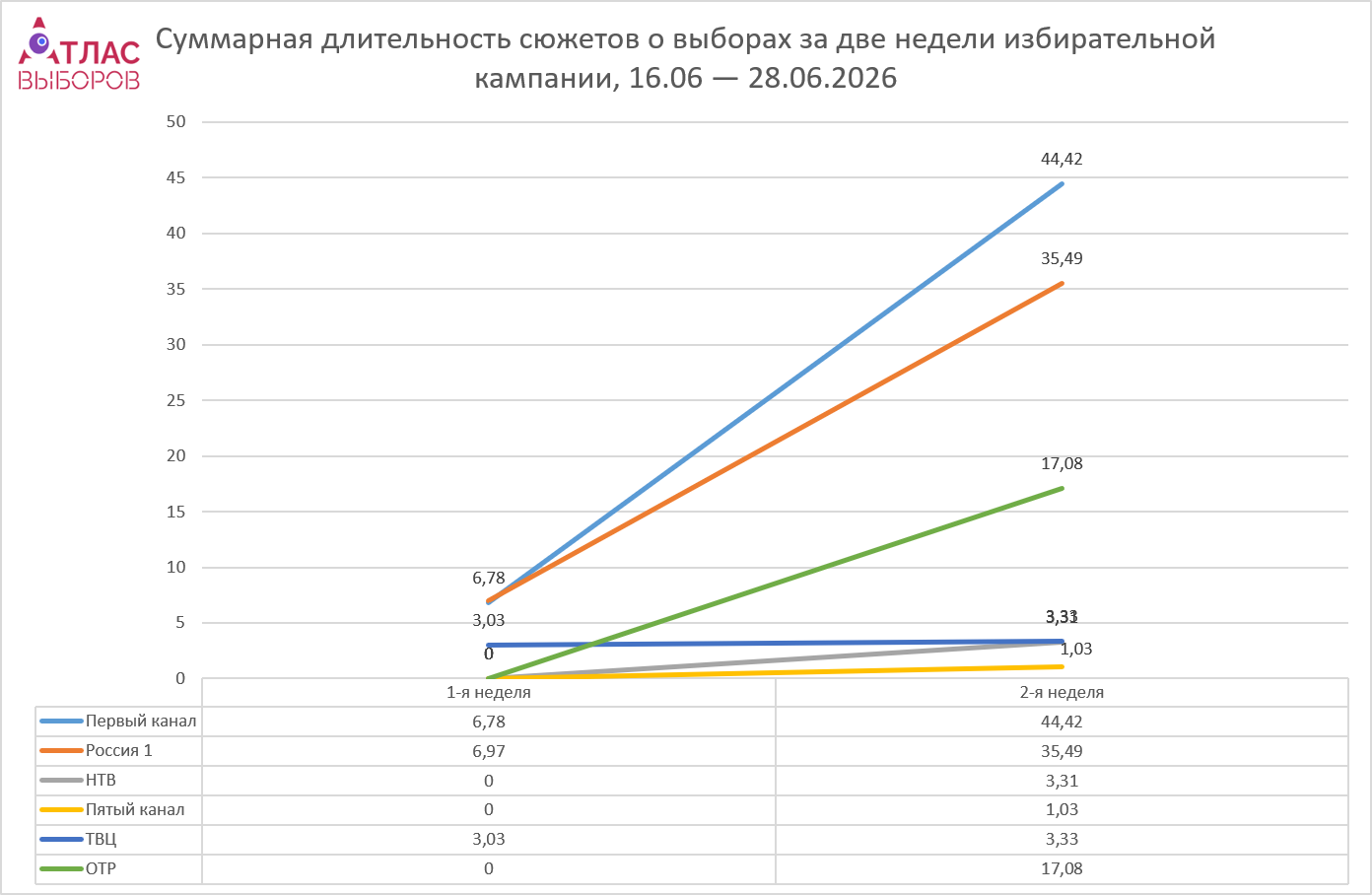
Not one of the television channels reported on all the political parties that have already entered the electoral race (taking into account those that have already held their pre-election congresses, there are five of them). Channel One, “Rossiya 1”, NTV and OTR mentioned two political parties each. During the past week, TVC reported only on the LDPR. Channel Five ignored the elections entirely.
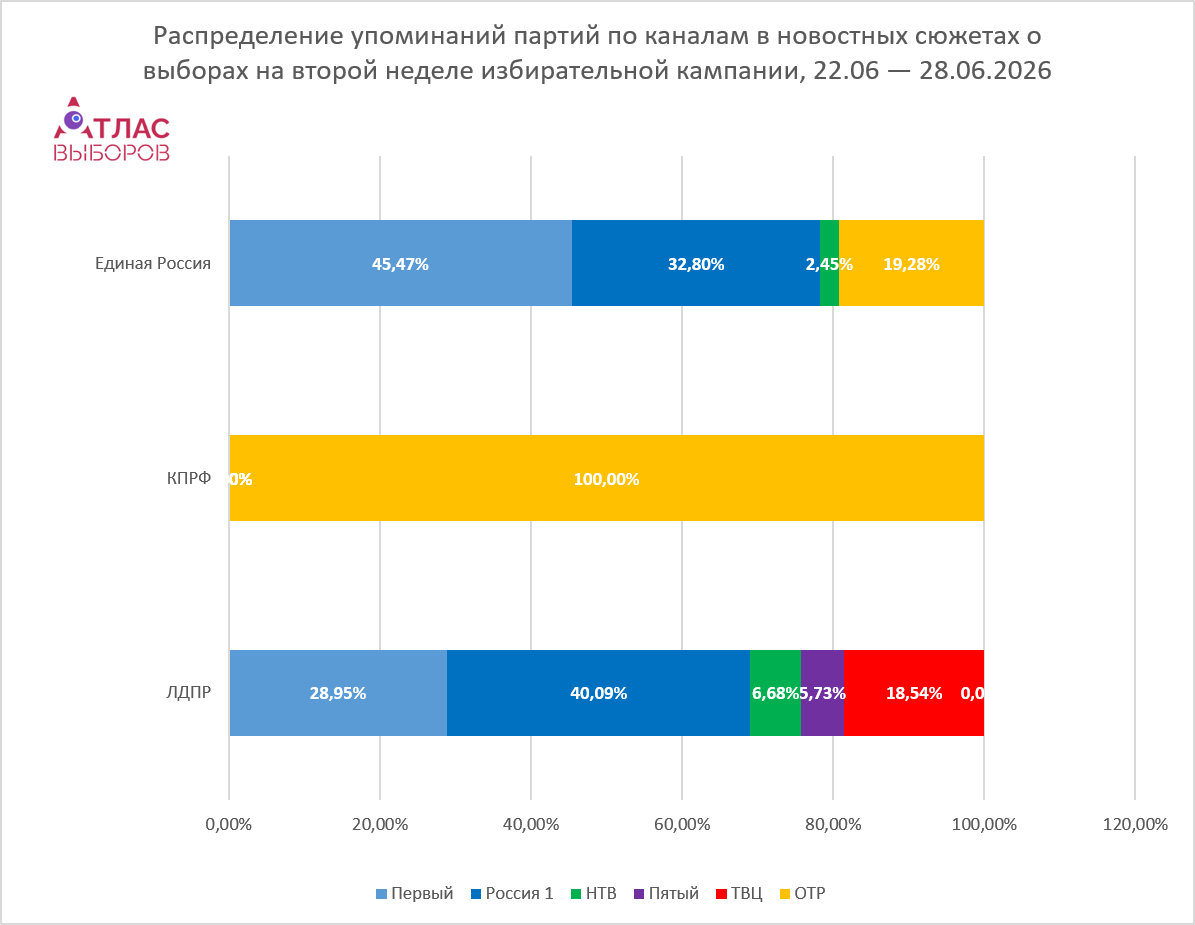
Number of mentions of political parties
While during the first week of the campaign there really were almost no pre-election events (only the CPRF congress), the second week was considerably more eventful. Five parties that enjoy the “parliamentary privilege” (meaning they are not required to collect voter signatures in support of their nomination) held their pre-election congresses, at which candidates were nominated: the LDPR, the Party of Pensioners, Yabloko, Rodina and United Russia. This provides an opportunity to compare how television channels cover identical events of different parties, and whether the principle of equality for election participants is observed in their broadcasting.
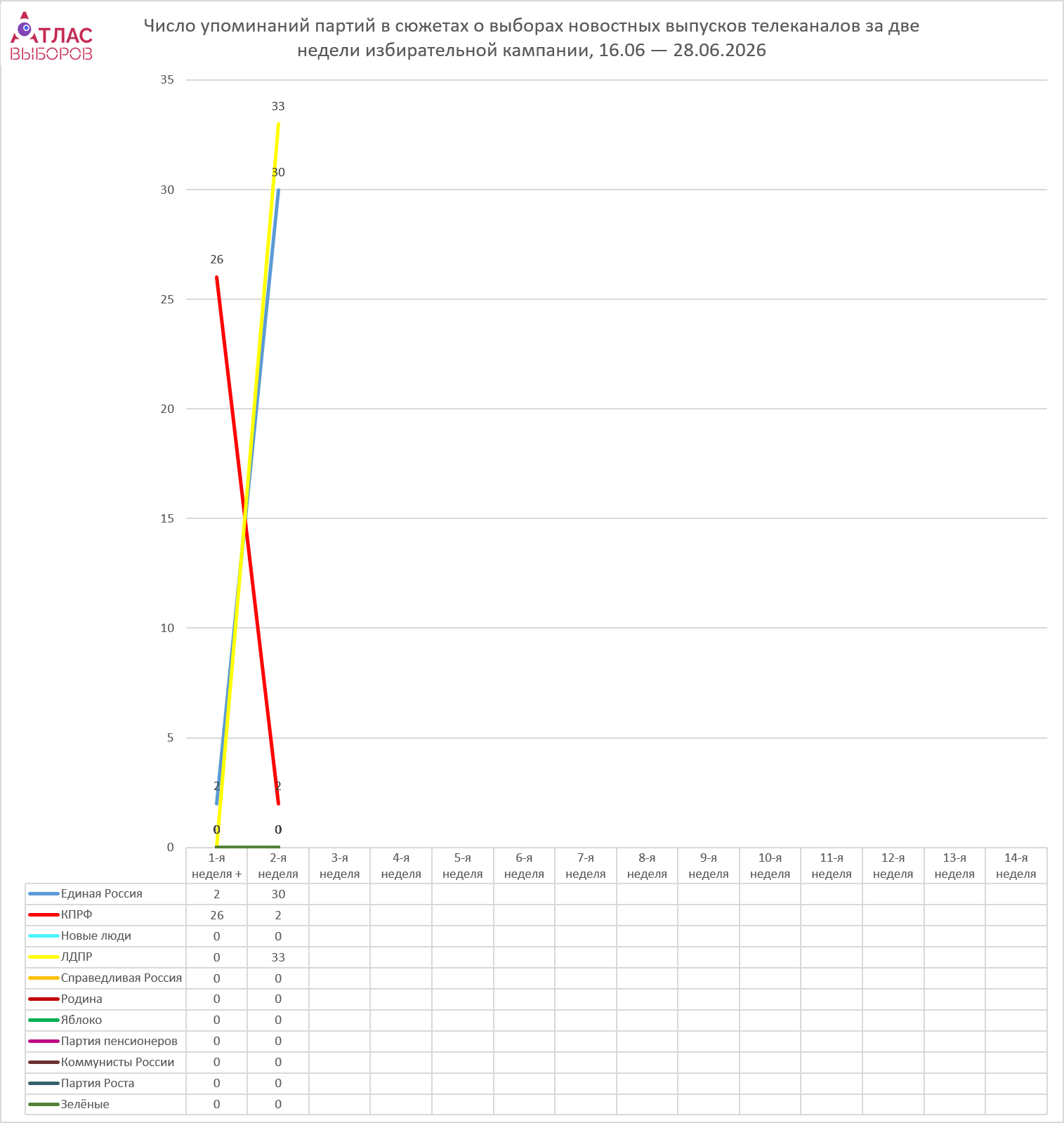
The main newsworthy events of the week were the 23rd congress of the United Russia party and the pre-election congress of the LDPR. Both congresses were covered more actively than the CPRF congress held the week before. The congresses of the Party of Pensioners, Rodina and Yabloko received no mentions at all.
The United Russia congress had the most extensive presence on the air. The stories centred on Vladimir Putin’s participation in it and his speech, emphasising the connection between the party and the president. A number of stories relayed the president’s talking points about Russia’s confrontation with Western countries and the special military operation. Stories about the party congress also presented the federal part of the candidate list (it was stressed that holders of the title of Hero of Russia were included in the top five of the list, and that one of the key principles for forming the candidate list was the nomination of participants in the special military operation) and discussed the party programme.
The LDPR is in second place by the amount of attention received. The stories reported on the party’s pre-election congress, the approval of the federal candidate list for the State Duma elections, and the presentation of the “100 Days of Transforming Russia” programme, which includes a broad set of social, economic and political initiatives. Special attention was given to support measures for participants in the SMO and their families. The stories also included direct speech from Leonid Slutsky, who spoke about the importance of victory in the special military operation for the future of Russia.
Unlike the previous week, when the CPRF congress was one of the most notable events on the pre-election agenda, the television presence of the CPRF this week was minimal. The main newsworthy event was Gennady Zyuganov’s birthday, as he received congratulations from the president and fellow party members. A short story was devoted to the activities of the party’s regional branch. The OTR channel reported on a conference of the Moscow Oblast branch of the CPRF, devoted to the nomination of candidates for the regional elections. In total, the CPRF received just half a minute of attention from federal television channels this week.
The congresses of Yabloko, Rodina and the Party of Pensioners were not covered on any of the channels, nor was the verdict in the political criminal case against the deputy chair of Yabloko, Maxim Kruglov. New People were mentioned only in two stories on Channel Five, devoted to youth policy and a street art festival. Both of these reports were presented without connection to the election campaign.
Distribution of airtime between parties
The distribution of airtime and newsworthy events during the second week of the election campaign records a substantial dominance of United Russia on the federal television agenda.
It accounted for 86.25 minutes of airtime, that is, over 80% of the time devoted to all the political parties.
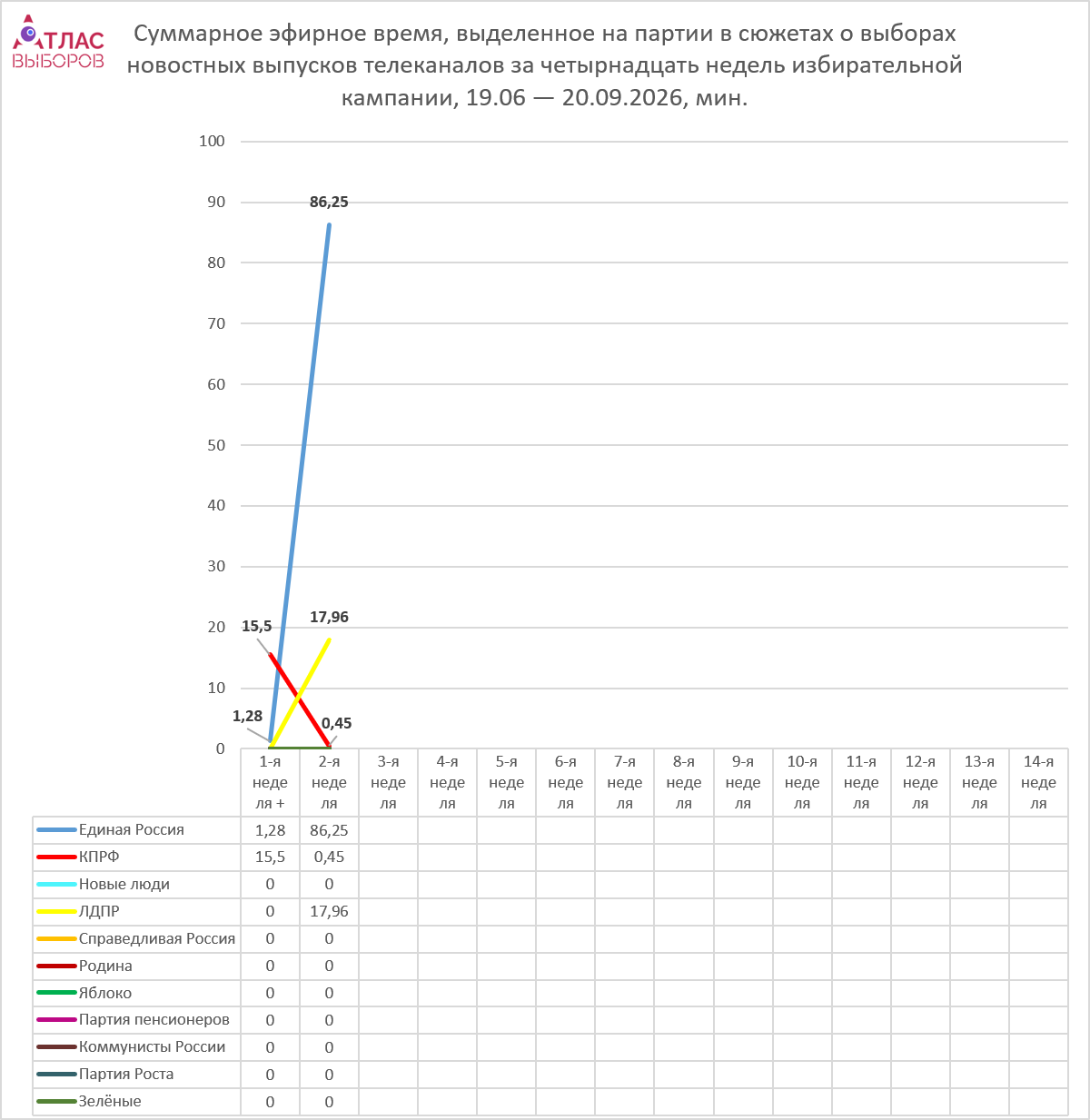
Second place by airtime duration went to the LDPR party and its party congress: almost 18 minutes and 33 mentions.
Unlike the previous week, when significant attention was given to the CPRF congress, this week the party received less than a minute of total airtime and only two mentions. Only the activities of the party’s regional branch were mentioned in the context of the elections.
The New People party appeared exclusively in stories unrelated to the election campaign. Other parties received no mentions on the air this week.
Tone of mentions
The coverage of United Russia’s activities was predominantly positive in nature. In the stories, the party was presented as the country’s leading political force, responsible for implementing state policy and supporting participants in the special military operation. The reports repeatedly used positive characterisations of the party and its candidates. For instance, “Rossiya 1” stories stated that United Russia is the country’s largest and leading political party. On OTR, United Russia was characterised as the “leader party”, “pillar of the state”, “close to the people”, “patriotic” and “responsible”.
The LDPR was also covered in a predominantly positive tone. The stories recounted the party programme, social initiatives and candidates in detail, and the direct speech of the party leadership was also widely quoted.
The rare mentions of the CPRF were neutral in character on this occasion. As in the previous week, no negative stories about the parliamentary parties were identified.
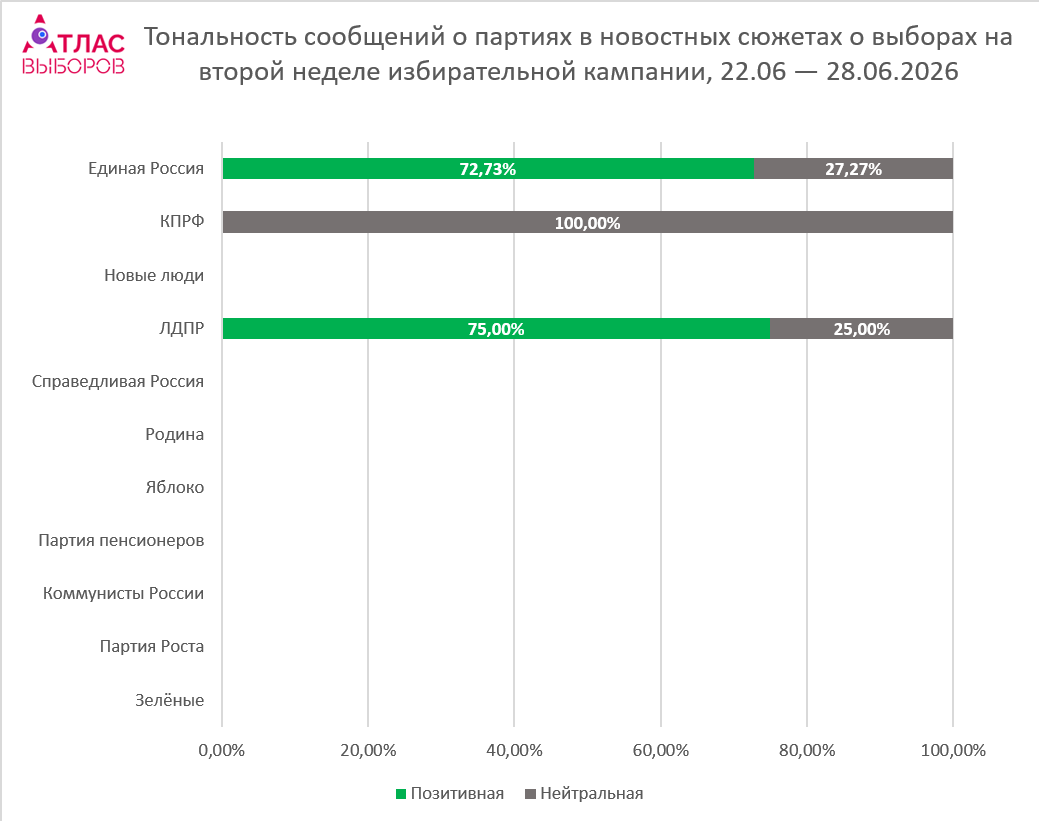
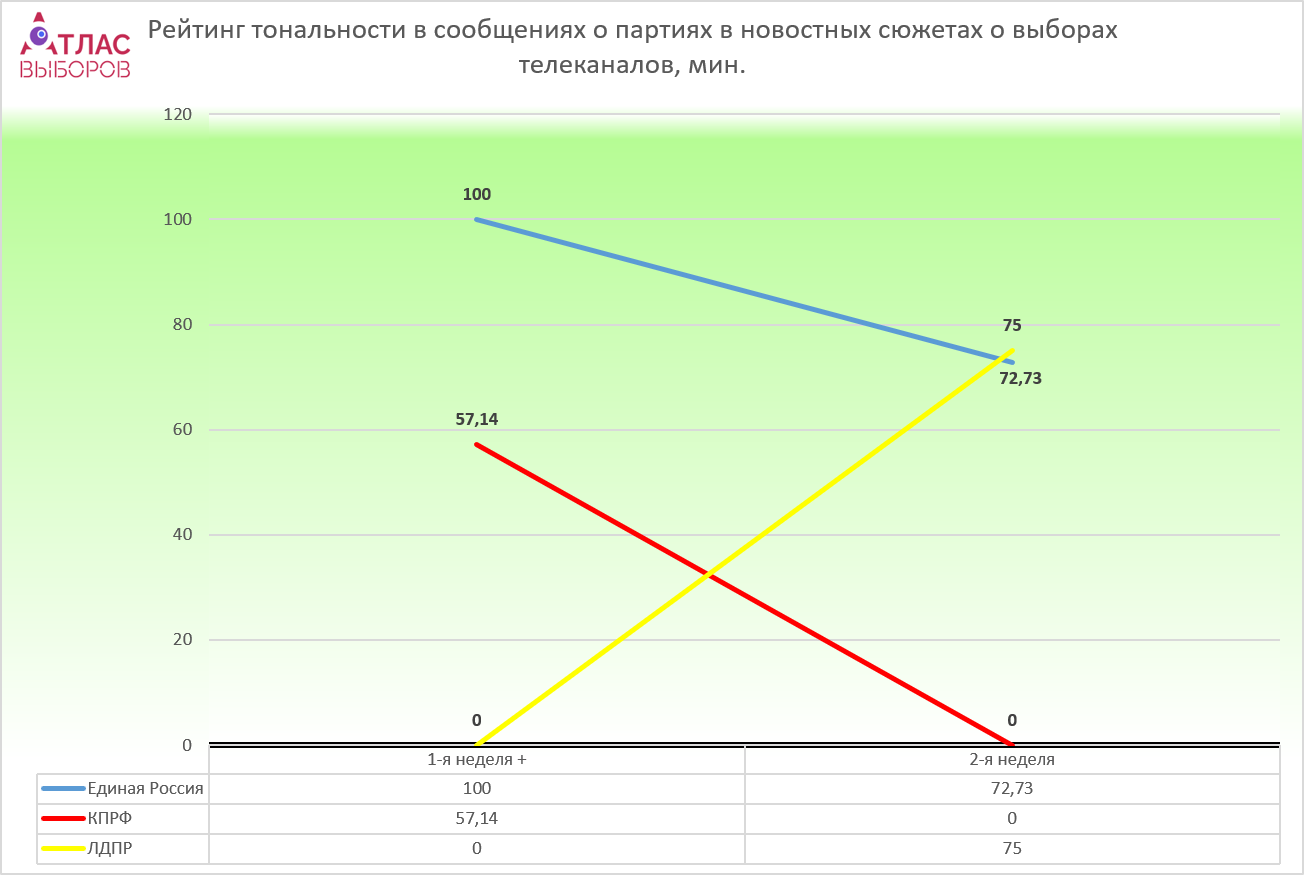
As a result, in the tone rating (the difference between positive and negative evaluations), the LDPR slightly overtook even United Russia in the second week, while the CPRF’s figure dropped to zero.
Methodology
Six federal television channels were selected for the media monitoring, those included in the first multiplex and enjoying the greatest popularity with television viewers — Channel One, “Rossiya 1”, NTV, TV Centre, Channel Five, OTR.
On each of the six television channels, the news bulletins available in video archives were analysed. During the second week of the election campaign from 22 to 28 June 2026, 217 news bulletins were studied (Channel One — 38 bulletins, “Rossiya 1” — 36 bulletins, NTV — 29 bulletins, TVC — 29 bulletins, OTR — 61 bulletins, Channel Five — 24 bulletins).
We analysed each news bulletin for the presence of stories about political parties. If stories about parties were present, we were interested in the following indicators:
- number of mentions;
- time allocated to the party;
- tone of the information (positive, neutral, negative);
- presence of direct speech from party representatives;
- presence of voter opinions about the parties in the story;
- characterisations of the parties voiced by the anchor or voiceover.