Report on monitoring of federal TV channels during the first week of the election campaign for the elections of deputies to the State Duma of the Russian Federation of the ninth convocation, scheduled for 20 September 2026
The "Atlas of Elections" project has launched a weekly monitoring programme for federal TV channels during the State Duma elections. We will track how equal the coverage of election participants' activities is on state-controlled federal TV channels.
Television remains one of the main sources of information for many Russians. At the same time, society places a special role on the media — they are responsible for creating conditions for citizens to conduct public political discussion. Both the Russian Constitution and many international covenants require the media to take ethical and balanced positions and to cover the electoral process in a fair, balanced and impartial manner. Media representatives must not engage in campaigning.
The results of the media monitoring will be published weekly.
Main findings for the first week of the campaign
-
TV channels virtually ignored the start of the election campaign. Over the first six days, which encompassed the announcement of the start of the election campaign, the pre-election congress of the Communist Party (CPRF), the announcement of United Russia's preparation of its election programme, the beating of a potential candidate for deputy from Chelyabinsk, Vladimir Kornev, a court hearing in the criminal case against Yabloko deputy chairman Maxim Kruglov and other events, six leading TV channels devoted less than 17 minutes to the participation of political parties in the elections.
-
The only participants in the pre-election news agenda were the CPRF and United Russia; three other parliamentary parties received isolated mentions, none of which were related to the elections. The remaining parties were not mentioned at all during the first week of monitoring.
Methodology
Six federal TV channels included in the first multiplex and enjoying the greatest popularity with viewers were selected for the media monitoring — Channel One, Russia 1, NTV, TV Centre, Channel Five, OTR. On each of the six TV channels, news bulletins available in the channels' video archives were analysed. The Central Election Commission (CEC) of the Russian Federation announced the start of the election campaign on 16 June. Thus, over the partial week from 16 to 21 June 2026, 193 news bulletins were studied.
We analysed each news bulletin for the presence of stories about political parties. If stories about parties were present, we were interested in the following indicators:
- number of mentions;
- time allocated to the party;
- tone of the information (positive, neutral, negative);
- presence of direct speech by party representatives;
- presence in the story of voters' opinions about the parties;
- characteristics of the parties voiced by the presenter or voice-over.
Due to the fact that the elections were called on Tuesday 16 June, the first week includes monitoring data for six days from 16 to 21 June 2026.
Number and content of news stories
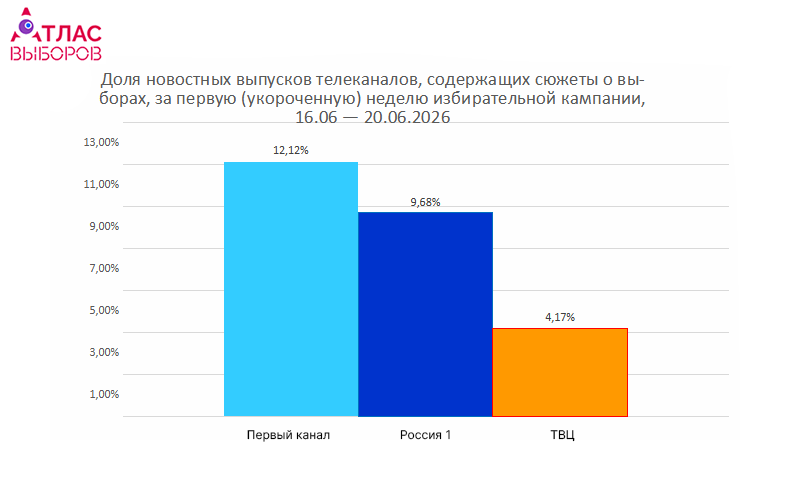
During the first week of monitoring, out of 189 bulletins analysed, only a small portion contained mentions of the elections or political parties. On Channel One, the share of such bulletins was 12.1%, on Russia 1 — 9.7%, on TV Centre — 4.17%. On NTV, coverage of the election campaign was limited to a report on the upcoming elections without mentioning political parties. OTR and Channel Five did not mention the start of the elections to the federal parliament at all.
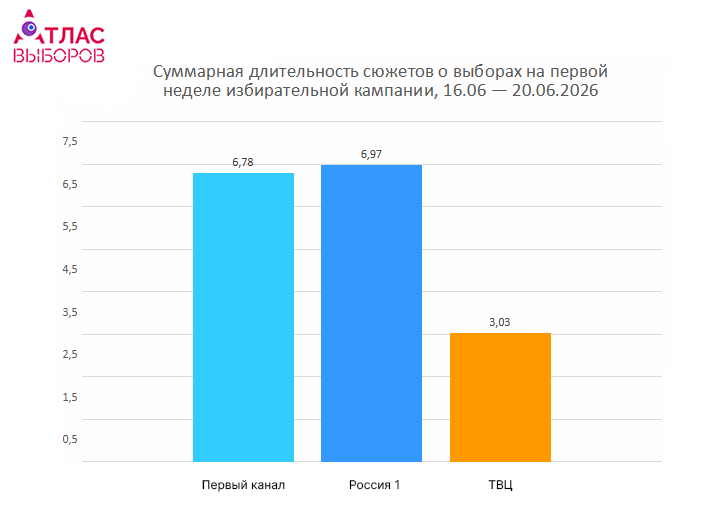
The duration of these stories was also extremely modest: Channel One and Russia 1 each devoted less than seven minutes to this most important political topic, and TV Centre — just over three.
The main news pegs were the start of the election campaign, the 19th Congress of the CPRF and United Russia's preparations for the elections. At the same time, a significant portion of the mentions of political parties were related not to the elections, but to their current socio-political activities.
The most notable event of the first week of the campaign was the 19th Congress of the CPRF, which was covered by Channel One and Russia 1. The stories reported on speeches by the party leadership and the presentation of the election programme.
United Russia was mentioned in connection with the preparation of its programme for the elections, as well as in stories about events dedicated to the anniversary of the start of the Great Patriotic War and volunteer actions.
Separate stories were devoted to the start of the election campaign. This topic was covered in the greatest detail on the Russia 1 TV channel, where direct speech by the Chair of the Central Election Commission, Ella Pamfilova, was aired. The reports stressed that the elections would be held in the context of the ongoing special military operation, and also noted the participation in voting of residents of regions located in the zone of military operations.
At the same time, for example, the criminal court process against the deputy chairman of Yabloko — a party that enjoys a parliamentary privilege — was not mentioned at all.
Number of mentions of parties in news stories
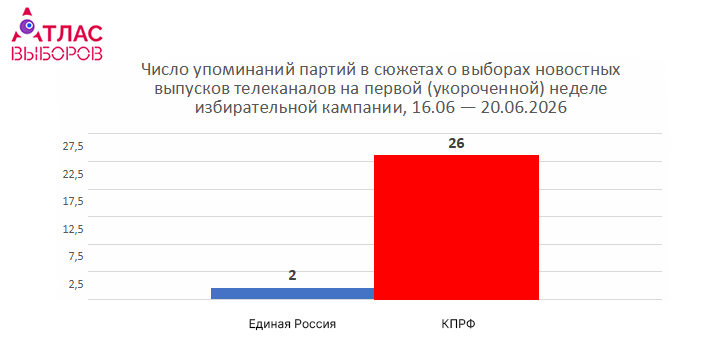
The first week of the campaign is likely to prove unique — because the CPRF was the first to hold its pre-election congress and announce its list of candidates for the elections, almost all mentions went to it. In total, in news stories related to the elections during the first week of the campaign, there were 26 mentions of the CPRF and only two mentions of United Russia. Other parties were not mentioned in the pre-election context.
Admittedly, there were also some mentions of parties outside the context of the elections. Thus, if one counts mentions of parties outside pre-election segments, the ratio is as follows: CPRF — 42 mentions, United Russia — six, New People — three, LDPR — two, the SRs — one. For instance, the CPRF was also covered as a party supporting participants in the SMO. Other parliamentary parties appeared mainly in reports on social initiatives, humanitarian activities and individual socio-political events.
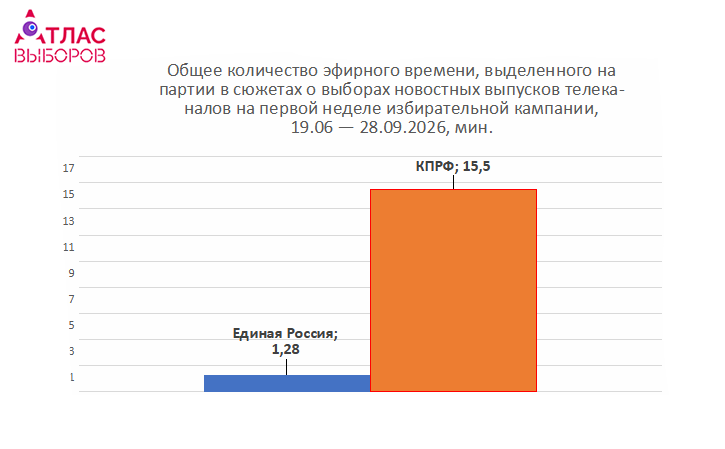
In terms of the ratio of airtime allocated to the parties, the picture was similar — the CPRF received 15.5 minutes of airtime over the week, while United Russia received just over a minute.
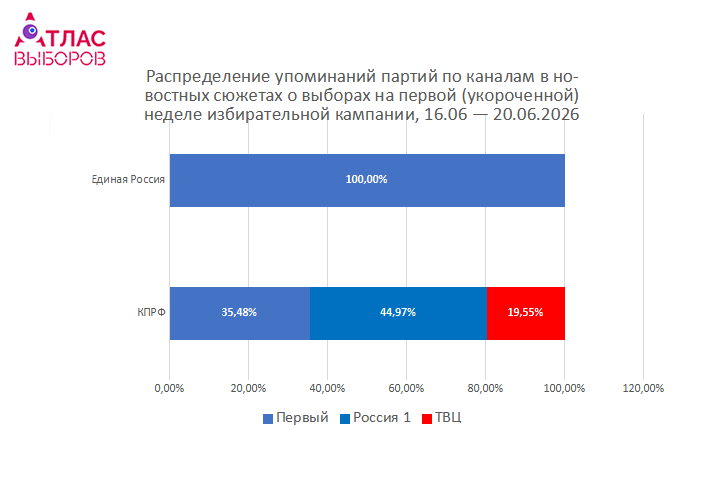
At the same time, both mentions of United Russia were only on Channel One. Almost half of the mentions of the CPRF were on Russia 1, a third — on Channel One, and the rest — on TV Centre.
Tone of mentions
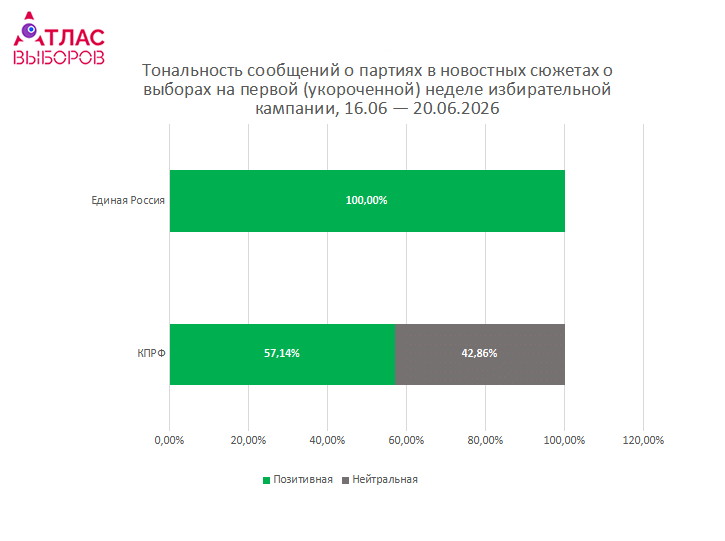
Neutral and positive tones dominated the coverage of the parties' activities. Both mentions of United Russia were in a positive key. Mentions of the CPRF were in a neutral or positive key. There were no negative mentions of political parties in stories related to the elections during the period under review.