Last Sunday, 23 November, local government elections were held in four regions of Russia. Deputies were elected to seven representative bodies of a municipal formation.
Republic of Dagestan: elections on former pasture lands
In the republic’s Tlyaratinsky District, deferred voting took place for the election of deputies to the assembly of the Gindibsky Selsovet.
Territorially, the selsovet’s settlements — the villages of Ibragimotar and Kalininaul — are located entirely in the lowland Babayurtovsky District. They are enclaves that were formed in the 1930s as a result of the transfer of land for winter livestock pasture from the mountainous area of Tlyaratinsky District.
The distant-pasture livestock lands located on the plains of Dagestan have agricultural designation status. However, they gradually became overgrown with settlements formed by residents of the mountain districts. Such settlements had no official status or self-government. In 2021, the republic’s Constitutional Court issued a ruling that finally gave local people the opportunity to build houses and register property rights.
On the one hand, this decision provoked discontent among residents of Babayurtovsky District, on which an enclave of people from Tlyaratinsky had formed. On the other, in Ibragimotar itself, due to the existing legal uncertainty, a newly built school could not be opened for almost four years.
On the single voting day, the ten registered candidates in the election of deputies to the Gindibsky Selsovet assembly — among them seven representatives of United Russia and three self-nominees — were not enough to fill the seats. The previous convocation of the representative body consisted of only seven deputies, whereas the current one will now have 11. The Gindibsky Selsovet publishes virtually no decisions on its website, so it is impossible to establish the reason for the changes to the charter and the size of the assembly — even though, in fact, this is precisely what led to the postponement of the elections.
Now, 24 candidates were registered here at once: 11 from United Russia and 13 self-nominees. It is interesting that a total of 16 candidates were nominated and registered by the party, but since there are only 11 vacant seats, five dropped out of the race.
Following the voting, eight candidates — five of them from the United Russia party — received not a single vote from voters. Five deputy seats went to United Russia candidates and six to self-nominees.
Krasnoyarsk Krai: mission — to defeat the “against all” candidate
The region held repeat elections of deputies to the district councils of three newly created municipal okrugs: Kezhemsky, Idrinsky-Krasnoturansky and Kuraginsky. Deferred voting also took place here for the election of deputies of the Severo-Yeniseisky Municipal Okrug.
On 19 June, a law introducing a single-tier system of local self-government came into force in Krasnoyarsk Krai — instead of 472 municipal formations, six urban okrugs and 33 municipal okrugs remain here.
At the same time, several okrugs were formed as a result of the merger of districts. Deputies of the council of one of them, Sukhobuzimsky, appealed to the krai court demanding the repeal of the municipal reform. The district parliament believed that the legislation of the Russian Federation had been violated during the merger of the municipal formations: public hearings were not held, residents’ opinions on the boundary changes were not taken into account, the adopted law impaired the accessibility of municipal okrug centres for residents, and, finally, the reform itself was initiated in accordance with a federal law that itself came into force only a month after it began.
The court sided with the respondents, the governor and the krai legislative assembly. However, the plaintiffs intend to appeal the decision in the Supreme Court and the Constitutional Court of the Russian Federation, as recounted by Olga Nekrasova, chair of the Sukhobuzimsky District council, and Vera Berzina, deputy of the Sukhobuzimsky Village Council. They also reported pressure from the election commission during the nomination and registration stage for the elections to the representative body of the new municipal okrug.
As a result, Nekrasova, a United Russia deputy and the only woman Cossack ataman in Russia, did not stand as a candidate, while self-nominee Berzina was denied registration. All the voter signatures collected in support of her nomination were declared invalid, as the signature sheets had not been produced using funds from the electoral fund.
A wave of active protests against the municipal reform also affected residents of Taseyevsky District, which was incorporated into Dzerzhinsky, as well as Novoselovsky, which became part of Balakhtinsky.
The first attempt to elect the representative bodies of the 28 newly created okrugs took place on the single voting day in September 2025. A proportional-majoritarian system was used: some deputies were elected from a single electoral district, and some from single-mandate and multi-mandate districts. In addition, voters had the opportunity to mark the “against all” box on the ballot: almost 18,000 voters used it for party lists alone — this is precisely what led to the scheduling of repeat elections in the newly created okrugs for 23 November.
On the single voting day in Idrinsky-Krasnoturansky Okrug, the “against all” candidate outperformed three candidates at once: from United Russia, the CPRF and the LDPR. Voters in Kuraginsky and Kezhemsky okrugs voted against deputies of the previous convocation. In the former, residents expressed no confidence in Sergei Slavsky, and in the latter, they voted against the previous convocation’s deputy Vasily Bedritsky, chair of the local council of the A Just Russia party, who nevertheless also stood as a United Russia candidate.
The elections in Severo-Yeniseisky Municipal Okrug were postponed because, on the single voting day, only one registered candidate was contesting two seats.
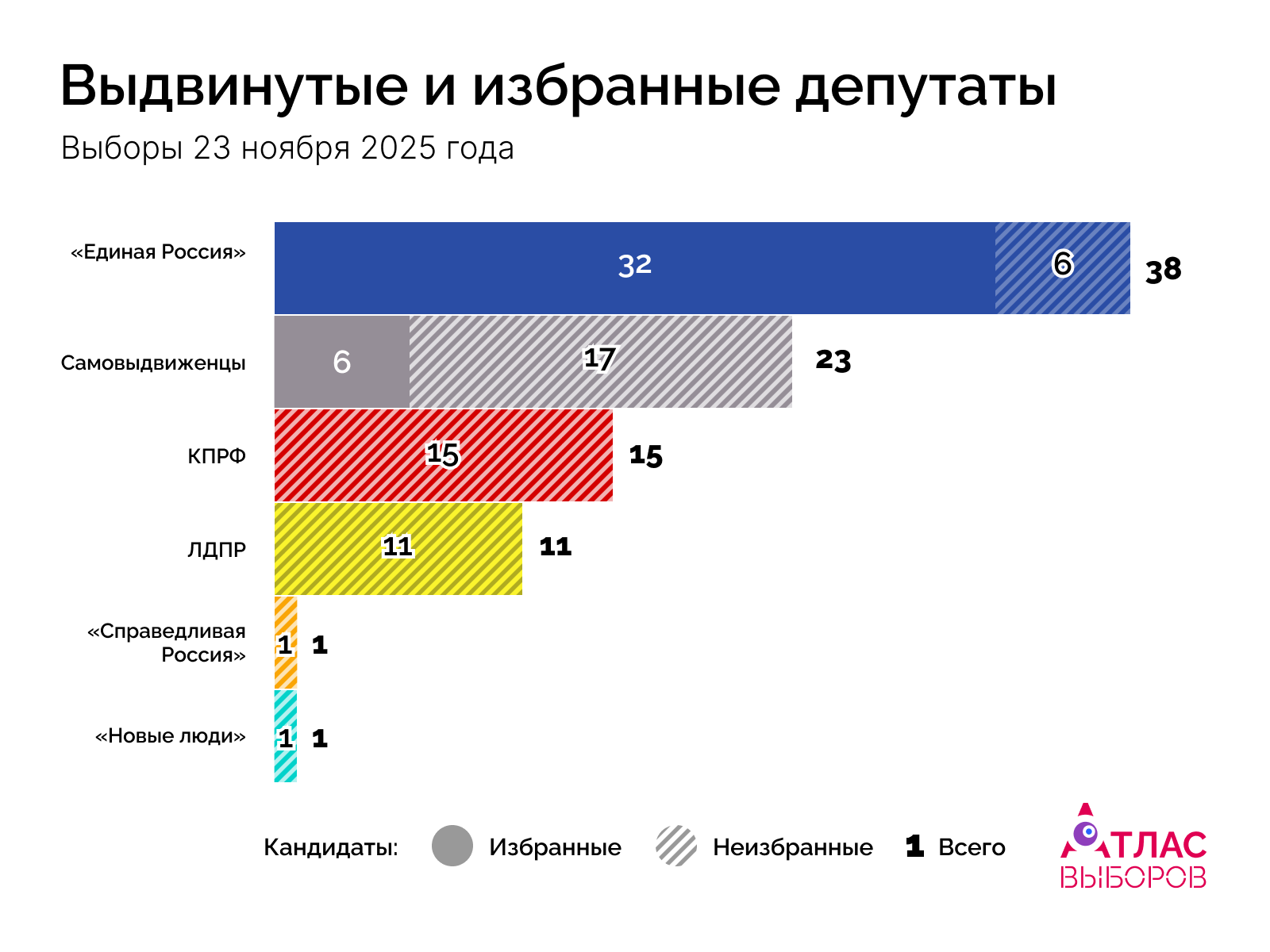
On 23 November, five deputy seats were being filled in the region. Fifteen candidates were registered: five from United Russia, four from the LDPR, three from the CPRF and three self-nominees. Following the voting, all seats went to United Russia candidates.
Tver Oblast: elections after the United Russia walkout
The region held early elections of deputies to the duma of the Udomelsky Municipal Okrug.
On 17 June, a mass exodus of United Russia deputies occurred at a session of the representative body: eight of the nine deputies of the party faction resigned their powers, with only chair Natalya Breus remaining in her post. The faction deputies cited the duma’s refusal to amend the okrug charter to reduce its size from 21 to 15 members and to switch to a system of single-mandate electoral districts instead of the current three-mandate ones as the reason for what happened. The initiative was blocked by the CPRF faction, which was almost equal in size to United Russia and included eight deputies.
Only 11 seats remained filled, whereas the quorum for holding sessions under the charter was supposed to be 14 deputies. As a result, on 21 July, the Tver Oblast Court ruled that the composition of the duma was not competent, and on 9 September, the territorial election commission of Udomelsky Okrug called early elections. A total of 47 candidates were registered for them: 21 from United Russia, 12 from the CPRF, seven from the LDPR, one from the New People party and six self-nominees.
Two CPRF candidates — Galina Sorokopud and Oleg Vorotilin — withdrew after registration on personal application. Dmitry Podushkov, the nominated ex-head of the town of Udomlya and leader of the party faction in the Udomlya City Duma, reported that Sorokopud had been subjected to strong pressure from her employer, the municipal institution “Blagoustroistvo.” Podushkov wrote an open appeal to the country’s president about mass violations in Udomelsky District, where he also mentioned pressure on voters and enterprise managers, the organisation of public events at budget expense, and the involvement of officials in campaigning.
It is important to note that ex-chair of the district duma Natalya Breus was nominated by United Russia in the same district.
However, as a result of a series of complaints submitted to the territorial election commission by LDPR candidate Eduard Shumsky, Dmitry Podushkov himself was stripped of his registration. The grounds were the publication of illegal campaigning material in the newspaper “Golos Udomli,” of which the candidate was the founder. By a court decision on 20 November, his name was struck from the ballot.
Following the voting, all seats without exception went to United Russia candidates.
Chelyabinsk Oblast: loss of trust over support for self-nominees
In the town of Chebarkul, deferred voting took place for the election of a deputy in single-mandate electoral district No. 19.
On the single voting day, the main elections to the town assembly were held. The only registered candidate in the specified district turned out to be former speaker of the town assembly Nikolai Balandin. However, he was expelled from the party and recalled by decision of the local branch of United Russia due to loss of trust. He was accused of supporting a group of self-nominees who stood in multiple districts.
Twelve United Russia candidates, each in their own district, attempted to have the unexpected rivals removed through the courts, but without success. Following the voting, self-nominees won nine seats out of 22, while United Russia members won 12, barely retaining a majority. One more seat went to an LDPR candidate.
In the elections that took place, ten candidates stood: one each from the United Russia and A Just Russia parties and eight self-nominees. However, only three were registered: the candidates from the two parties and a self-nominee. Seven self-nominees, including former town assembly speaker Nikolai Balandin, lost their candidate status at the nomination stage, as they did not submit the documents required for registration.
Following the voting, the deputy seat went to United Russia candidate Yekaterina Khudyakova.
23 November in Russia
Eighty-nine candidates contested 38 deputy seats in the representative bodies of seven municipalities in majoritarian electoral districts.
Total since the start of the new electoral cycle
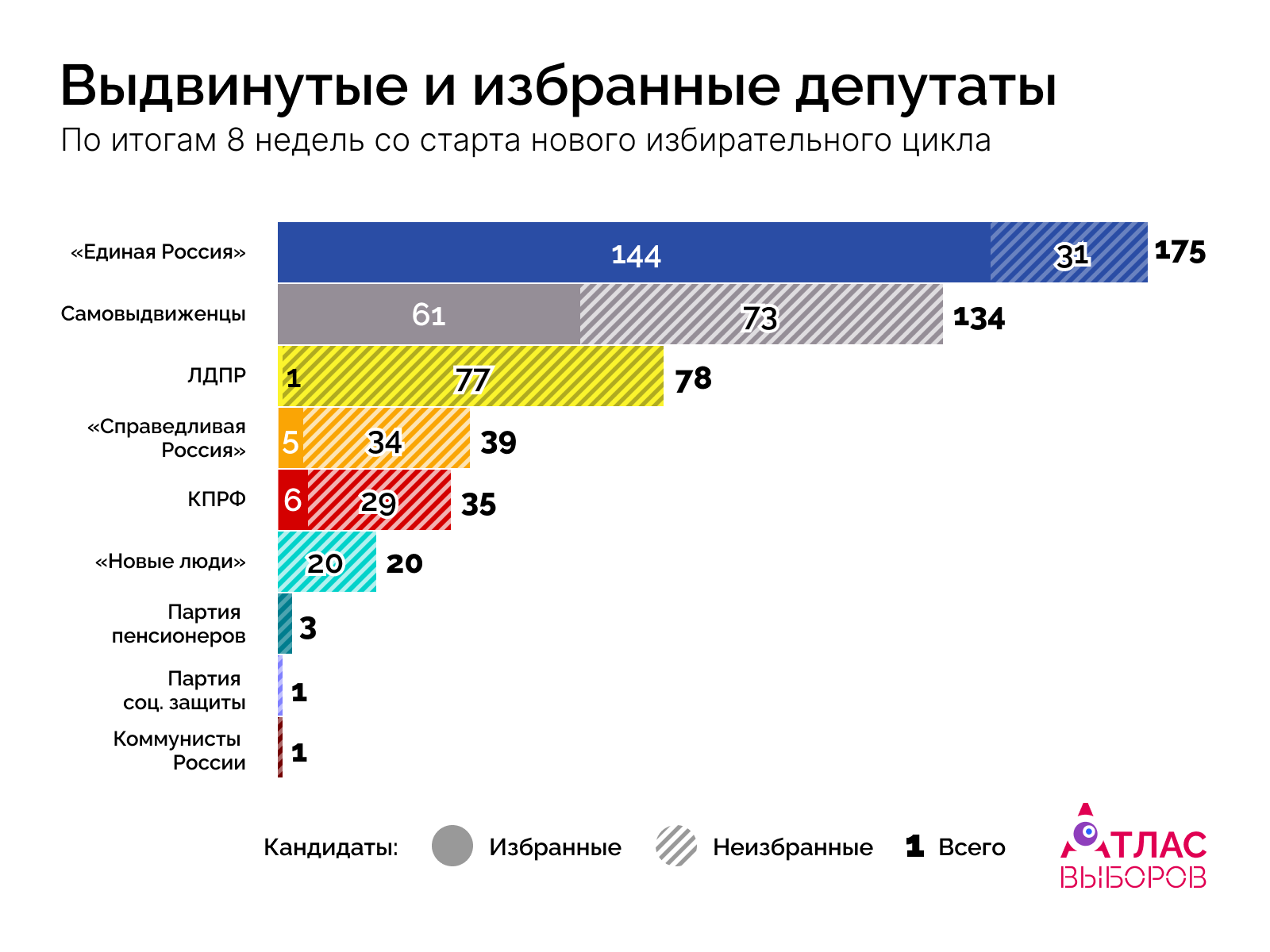
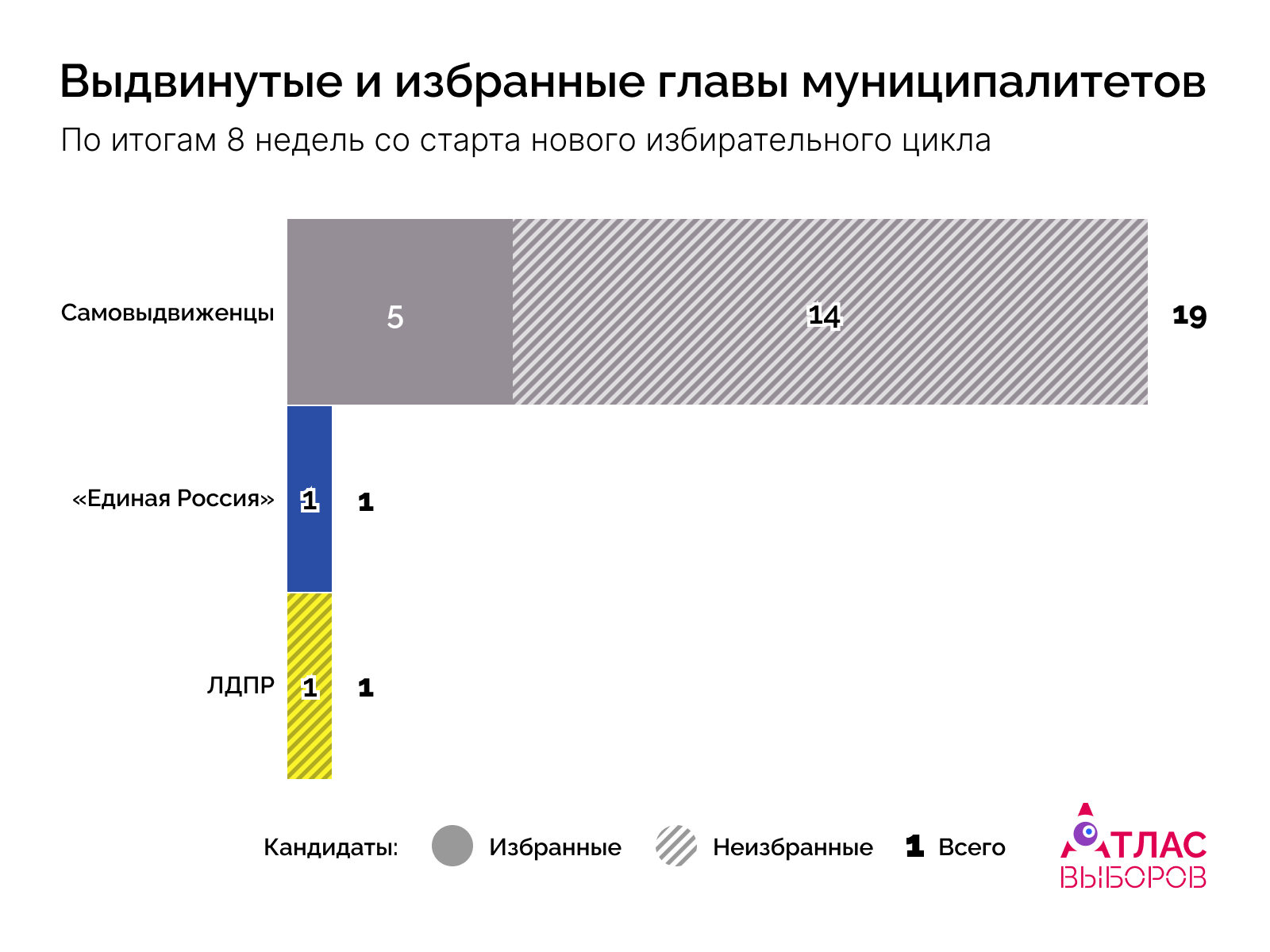
After the single voting day of 14 September 2025, eight electoral campaigns for the election of municipal heads have taken place. Twenty-one candidates took part in them.
Elections of deputies to 42 local representative bodies have taken place, with 217 deputy seats being filled.